
The large intestine is the place where colon cancer begins. Sometimes the disease develops without causing any major change that a person can notice. This is why regular health checks can be useful, especially when there are known risk factors. After a diagnosis, the next important question is how far the cancer has progressed and whether it has gone outside the colon. This process is called the staging. Colon cancer stages are grouped from 0 to IV according to how far it has developed.
Understanding these stages can make the diagnosis a little easier to understand. It also helps a person know why different tests are advised and why care may differ from one person to another. Along with proper health guidance, attention to food, digestion, daily routine, rest, and emotional well-being can also be useful for maintaining overall strength. At Jeena Sikho HiiMS, such factors are considered as part of a broader wellness approach, according to the individual’s condition.
What Do Colon Cancer Stages Mean?
A cancer stage mainly tells how much the cancer has grown and whether it has spread to nearby tissues, lymph nodes, or distant organs. Doctors generally use the TNM system to study these details.
- T tells how deeply the main tumour has grown into the colon wall.
- N tells whether nearby lymph nodes contain cancer cells.
- M tells whether the cancer has spread to distant parts of the body.
These findings are then combined to give an overall stage from 0 to IV. A higher stage generally means that the cancer has spread further.
Understanding the Stages Step by Step
Once doctors have looked at the tumour, lymph nodes and possible spread, these findings are used to decide the overall stage of colon cancer. The stage gives a clearer idea of how far the disease has developed.
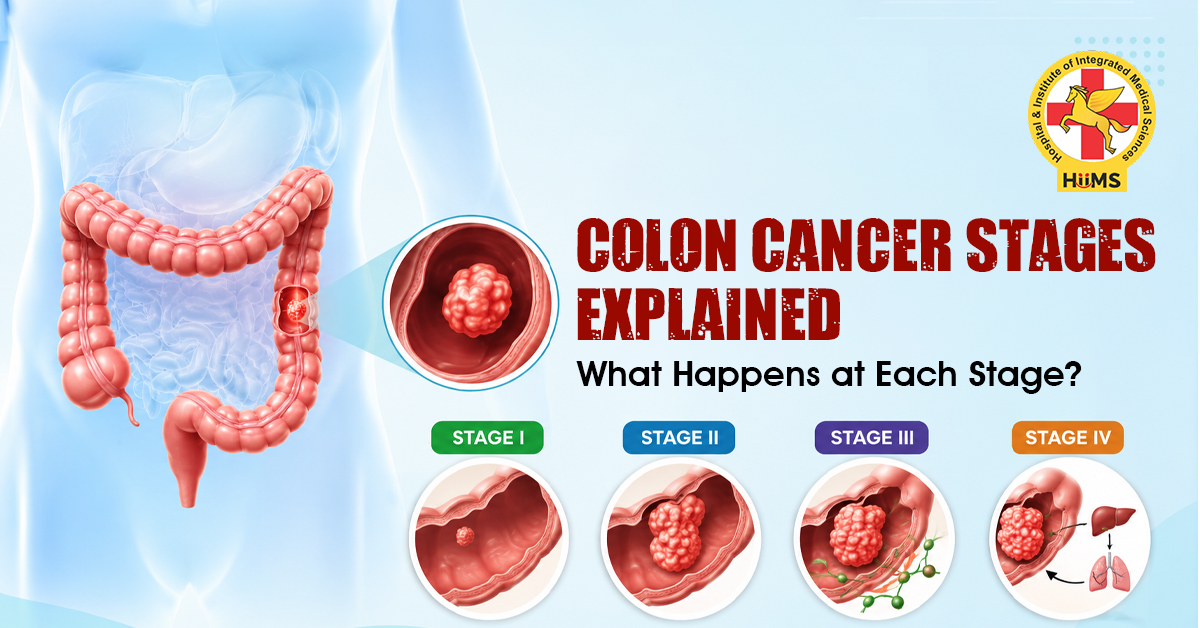
The stages do not all mean the same thing. In the early stages, abnormal cells or cancer may be limited to the inner part of the colon. The cancer can grow deeper into the colon wall. It can also spread to nearby lymph nodes or other parts of the body.
Let us now understand each stage in a simple way, starting with Stage 0.
Stage 0: Abnormal Cells in the Inner Lining
In Stage 0, the changes are still limited to the innermost lining of the colon. This stage is called carcinoma in situ. The abnormal cells have not moved into the deeper tissues of the colon and there is no sign that they have spread to the lymph nodes or distant parts of the body.
At this stage,
- Abnormal cells remain in the inner lining.
- There is no growth into the deeper colon wall.
- There is no spread to nearby lymph nodes or distant organs.
- A person may not notice any clear symptoms.
Since symptoms may be absent, tests can sometimes find these changes before they become more serious. This is one reason why the regular colon cancer screening is important.
Stage I: Cancer Has Grown Into the Colon Wall
In Stage I, cancer has moved beyond the inner lining and started growing into deeper layers of the colon wall. It has not spread to nearby lymph nodes or the distant organs.
The main points of Stage I are,
- Cancer has entered the deeper layers of the colon wall.
- Nearby lymph nodes are not involved.
- There is no spread to distant organs.
- The exact depth of growth is checked through testing and examination of the tissue.
Bowel habits may change in some people, along with mild stomach pain or blood in the stool. However, such problems can also be linked with other digestive conditions and are not enough to confirm cancer.
If the early signs of colon cancer remain for a longer period, it is better to get them checked, especially repeated bowel changes or blood in the stool.
Stage II: Cancer Has Grown Through the Colon Wall
In Stage II, the cancer has moved deeper into the wall of the colon, while the nearby lymph nodes remain free from cancer. It has three parts, IIA, IIB, and IIC, depending on the extent of growth.
- Stage IIA: Cancer has grown through the muscle layer and towards the outer part of the colon.
- Stage IIB: Cancer has grown through the outer layer of the colon.
- Stage IIC: Cancer has reached nearby organs or structures.
Changes in bowel habits, abdominal discomfort, tiredness, and blood in the stool can sometimes be early signs of colon cancer. But symptoms are not enough to decide the stage. Medical tests help in finding how far the disease has spread.
Stage III: Cancer Has Reached Nearby Lymph Nodes
Stage III means that cancer has moved into nearby lymph nodes. The stage is decided by how deep the cancer has grown and how many lymph nodes are affected.
Important points include,
- Nearby lymph nodes are involved.
- Cancer may have grown through several layers of the colon wall.
- The number of affected lymph nodes can vary.
- There is no distant spread in Stage III.
Lymph nodes are small parts of the immune system. If cancer cells reach the nearby lymph nodes, it shows that the disease has gone beyond where it first started.
At this stage, proper healthcare advice becomes important. Simple food, enough rest, light activity, and a regular routine may also support general wellbeing, depending on the person’s condition.
Stage IV: Cancer Has Spread to Distant Areas
Stage IV is the most advanced of the colon cancer stages. Here, cancer has moved from the colon to the distant parts of the body. The liver and lungs are common areas where it may spread, although the other organs can also be affected.
Stage IV is divided into,
- Stage IVA: Cancer has spread to one distant area or organ.
- Stage IVB: Cancer has spread to more than one distant area or organ.
- Stage IVC: Cancer has spread to the tissue lining the abdominal wall, with or without involvement of other distant areas.
The symptoms at this stage depend on where the cancer has spread. A person may have changes in bowel habits, abdominal pain, weakness, loss of appetite, or unexplained weight loss. However, symptoms alone cannot determine the stage. Care at this stage needs close professional guidance.
What Symptoms May Be Seen at Different Stages?
Symptoms do not always tell the exact stage of colon cancer. Some people may have no symptoms in the early period, while others may notice the changes earlier. Common early signs of colon cancer can include changes in bowel habits, blood in the stool, abdominal discomfort, weakness, tiredness, and the unexplained weight loss.
Possible warning signs include,
- Constipation or loose motions that continue for several days
- A change in the usual shape or appearance of stool
- Blood in or on the stool
- Repeated abdominal cramps or pain
- Feeling that the bowel has not emptied properly
- Unusual weakness or tiredness
- Weight loss without trying
These symptoms can also happen because of conditions other than cancer. Still, symptoms that continue should not simply be ignored.
Why Knowing the Stage Matters
Knowing the colon cancer stages helps doctors understand the extent of the disease and plan appropriate care. It also gives the patient a clearer picture of what is happening inside the body.
The stage alone does not describe the complete health of a person. Age, general health, tumour features and response to care can also matter. For this reason, two people with the same stage may still have different experiences.
Natural and Ayurvedic Support During Cancer Care
Ayurveda gives importance to food, digestion, daily routine, rest and mental calmness, while Jeena Sikho HiiMS follows an approach that focuses on understanding and addressing the root causes of imbalance according to the individual’s condition.
A natural wellness approach may include:
- Simple food suitable for digestion
- Proper rest and regular sleep
- Gentle movement when suitable
- Breathing and relaxation practices
- Adequate hydration when appropriate
- Selected Ayurvedic therapies under guidance
These practices are mainly meant to support strength and general wellbeing. Colon cancer treatment and other necessary care should be decided according to the stage and health condition.
Conclusion
Understanding the colon cancer stages helps explain how the disease can develop and spread. The stage is decided through proper tests and cannot be judged only by symptoms. Along with necessary care, Ayurveda may provide supportive attention to food, digestion, rest and daily routine. Jeena Sikho HiiMS offers personalised Ayurvedic wellness guidance according to individual needs. For further guidance, booking an appointment can help a person understand suitable supportive care.

FAQs
- What are the colon cancer stages?
The colon cancer stages range from Stage 0 to Stage IV and describe how deeply the cancer has grown and whether it has spread.
- Can colon cancer have symptoms in the early stages?
Yes, symptoms may appear early, but in some cases there may be no noticeable signs at all.
- What are the common signs of colon cancer?
Changes in bowel habits, blood in stool, stomach pain, tiredness, and sudden weight loss are some of the common signs.
- What does TNM mean in colon cancer?
TNM describes the tumour growth, lymph node involvement, and spread of cancer to distant areas.
- Can a person with colon cancer follow the Ayurvedic lifestyle practices?
Gentle exercise, enough rest, relaxation and suitable food can be included with proper guidance.