

Many people find out about a thyroid problem by chance, during a scan done for something else. Knowing the thyroid cancer symptoms helps you notice changes sooner instead of waiting for them to settle on their own.
In this blog, we go through seven early warning signs, who is more likely to be affected, how doctors check a lump, and when to see a specialist. Most neck lumps turn out to be harmless, so this guide is here to help you decide what to get checked, not to worry you.
Early Signs of Thyroid Cancer: What to Look For
Your thyroid is a small butterfly-shaped gland at the base of your neck. It helps control your heart rate, body temperature and energy use. In the earliest stage, thyroid cancer often causes no complaints at all, as Scripps Clinic doctors explain. That is why the early signs of thyroid cancer are easy to miss.
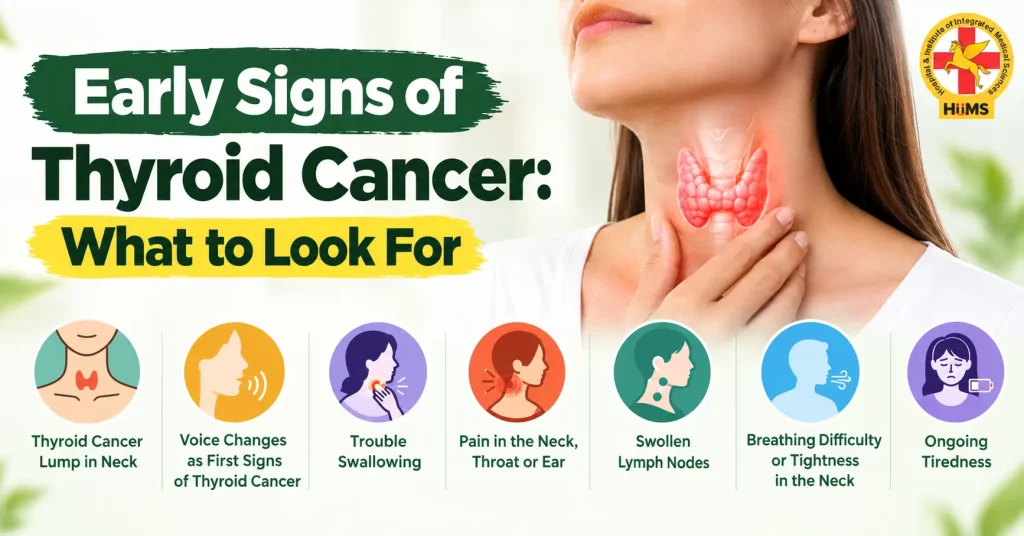
Here are seven changes worth knowing about. Having one of them does not mean you have cancer, because many thyroid conditions look similar. Noticed some symptoms of thyroid cancer? Talk to the team at Jeena Sikho HiiMS for a consultation.
1. Thyroid Cancer Lump in Neck
A lump or swelling near the base of the neck is the most common sign, according to a Johns Hopkins specialist quoted by AARP. You may spot it in the mirror or feel it while buttoning a collar. A thyroid cancer lump in neck is usually painless and grows slowly, so people tend to put off getting it checked. At Jeena Sikho HiiMS Goa, patients often tell us they saw the swelling weeks before they booked a visit.
2. Voice Changes as First Signs of Thyroid Cancer
Hoarseness that does not go away is another common sign. Mayo Clinic doctors note that a growth can affect the nerve that controls the voice box, which changes how your voice sounds. A cold-related rough voice clears up by itself. One that stays is worth a check.
3. Trouble Swallowing
Some people feel food sticking or a sense of pressure in the throat. This can happen when a growth presses on the food pipe or windpipe.
4. Pain in the Neck, Throat or Ear
Pain usually starts at the front of the neck and can sometimes spread toward the ears, especially while swallowing, as Apollo Hospitals describes.
5. Swollen Lymph Nodes
When thyroid cancer spreads to nearby lymph nodes, they can feel like small lumps on the side of the neck. Swollen glands from an infection are far more common and usually settle in a week or two. Lumps that stay are the ones to show a doctor.
6. Breathing Difficulty or Tightness in the Neck
This is more likely when a growth has become larger. If you feel short of breath or tight around the neck, get checked soon.
7. Ongoing Tiredness
Cancer Treatment Centers of America lists fatigue as a fairly common early sign, but it has many other causes, such as poor sleep, low iron or a thyroid imbalance. On its own, it rarely points to cancer.
Early Symptoms of Thyroid Cancer in Women and Men
Thyroid cancer is more common in women. Johns Hopkins doctors say women are about three times more likely to develop it than men. The early symptoms of thyroid cancer are largely the same in both.
Signs of Thyroid Cancer in Women
HCG Oncology lists a neck lump, pressure in the neck, voice changes and difficulty swallowing as the usual complaints in women. A lump or lasting hoarseness are often the first signs of thyroid cancer, yet the signs of thyroid cancer in women are sometimes put down to hormones or an existing thyroid problem. If you already take thyroid tablets, still mention any new lump to your doctor.
Signs of Thyroid Cancer in Men
In men, the same source lists an enlarged lymph node or lump, tightness in the neck, swallowing difficulty and hoarseness. Because the signs of thyroid cancer in men can look like a swollen gland from a throat infection, a lump that stays for weeks should be checked rather than ignored.
Thyroid Cancer Symptoms in Adults: When to See a Doctor
Thyroid cancer symptoms in adults are easy to explain away, so here is a simple guide. Keep these thyroid cancer warning signs in mind and see your doctor, ideally an endocrinologist or head and neck specialist, if you notice:
- A neck lump that stays or keeps growing
- Hoarseness that does not go away
- Trouble swallowing or breathing
- Neck, throat or ear pain with no clear reason
- A family history of thyroid cancer, or radiation to the head or neck in childhood
Please don’t wait for pain, since most lumps don’t hurt. Not sure what your symptoms mean? Get a free consultation with our Jeena Sikho HiiMS Goa experts.
Neck Lump and Thyroid Cancer: Is Every Lump Cancer?
No. Thyroid nodules are very common. The American Thyroid Association says ultrasound studies find nodules in more than half of people, and only about 5% of nodules are cancer. So the link between a neck lump and thyroid cancer is less common than many people fear.
Thyroid Nodule Symptoms
Most nodules cause no problems and are found during a scan or routine check-up. When thyroid nodule symptoms do appear, they include visible swelling, a feeling of pressure or trouble swallowing. Some nodules make extra thyroid hormone, which can cause a fast heartbeat, sweating or weight loss.
Thyroid Cancer Symptoms and Causes: Who Is at Risk?
Doctors often can’t point to one clear reason. Most people with thyroid cancer have no known risk factor. Looking at thyroid cancer symptoms and causes together, a few things do raise the risk:
- Being female, especially in the reproductive years
- Having a close relative with thyroid cancer. One review reports about six times the risk for first-degree relatives of people with differentiated thyroid cancer
- Radiation to the head or neck in childhood
- Inherited gene changes, which a published review links to about 20 to 25% of medullary cases
Types of Thyroid Cancer
There are four main kinds: papillary, follicular, medullary and anaplastic. Papillary is the most common. In ICMR hospital registry data from 96 centres across India (2012 to 2019), papillary made up 69% of cases. Follicular is the next most common. Medullary starts in a different kind of cell and can run in families. Anaplastic is rare and grows faster, so it needs prompt specialist care.
Knowing the types of thyroid cancer matters because the plan and outlook differ for each. In the US, the overall five-year survival rate is about 98%, but your own outlook depends on type and stage.
Thyroid Cancer in India: Research, Statistics, and Risk Awareness
An ICMR study published in 2025 estimated 38,574 new thyroid cancer cases in India this year, with 29,037 in women and 9,537 in men.
An earlier ICMR cancer atlas also reported a belt of thyroid cancer in women across coastal districts of Kerala, Karnataka and Goa. Researchers looking at Kerala’s rising numbers suggest part of it may be due to more scans finding small tumours, so the numbers are a reason to stay aware, not to worry.
Thyroid Cancer Diagnosis: What Tests to Expect
Your doctor will start by feeling your neck and asking about your family history. A blood test for thyroid function and a neck ultrasound usually follow. If a nodule looks suspicious, a fine needle aspiration biopsy (FNAB) is done, where a thin needle collects a few cells, often in the clinic.
A thyroid cancer diagnosis is confirmed only after the cells are examined. A scan alone cannot confirm it.
How to Detect Thyroid Cancer Early
If you are wondering how to detect thyroid cancer early, a few habits help. Once in a while, stand in front of a mirror, tilt your head back slightly, take a sip of water and swallow while watching the lower front of your neck. Look for any bulge or one-sided swelling. If you have a family history or had childhood radiation, ask your doctor how often to get checked.
Thyroid Cancer Treatment Options and Supportive Care at Jeena Sikho HiiMS
For most thyroid cancers, surgery is the main treatment. It is sometimes followed by radioactive iodine and thyroid hormone tablets, as this review explains. Your doctor plans this based on the type and stage of the cancer.
Alongside this, Jeena Sikho HiiMS Goa offers Ayurveda and naturopathy-based supportive care for people dealing with thyroid problems and for those going through cancer treatment. It includes Panchakarma, diet and lifestyle guidance, and the following:
- Golden Therapy: This is part of the Ayurveda-based supportive care plan at HiiMS. The doctors decide if and how it fits into your plan after going through your reports and general health.
- Cancer Detox Juice: This is an Ayurvedic herbal juice given as part of the diet and detox routine at HiiMS. It is meant to support digestion and the body’s natural detox, taken in the amount your doctor advises.
Conclusion
Most thyroid cancer symptoms start small: a lump, a rough voice or mild trouble swallowing. Nodules are common and most are not cancer, but anything that stays for more than a few weeks deserves a check. Early attention gives you more options and more peace of mind. If you are in Goa or nearby, book your VOPD consultation with Jeena Sikho HiiMS Goa today.

FAQs
1. Can thyroid cancer happen without any signs?
Yes. In the early stage, many people feel completely normal, and it is often found during a scan or routine check-up.
2. Is every neck lump cancer?
No. About 5% of thyroid nodules turn out to be cancer, according to the American Thyroid Association. Still, a lump that stays for weeks should be checked.
3. Which test confirms thyroid cancer?
A fine needle aspiration biopsy, where a few cells are taken from the nodule and examined, is the usual way to confirm it.
4. Who is at higher risk?
Women, people with a close relative who had thyroid cancer, and those who had radiation to the head or neck in childhood.
5.Is thyroid cancer treatable?
Many cases respond well, especially when found early. The overall five-year survival rate in the US is about 98%, though each person’s outlook depends on type and stage.