
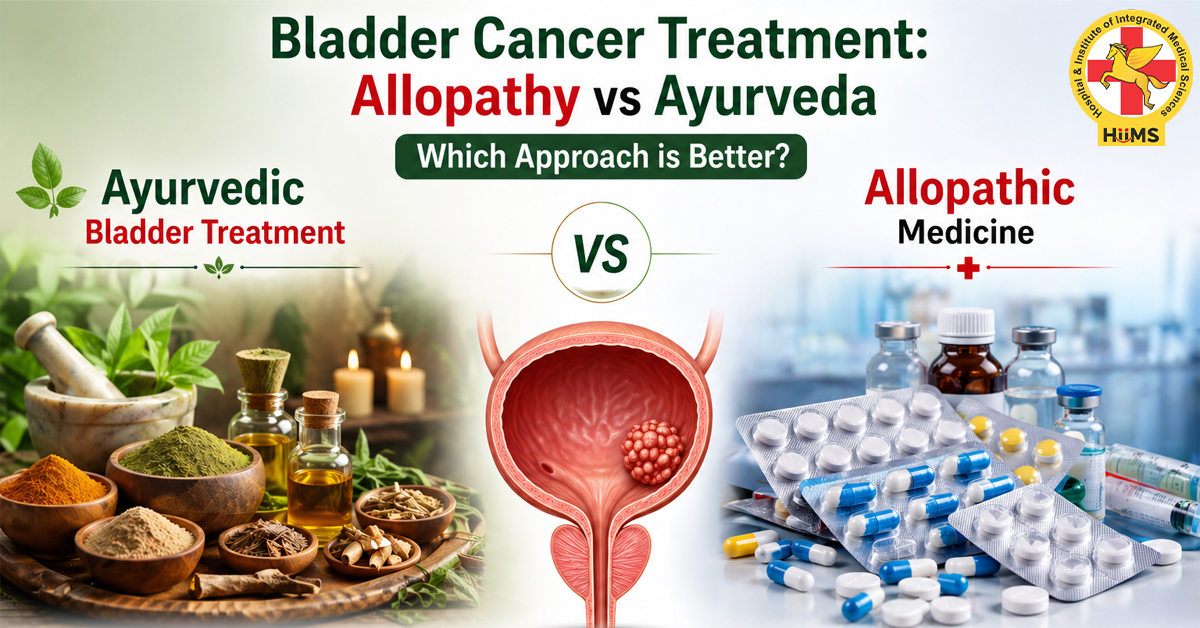
The moment you hear the word “cancer,” everything pauses for a second. Conversations blur, thoughts race, and one question quietly takes over: what now? When it comes to bladder cancer treatment, that question often becomes even more confusing. Not because there aren’t options, but because there are too many, and each one sounds urgent in its own way.
In this blog, we are going to explore how bladder cancer treatment is understood through two different approaches, modern medical treatment and Ayurveda, and how people often try to make sense of both.
Understanding Bladder Cancer in Simple Terms
At first, most people just try to understand what they’re facing. Bladder cancer is a disease in which cells in the bladder grow out of control and form a tumour. This can change how the bladder works and how the body feels in general.
For some people, the signs show up as blood in the urine, frequent urges to urinate, or a discomfort that doesn’t go away easily. That’s why something like urinary bladder cancer treatment can look very different from one person to another.
Modern Medical Treatment for Bladder Cancer (Allopathy)
For many people, the first recommendation they hear is modern medical treatment, often called allopathy. Doctors may suggest surgery, chemotherapy, or radiation depending on the stage and condition. It all happens quickly, and in many cases, that urgency is real.
The goal of this treatment is simple: find the cancer and treat it as soon as possible. Having a clear plan in that moment can feel reassuring, like at least there’s a direction.
But the body goes through a lot during this phase. Some days feel heavier than others. Energy levels drop, appetite changes, and it affects them emotionally, too. Recovery takes time, and it doesn’t always move in a straight line.
So while this form of bladder cancer treatment focuses on removing the disease, it also asks a lot from the person going through it.
Ayurveda as a Supportive Approach in Healing
At some point, people start looking for something that feels a little gentler. Not instead of treatment, but alongside the thought: is there a way to support the body through all this? That’s usually where Ayurveda comes in.
Ayurveda is not a replacement, but a different way of thinking about healing. Instead of focusing only on the disease, Ayurveda looks at the body as a whole. They aim to rebuild strength, improve digestion, and help the body respond better over time. Ayurveda often uses four approaches: Shaman (gentle support with herbs), Shodhan (deeper cleansing), Aahar, and Vihar.
Aahar is about eating fresh, natural, sattvic food that makes you feel good and light, while Vihar is about keeping your daily routine and lifestyle in balance. Shaman is basically the rejuvenation process, which is more about using herbs to help keep things in balance. Shodhan includes deep detoxification therapies such as Panchakarma and other therapies.
Ayurveda isn’t about quick changes. It’s more about giving the body space to reset in its own way. The body starts to feel lighter, more settled, and a little more like itself again.
So while one path often focuses on direct action, this one takes a slower route and asks how the body can come back into balance naturally.
Choosing the Right Approach for Your Situation
Most people get stuck here, not because there aren’t any options, but because both seem important in their own ways. In stage 1 of bladder cancer treatment, it may seem easier to make decisions based on how quickly the problem needs to be fixed.
Likewise, treatment for bladder cancer in elderly people is often to find a balance between how well the treatment works and how well the body can handle it.
No one answer works for everyone. Allopathy is often the first choice in emergencies because it works quickly and directly.
Many people also use Ayurveda during or after treatment, though. The Ayurvedic approach is thought to help the body get back into balance slowly, support recovery, and build strength.
An Integrated Approach to Healing and Recovery
These days, a lot of people don’t feel the need to stick to just one approach. Instead, they try to find a balance, using modern treatment where it’s needed, while also supporting the body in other ways through Ayurveda.
In places like Jeena Sikho HiiMS, this kind of approach is part of the process. Along with modern care, their attention to daily habits, food, and simple ayurvedic as well as natural treatment-based support. It is all shaped around how the person is actually feeling and responding.
When you look at it simply, modern care focuses on treating the condition, while Ayurveda helps the body recover, adjust, and slowly build its strength again over time.
Conclusion: Finding the Right Direction in Treatment
There isn’t one answer that fits everyone, and that’s okay.
Some people choose allopathy, especially when things need to be handled quickly. Others look toward supportive approaches like Ayurveda to help the body regain strength and feel more balanced during recovery.
In the end, it’s not really about choosing one side. It’s about finding what your body needs at that moment when it comes to bladder cancer treatment.
If you’re trying to figure all this out, you don’t have to go through it on your own. You can take guidance from an experienced bladder cancer doctor at Jeena Sikho HiiMS through VOPD (online video consultation). They can help you explore a treatment path that suits your condition and move forward with a bit more clarity.