
Cancer doesn’t appear suddenly. It develops over time. Actually, the truth is quieter and slower. It starts inside one tiny cell, deep in the body, and nobody notices it happening. Only after months, sometimes years, does it show up as a lump, a symptom, or in a doctor’s report.
If you want to understand how cancer develops, go back to this starting point: why does that one cell stop following the body’s rules? It doesn’t die when it should, and it doesn’t stop growing when it should. Slowly, it multiplies into something the body can no longer control. Knowing this helps you take health seriously, catch warning signs early, and understand why lifestyle is so important.
Here’s the full explanation, step by step, in very simple language.
What Is Cancer and Why Does It Develop?
Our body runs like a well-managed system. Cells grow only when needed. If one gets damaged, the body repairs it, and once a cell has done its job or gotten too old, it dies on its own to make space for a new one.
Cancer cells break this rule. A normal cell stops when told to. A cancer cell ignores that signal and keeps dividing, even when the body has no use for more cells. This is the basic idea behind cancer cell growth: cells that simply won’t stop.
How Cancer Starts: The First Step in Cancer Formation
Every cell carries an instruction manual, written in DNA. When something damages this manual, the instructions get confused. This is called a cancer cell mutation, and it’s the starting point of how cancer starts. One small mistake can grow into something much bigger if the body fails to fix it.
Common Factors That Can Damage Cells
Everyday things cause this damage, such as tobacco, regular alcohol, long-term pollution, radiation, and infections that stick around for years. Poor sleep and bad eating add to the risk. Sometimes it runs in the family, with some people born with genes that make their cells more vulnerable.
The Cancer Formation Process: Step-by-Step
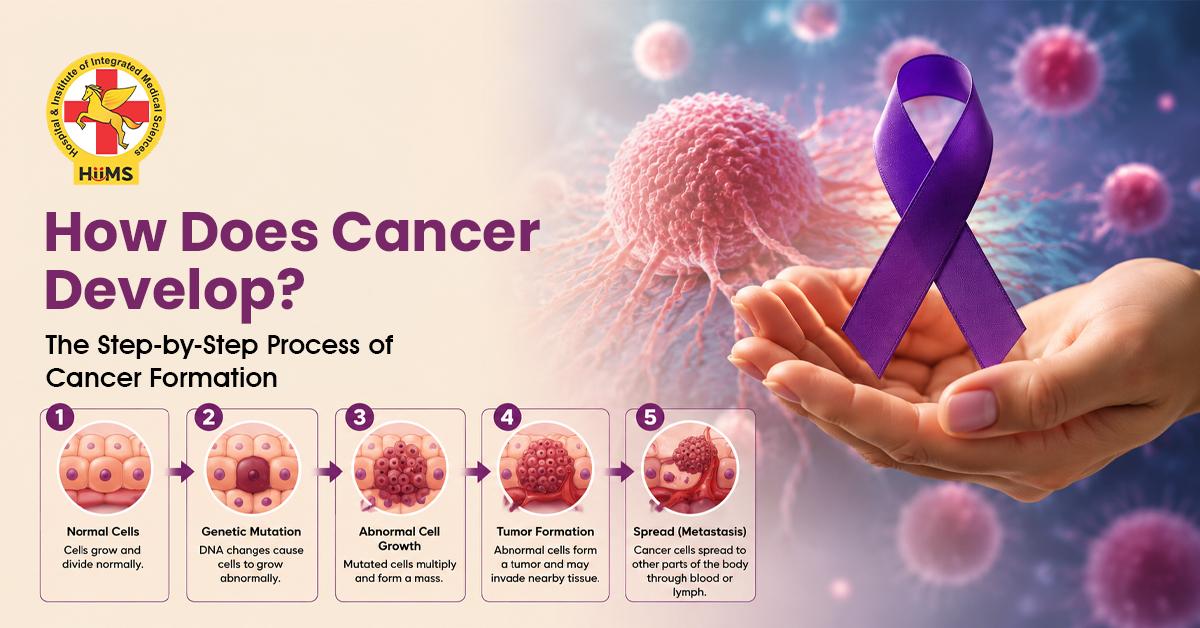
Step 1 – Cell Mutation (Initiation)
It all starts with one damaged cell. That single change is the first domino in the entire cancer formation process.
Step 2 – Continuous Cell Growth (Promotion)
Once damaged, the cell divides more than it should. The body’s usual checks stop working on it, so it keeps multiplying and building up in number.
Step 3 – Tumour Formation
Over time, these extra cells form a lump. Not every lump means cancer — a benign lump stays put and doesn’t harm nearby tissue, while a malignant one is aggressive and invades tissue around it.
Step 4 – Cancer Progression
As cancer progression continues, the affected area presses on nearby tissue, pulls in more blood supply, and slowly damages the organ it is situated in.
Step 5 – Spread to Other Parts of the Body (Metastasis)
In serious cases, cells break away and travel through the blood or lymph system, settling in a different part of the body. This is why you’ve heard that advanced cancer gets so much harder to manage.
Understanding the Stages of Cancer Development
Early Cellular Changes
The stages of cancer development usually start with hyperplasia, where too many cells crowd a space but still look fairly normal, moving on to dysplasia, where cells start looking and behaving abnormally.
Localized Cancer
Here, the abnormal cells are still stuck in one place and haven’t spread out, which is why catching cancer early makes such a big difference.
Advanced Cancer
Once it crosses that boundary and affects other areas, it’s called “advanced,” needing stronger, longer treatment.
Why Cancer Does Not Develop Overnight
Since this process needs several genetic changes to line up one after another, it usually takes years, sometimes decades, to become visible.
Lifestyle, surroundings, family genes, immunity, and exposure to harmful substances decide how fast or slow this process moves.
How Jeena Sikho HiiMS Approaches Long-Term Health Support
No two people are the same, so a proper health check comes first before any plan is suggested.
Practices like Panchakarma, personalized diet plans, yoga, and meditation work alongside regular treatment, supporting the body as a whole.
Conclusion
Cancer doesn’t develop overnight. It builds up slowly, one damaged cell leading to another, until it becomes visible. Understanding how cancer develops is a reminder that small daily habits are more important than people think.
If you or someone around you has ongoing health concerns, don’t wait too long to get it checked. Ayurveda focuses on the body’s balance, but timely healthcare advice comes first. You can also opt for an online VOPD consultation for your health issue with expert doctors at Jeena Sikho HiiMS.

FAQs
Q1. How does cancer develop in the body?
It starts with a change in a single cell’s DNA, allowing that cell to grow beyond what the body normally allows.
Q2. What is the first step in the cancer formation process?
The first step is a mutation in the cell’s DNA, which slowly leads to abnormal growth.
Q3. Can cancer develop without noticeable symptoms?
In many cases, the early changes stay hidden for a long time before any real symptom shows up.
Q4. How long does cancer take to develop?
It varies from person to person, but the process usually takes several years to develop fully.
Q5. What lifestyle habits may influence cancer cell growth?
Smoking, excess alcohol, an unhealthy diet, and constant pollution exposure are among the biggest factors.