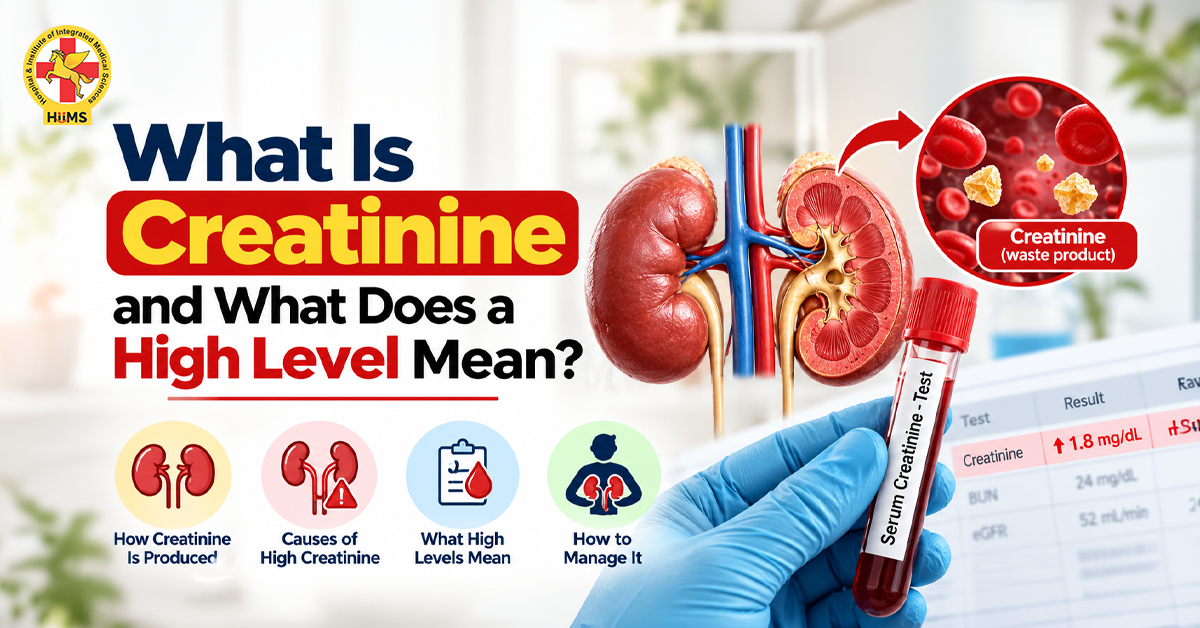

Imagine receiving your blood test report and finding that your creatinine level is above the normal range. You may feel completely fine, but the result can leave you wondering whether something is wrong with your kidneys.
Creatinine builds up in your blood as a natural result of muscle activity. Your kidneys usually filter it out, and you pass it in your urine. If a blood report shows more creatinine than usual, your doctor may look into how well your kidneys are working. Sometimes, though, dehydration or certain medicines can affect the result too.
The important thing is to understand why the number has increased instead of drawing conclusions from one report. High creatinine levels need to be assessed alongside other kidney test results, your health history and any symptoms you may have.
In this blog, we explain what creatinine means, why it rises, which tests help identify the cause, what dietary changes may be needed and how Ayurveda can complement an individualised kidney care plan.
What Is Creatinine and Why Do Doctors Check It?
Your muscles produce creatinine during normal daily activity. It enters the bloodstream and travels to the kidneys, which remove it through urine. Doctors measure blood creatinine to understand how effectively the kidneys filter waste.
What Is Considered a High Creatinine Level?
The expected range varies between laboratories and individuals. Age, sex, muscle mass, recent exercise, certain medicines and dietary factors can influence the result. Doctors also check eGFR, an estimate of how effectively the kidneys filter blood. The National Kidney Foundation’s creatinine guide explains why doctors consider these factors when analysing diagnosis.
Have an elevated creatinine report?
Arrange a consultation with a qualified doctor to review your results and understand which tests or next steps may be appropriate.
What Do High Creatinine Levels Mean for Your Kidney Health?
Sometimes, a blood report shows high creatinine, and the first thought is that something is wrong with the kidneys. That may be the case, but it isn’t the only explanation. Dehydration and certain medicines can also affect the reading.
So, doctors look at the full picture rather than judging kidney health from one number. They may check other test results or repeat the blood test to understand what is happening. The KDIGO 2024 guideline also explains how doctors assess kidney function and identify signs of chronic kidney disease.
What Are the Common Symptoms of High Creatinine Levels?
Early kidney problems may not cause noticeable symptoms. When symptoms occur, they can include:
- Swelling around the eyes, feet or ankles.
- Changes in urine output.
- Unusual tiredness or weakness.
- Nausea or reduced appetite.
- Breathlessness when excess fluid builds up.
These signs do not confirm high creatinine on their own. Doctors use blood and urine tests to find out what may be affecting the kidneys. The NIDDK guide to kidney failure also explains the symptoms that can appear when kidney problems become advanced.

What Are the Causes of High Creatinine Levels?
Creatinine may rise for several reasons, so identifying the cause is an important part of deciding what to do next.
Common Causes
- Diabetes and high blood pressure: Both can damage the kidneys over time.
- Dehydration: Losing too much fluid may temporarily affect kidney function.
- Kidney conditions: Acute kidney injury and chronic kidney disease can raise creatinine.
- Urinary blockages: Stones or other obstructions can interfere with urine flow.
- Medicines and supplements: Certain medicines, creatine supplements, intense exercise and high muscle mass may impact the result.
Which Tests Help Identify the Reason for High Creatinine?
To check how well your kidneys are working, your doctor may ask for a blood test to measure creatinine and calculate your eGFR. A urine test for albumin can also help spot signs of kidney damage. Depending on the findings, additional blood tests, urine tests or imaging may be needed.
Previous reports are very helpful too. Comparing older and newer results helps a kidney doctor understand whether the level has changed and decide which investigations are appropriate. The NIDDK guide to kidney disease tests and diagnosis explains these investigations in more detail.
Foods to Avoid with High Creatinine: What Should You Know?
What you should eat depends on how well your kidneys are working and what your blood tests show. Some people need to avoid certain foods, while others may not need major dietary changes.
Foods and Ingredients to Discuss with Your Dietitian
- Packaged and instant foods: These often contain high amounts of sodium, which can affect blood pressure and fluid balance.
- Large portions of protein: Your doctor may recommend adjusting protein intake according to your condition.
- Potassium- or phosphorus-rich foods: Restrictions may be needed if your blood tests show high levels.
- Potassium-based salt substitutes: These may not be suitable for people who need to limit potassium.
When considering foods to avoid with high creatinine, remember that the same restrictions do not apply to everyone. The NIDDK healthy eating guide explains why dietary changes should match a person’s kidney function and nutritional needs.
How Ayurveda Approaches Kidney Health
Ayurveda considers food habits, daily routines and individual health when planning care. Its traditional concepts of Aahar (food) and Vihar (lifestyle) focus on suitable eating patterns and daily habits.
The Role of Diet, Lifestyle and Individualised Care
Ayurvedic doctors may consider dietary guidance and selected herbs as part of an individualised plan. However, the person’s kidney function, body type, condition, prescribed medicines and laboratory results must guide these decisions.
How Jeena Sikho HiiMS Approaches Kidney Care
Jeena Sikho HiiMS offers an integrated approach to healthcare, with consultation and review of medical reports helping guide individuals, naturopathy, Panchakarma, dietary and lifestyle advice. Its GRAD System is described as combining three elements:
- HDT (Head Down Tilt): A supervised therapy in which the head rests lower than the feet at a certain angle of 5, 10, 15 degrees of angle basically for the urine function.
- HWI (Hot Water Immersion): A hot-water immersion procedure carried out under supervision. Basically, in this therapy, skin functions as a ‘third kidney’
- pH-Balance diet: Plant-based diet with proper nutrition. Food choices are planned around individual needs and health findings.
The healthcare team should assess whether these practices are suitable for each person. They should not replace prescribed kidney treatment or be presented as proven ways to restore kidney function.
Want to understand your kidney reports and available care options? Contact the Jeena Sikho HiiMS team to enquire about a consultation and guidance suited to your health needs.

Did You Know?
A 2025 study published in the Indian Journal of Medical Research, using data from 25,408 participants in the ICMR-INDIAB study, reported a weighted prevalence of impaired kidney function of 3.2%. The researchers defined impaired kidney function using an eGFR below 60 mL/min/1.73 m². This figure relates to impaired kidney function, not high creatinine alone. Read the published study on PubMed.
When Should You Consult a Kidney Doctor?
Consult a kidney doctor if your report shows high creatinine, particularly if the level has risen since your previous test. People with diabetes, high blood pressure or existing kidney problems may need regular checks. A sudden reduction in urine output, severe breathlessness or rapidly worsening swelling requires urgent medical attention.
Conclusion
A creatinine report is one part of understanding your kidney health. If it is showing high creatinine levels, the important thing is to find out what is behind the change rather than draw conclusions from a single result. Your doctor may consider your symptoms, medical history and other test findings before deciding whether further checks are needed.
For help understanding your kidney reports, you can enquire about a consultation at Jeena Sikho HiiMS. The hospital also offers enquiries about VOPD (online video consultation), so you can ask whether an online appointment with an expert doctor is suitable for you. This gives you an opportunity to discuss your concerns and learn about the next steps.

FAQs
1. What is a dangerous creatinine level?
The significance depends on the actual reading, previous results, eGFR, symptoms and overall health. A doctor should interpret the findings.
2. Can high creatinine levels return to normal?
The outcome depends on the cause. Some temporary increases may resolve, while chronic kidney disease may require ongoing care.
3. Which foods should I avoid with high creatinine?
Dietary restrictions depend on kidney function and blood potassium, phosphorus and other test results.
4. Can Ayurveda help manage kidney health?
Selected Ayurvedic practices may complement an individualised care plan. Ayurveda supports kidney health through a balanced diet, a healthy routine and herbs, guided by an expert doctor.
5. Does high creatinine always mean kidney disease?
A single high reading does not confirm chronic kidney disease. Doctors assess additional tests and medical history.