

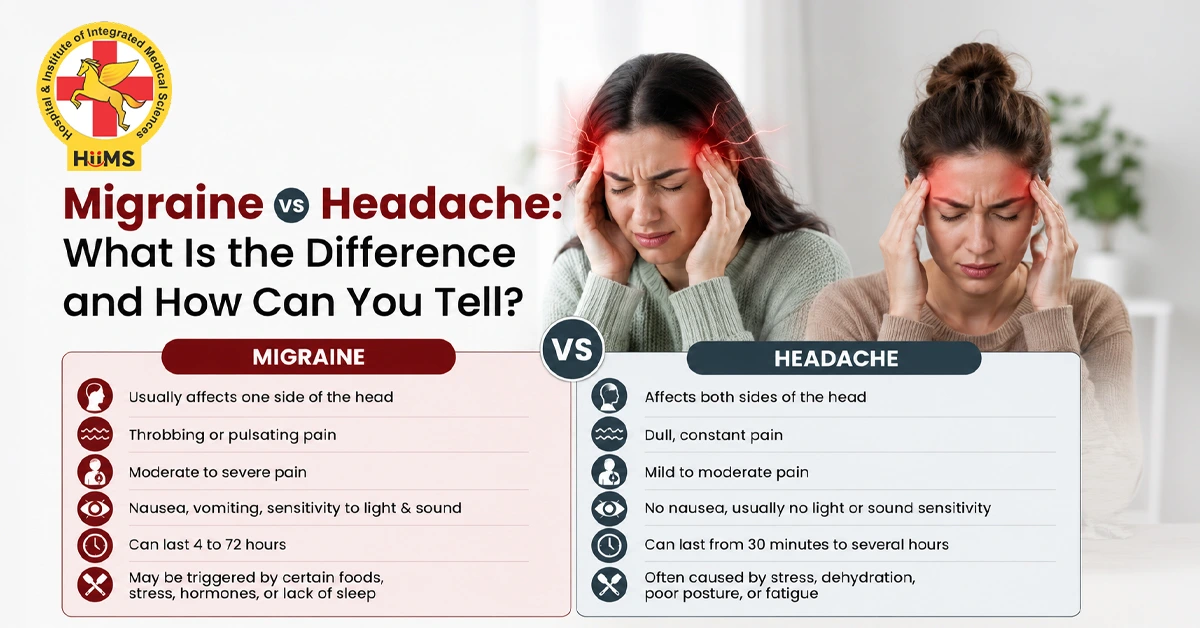

Head pain shows up differently for everyone, and honestly, most people just call it all “a headache” without thinking twice. But migraine vs headache isn’t just a matter of intensity; they are genuinely different conditions with different causes, different symptoms, and different treatment paths.
Getting this distinction right actually matters, since managing a migraine the way you will manage a regular headache often doesn’t work, and vice versa. This blog breaks down how to tell them apart, what triggers each, and what genuinely helps.
Migraine vs Headache: The Core Difference
Here’s the simplest way to think about it: a migraine is a type of headache, but not every headache is a migraine. Migraine is classified as a neurological disorder, not just intense pain, which is why it comes bundled with symptoms far beyond the head itself, nausea, light sensitivity, sometimes visual disturbances.
A regular headache, most commonly a tension headache, tends to be milder, shorter, and doesn’t carry that same cluster of additional symptoms.
Types of Headaches: Tension, Cluster, and More
Understanding migraine vs headache gets easier once you know the main categories doctors work with:
- Tension headaches, the most common type, affect up to 78% of people at some point
- Cluster headaches, far less common but extremely intense, are usually centred around one eye
- Sinus headaches, pressure-like pain around the forehead, cheeks, or nose, often tied to congestion
- Migraine, distinct from all of these due to its neurological nature and additional symptoms
Migraine Headache Symptoms: What Sets It Apart
Recognising migraine headache symptoms genuinely helps you tell them apart from a regular headache:
- Throbbing or pulsing pain, usually concentrated on one side of the head
- Pain that worsens with physical activity or movement
- Nausea, sometimes vomiting
- Sensitivity to light, sound, or smell
- Aura in some cases, visual disturbances like flashing lights or zig-zag lines, lasting up to 60 minutes before the headache begins
Tension headaches, by comparison, feel more like a tight band wrapped around your head, dull and steady, affecting both sides rather than one.
Is It a Migraine or Just a Bad Headache?
A few practical clues help here. Pay attention to how long it lasts; a typical tension headache resolves within a few hours, while migraine episodes can persist anywhere from 4 to 72 hours. Notice whether light or sound genuinely bothers you more than usual; that’s a strong signal pointing toward migraine rather than a regular headache.
And if you’re noticing any warning signs beforehand, unusual yawning, food cravings, or needing to urinate more often, that’s called prodrome, and it’s fairly specific to migraine.
What Triggers a Migraine Headache?
Migraine headache triggers vary quite a bit from person to person, but a few show up consistently. Stress, poor sleep, skipped meals, and hormonal shifts are common culprits. Certain foods, sometimes referred to as the “5 C’s,” chocolate, cheese, citrus, caffeine, and cured meats, are occasionally linked to, though this varies by individual and isn’t confirmed for everyone.
Interestingly, migraines are sometimes only triggered when several factors stack together, a day of travel combined with poor sleep and skipped meals, for instance, rather than one single cause.
Migraine Headache Treatment: Conventional Approaches
Migraine headache treatment typically involves preventive medications taken regularly to reduce how often attacks happen.
Tension headaches usually respond well to over-the-counter pain relief and rest, while migraine often needs more specific medication like triptans, since standard painkillers don’t always touch the underlying process.
If your headaches are becoming more frequent, more severe, or genuinely disrupting daily life, that’s worth a proper medical evaluation rather than continued self-management.
How Does Ayurveda Explain the Difference? Vata and Ardhavabhedaka
Ayurveda has its own way of distinguishing these conditions. Migraine is referred to as Ardhavabhedaka, literally meaning “half-head splitting pain,” and it’s tied specifically to aggravated Vata dosha, the energy governing movement and the nervous system.
This explains the sharp, throbbing, often one-sided nature of migraine pain quite well. Regular tension-type headaches are generally linked more to accumulated stress and muscular tightness rather than a deep dosha imbalance, which is part of why Ayurvedic treatment for the two conditions genuinely differs.
Ayurvedic Support at Jeena Sikho HiiMS for Migraine
At Jeena Sikho HiiMS, migraine support typically includes:
- Shirodhara, a continuous stream of warm herbal oil poured gently on the forehead to calm the nervous system, alongside Nasya, herbal oil administered through the nose to ease heaviness and congestion around the head.
- Abhyanga, full-body oil massage, supports circulation and helps balance Vata, while herbs like Brahmi are commonly included for their calming properties.
- Simple daily practices like Anulom Vilom breathing are often recommended too, all generally offered as supportive care alongside whatever medical treatment or trigger-management plan is already in place.
Conclusion
Understanding migraine vs headache genuinely changes how you approach managing either one, since treating a migraine like a regular headache, or vice versa, often means missing what actually helps.
If you want to explore how Ayurvedic support could work alongside your existing migraine or headache care, you can book a VOPD consultation with Jeena Sikho HiiMS and communicate with our team.

FAQs
Q.1 Can a tension headache turn into a migraine over time?
Ans: Not exactly, one doesn’t become the other, but stress can trigger both, and someone can experience both types separately.
Q.2 Why does light bother people more during a migraine than during a normal headache?
Ans: Now, because migraine is neurological, the nervous system is actually more sensitive to light and sound during an attack than it would be during a regular tension headache.
Q.3 Is aura only linked to migraine, or can other headaches cause it too?
Ans: Cluster headaches can occasionally involve aura too, but tension headaches typically don’t cause this symptom at all.
Q.4 Should I see a doctor if my headaches keep coming back?
Ans: Yes, especially if they’re increasing in frequency, severity, or genuinely interfering with your daily activities.
Q.5 Does stress cause both migraine and tension headaches?
Ans: Yes, both are commonly triggered by stress but the pain and other symptoms that follow are quite different for each.