
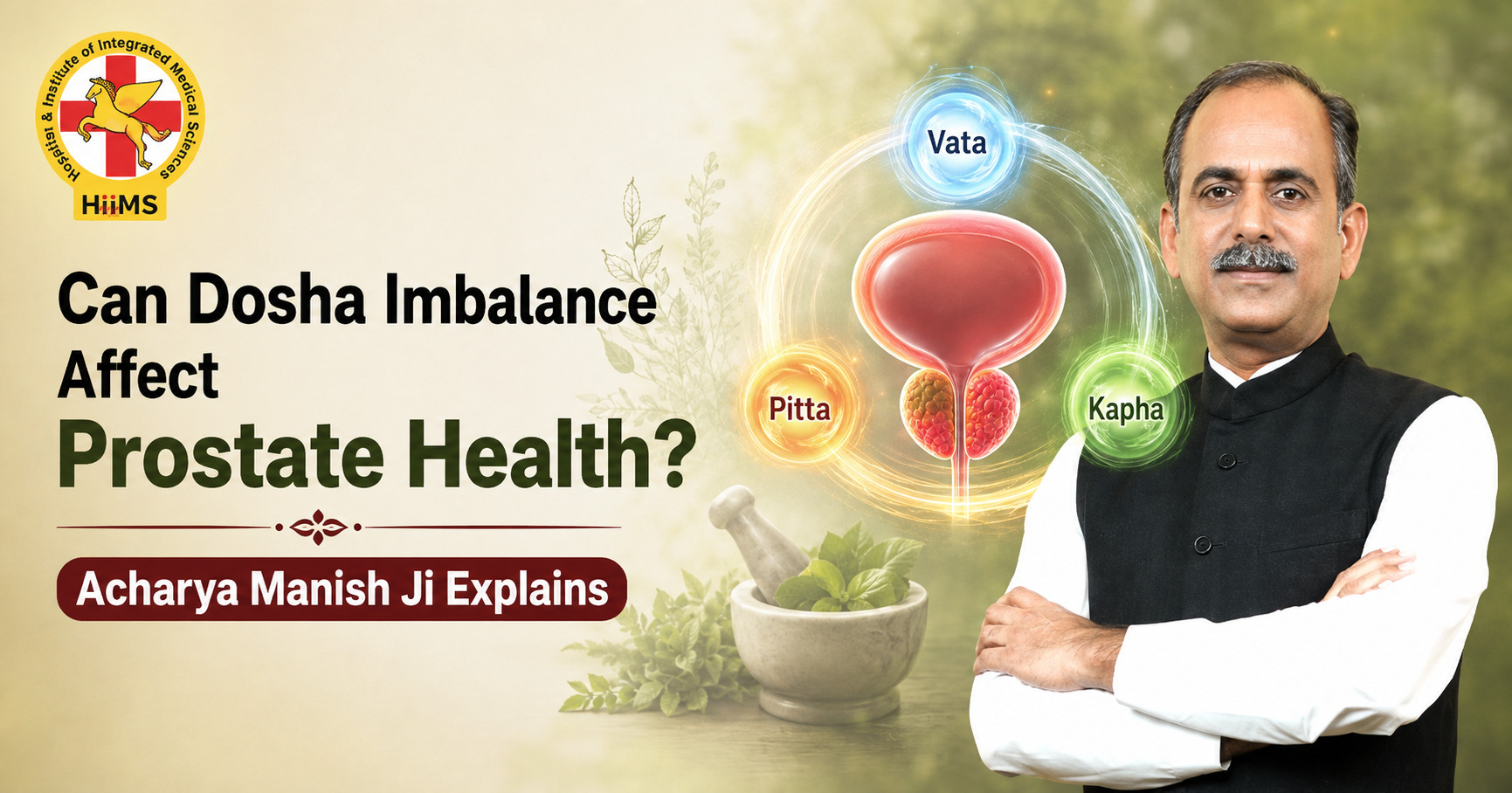

For many men, the first sign of a prostate problem is something small. Like a slightly weaker urine stream and an extra trip to the bathroom at night.
Most people think this happens as a normal part of aging, and sometimes that is exactly what it is. But the prostate is positioned at the center of the male urinary and reproductive system, and even small changes in how it works deserve attention, because uncommon but serious conditions such as prostate cancer can also progress quietly.
This brings up a question many men eventually ask: can dosha imbalance affect prostate health? Acharya Manish Ji, a respected Ayurvedic guru and founder of Jeena Sikho, answers this through a fundamental Ayurvedic idea, the body works as one connected system, where Vata, Pitta and Kapha form everything from digestion to elimination. At the same time, modern medicine remains essential for identifying and treating serious conditions.
In this blog, you will learn how Ayurveda looks at prostate wellness, which symptoms deserve attention, and why proper diagnosis always comes first.
What Is Prostate Cancer?
So, what is prostate cancer, in simple words? It is a condition where cells inside the prostate gland start growing abnormally and multiplying without the usual checks the body places on cell growth. Over time, this unchecked growth can form a tumour.
It’s worth keeping in mind that not every prostate issue is cancer. Enlargement, infection and inflammation are far more common and far less serious. This is exactly why proper health care evaluation is so important before anyone connects a symptom straight to cancer. Jumping to conclusions helps no one, and it often causes unnecessary worry.
Can Dosha Imbalance Affect Prostate Health?
In Ayurveda, the body is understood through three energies (Vata, Pitta and Kapha) and together, they influence how well the body functions. Ayurveda views pelvic and urinary health as part of this larger balance, not as something separate. A subtype of Vata, known as Apana Vata, is closely linked with elimination and reproductive function, which is why its state is crucial when we talk about the prostate.
When Vata Becomes Disturbed
A disturbed Vata often shows up as irregular elimination, a sense of dryness, and disrupted movement within the body. Urinary flow can feel inconsistent. This is frequently connected with long hours of sitting, ongoing stress, and the habit of suppressing natural needs instead of responding to them.
When Pitta Becomes Disturbed
Pitta imbalance is likely to bring heat and irritation into the picture. Some men describe a burning sensation, and there can be a general inflammatory pattern in the body. This is often linked to spicy or heavily processed food and routines that leave little room for rest.
When Kapha Becomes Disturbed
An aggravated Kapha usually brings heaviness and a state of stagnation. Movement slows down, and there can be a tendency toward congestion in the lower body. Inactivity and heavy, oily eating habits are commonly associated with this pattern.
It’s important to be clear here, this is an Ayurvedic way of interpreting imbalance and general prostate wellness. It is not proof that a dosha imbalance directly causes cancer, and it should never be treated as one.
Prostate Cancer Symptoms: Which Changes Should You Not Ignore?
Knowing the warning signs matters, whatever the underlying cause turns out to be. Common prostate cancer symptoms include frequent urination, needing to urinate often at night, a weak or interrupted urine stream, and difficulty starting urination. Blood in urine or semen, ongoing discomfort in the pelvis, back or hip, and changes in ejaculation or sexual function are also worth noting.
That said, these symptoms show up in several prostate conditions, most of which are not cancer, so they should never be used to self-diagnose.
Prostate Cancer Causes: What Do We Know?
Understanding prostate cancer causes works best when we look at it from two angles.
Known Risk Factors
Modern medicine points to increasing age, family history, genetic factors, obesity, metabolic health, and certain lifestyle patterns as recognised risk factors.
Where Ayurveda Looks Deeper
Ayurveda widens this view by looking at digestive health, daily routine, long-term imbalance, lifestyle patterns, and the body’s overall strength and resilience over time. Neither view replaces the other, they simply ask different questions.
Prostate Cancer Diagnosis: Why Testing Comes First
Persistent symptoms always call for a proper medical assessment. A prostate cancer diagnosis typically involves a PSA blood test, a Digital Rectal Examination, and imaging or scanning when a doctor advises it.
Ayurveda can assess a person’s physiology, daily habits and overall imbalance, and this adds useful context. But it cannot replace medical testing when cancer is suspected, that foundation has to be laid by appropriate diagnostic care.
How Ayurveda Approaches Prostate Health Through Balance
Food and Digestive Health
Simple, fresh, easily digestible meals support the body’s natural rhythm. Cutting back on heavily processed food, paired with dietary guidance specific to the individual, tends to make a noticeable difference over time.
Movement, Sleep and Daily Routine
Regular walking, avoiding long stretches of sitting, better sleep habits, and steady stress management all play a part in supporting the pelvic region and overall wellbeing.
Ayurvedic Therapies Under Expert Guidance
Panchakarma is one approach that Ayurveda offers for restoring balance, and Basti is often mentioned as a therapy connected with Apana Vata. These therapies should always be chosen according to a person’s individual condition, guided by a qualified practitioner, rather than treated as a one-size-fits-all prostate solution.
Acharya Manish Ji’s Approach: Look at the Whole Body
Acharya Manish Ji’s broader philosophy is simple, never look at one organ in its entirety. Digestion, lifestyle, dosha balance, urinary health and overall wellbeing are all connected threads, not individual experiences.
His approach focuses on understanding a person’s overall condition first, then building a plan suited to that individual. He is careful to make one thing clear: balancing the doshas is not presented as a way to prevent or cure prostate cancer. It is a way of supporting overall wellness alongside proper medical care.
Conclusion
Prostate concerns often start with small, easy-to-dismiss changes. The idea of Vata, Pitta and Kapha balance offers an Ayurvedic perspective for understanding overall wellbeing, not a replacement for medical attention.
If urinary symptoms persist, they should never be ignored, and any concern around prostate cancer deserves timely medical evaluation and proper diagnosis. Jeena Sikho HiiMS brings these threads together through an integrated approach, combining appropriate medical evaluation with Ayurveda, diet, lifestyle guidance and personalised care.
If you’re dealing with a prostate-related health concern, you can also opt for a VOPD (online video consultation) with expert doctors at Jeena Sikho HiiMS to understand your condition and the right way forward.
FAQs
Q1: Can dosha imbalance affect prostate health?
Ans: Ayurveda views prostate function as connected to Vata, Pitta and Kapha balance, offering one perspective for understanding wellness alongside regular medical care.
Q2: What are the common prostate cancer symptoms?
Ans: Frequent or nighttime urination, a weak urine stream, pelvic discomfort and changes in urinary or sexual function are signs worth getting checked by a doctor.
Q3: What are the known prostate cancer causes and risk factors?
Ans: Age, family history, genetics, obesity and certain lifestyle habits are recognised risk factors, alongside Ayurveda’s broader focus on digestion and daily routine.
Q4: How is prostate cancer diagnosis done?
Ans: Doctors typically rely on a PSA blood test, a Digital Rectal Examination, and imaging or scanning when further evaluation is medically necessary.
Q5: Can Ayurveda be used alongside conventional prostate cancer care?
Ans: Many people combine Ayurvedic lifestyle and dietary guidance with conventional treatment, under the supervision of an Ayurvedic doctor.