
Most of us don’t really think twice about a new mole or a small dry patch on our skin. We usually brush it off as a bug bite, an age spot, or maybe just a bit of sun irritation that will go away in a few days. But your skin is actually quite chatty. It is the largest organ you have, and it often tries to tell you when something is wrong deep inside.
Understanding the symptoms of skin cancer early on can make a world of difference because, unlike many other health issues, skin cancer is usually visible right on the surface if you know where to look. Checking your skin might seem like a chore, but it is one of the most powerful things you can do for your health. Whether you spend a lot of time in the sun or mostly stay indoors, skin changes can happen to anyone.
The goal isn’t to live in fear or constantly scan yourself with a magnifying glass but to become familiar with your “normal” so you can spot the abnormal. In this guide, we are going to walk through the common warning signs on what to keep an eye out for.
What Does Skin Cancer Actually Look Like?
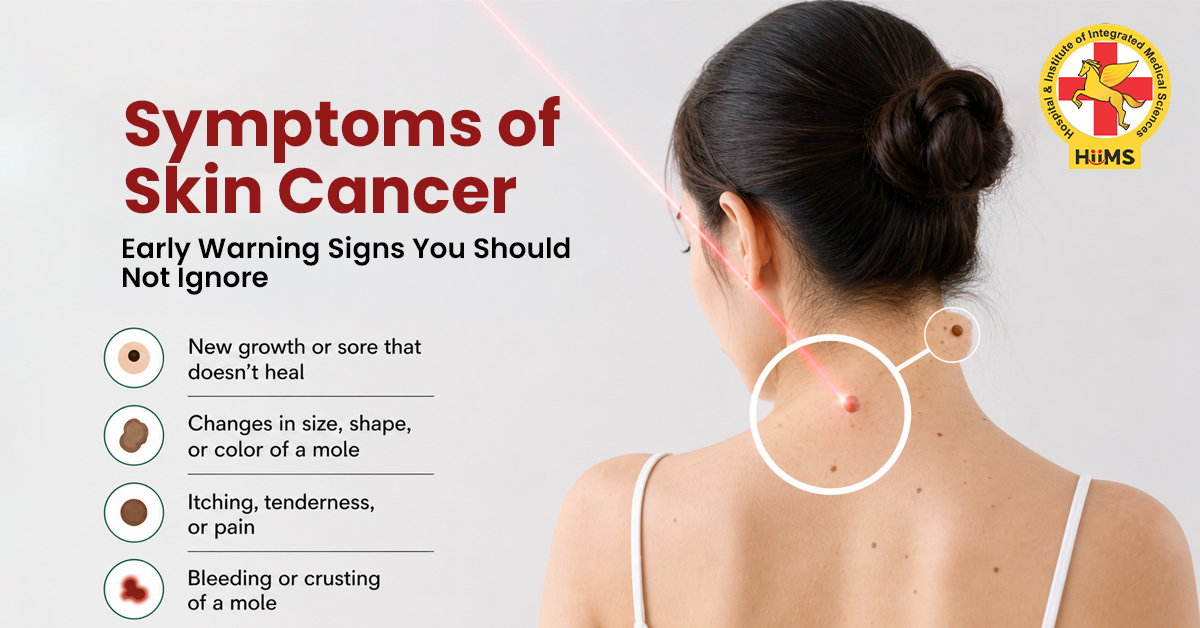
There is a big misunderstanding that skin cancer always looks like a large, scary black mole. While that can happen, skin cancer symptoms are often much more subtle. Occasionally it looks like a pimple that refuses to heal or a waxy bump that bleeds a little when you brush it with a towel.
Because there are different types of skin cancer, like basal cell, squamous cell, and melanoma, the signs can vary. Some might appear as a flat, scaly red patch that feels rough to the touch, almost like sandpaper.
Others might look like a pearly or flesh-coloured bump that has tiny blood vessels visible inside it. The key thing to remember is persistence. If a spot appears and stays there for weeks without getting better, it’s worth a second look.

The ABCDE Rule for Checking Moles
When people talk about early signs of skin cancer, they often mention the ABCDE rule. This is a basic way for you to check your moles at home. It’s not textbook science; it’s just a checklist to see if a mole is acting weird.
- Asymmetry: If you were to draw a line through the middle of the mole, would the two halves match? If they look entirely different, that is a warning sign.
- Border: Check the border. Normal moles have a smooth appearance. When the edges are irregular and indistinct, pay attention.
- Colour: A normal mole is usually one shade of brown. If you see a mix of black, tan, red, or even blue, it’s time to be cautious.
- Diameter: Is it bigger than a pencil eraser? While small cancers exist, anything larger than 6mm needs checking.
- Evolving: This characteristic is arguably the most important one. Is the mole changing? If it starts itching, bleeding, or growing suddenly, don’t ignore it.
Warning Signs You Might Miss
Sometimes, the warning signs of skin cancer don’t involve moles at all. There are certain silent signs of skin cancer that one may overlook as common skin problems.
An example is when a wound heals but reappears at the same spot, repeatedly. There is also a tendency for skin cancer to manifest in patches of skin that become extremely painful or itchy.
Skin cancer may also develop under fingernails/toenails, taking on the form of dark streaks.
People often think skin cancer only happens on the face or arms, but it can show up anywhere, even places that never see the sun, like the soles of your feet or between your toes. This is why a full body check every few months is a great habit to start.
Why Early Detection Changes Everything
The reason doctors and health experts talk so much about skin cancer signs is that when caught early, most skin cancers are highly treatable.
If you catch a spot while it is still just on the top layer of your skin, the fix is often very simple.
However, if you wait until a spot starts hurting or growing deep into the skin, the journey becomes much harder. It is always better to have a “false alarm” where a doctor tells you a mole is perfectly safe than to wait and wish you had gone sooner. Your skin is great at regenerating, but it needs your help to stay ahead of these changes.
Natural Support and Healing
At Jeena Sikho HiiMS, we believe in looking at the body as a whole. Even when the symptoms of skin cancer are based on external manifestations of the disease, good health will always come from the inside.
The healing technique we follow is one that relies on the synergy between Ayurveda and modern science to achieve balance through the following process:
Blood Cleansing: Through the use of traditional herbal treatments for purifying the blood and reducing inflammation.
Feeding a Sattvic Diet: Eating living foods and feeding the body to allow it to heal itself.
Removing Toxins: Supporting the body in eliminating any toxins which may lead to abnormal growth of cells.
Whether you are seeking ways to prevent skin cancer or trying to improve the health of your skin naturally, it can make a world of difference to pay attention to your nutrition, digestive system, and stress.

Conclusion
Your skin is your body’s first line of defense. It takes a lot of hits from the sun, pollution, and age, so the least we can do is pay attention when it tries to tell us something. If you see a new spot, a changing mole, or a sore that won’t go away, take it seriously. It might be nothing, but knowing for sure gives you peace of mind.
Staying proactive is the best gift you can give yourself. Eat well, protect your skin, and keep an eye out for any changes. If you are feeling overwhelmed or noticed something unusual and want a more natural, holistic perspective on your health, we are here to guide you.
For a deeper understanding of your health or a personalized path toward wellness, you can book a VOPD consultation with Jeena Sikho HiiMS Delhi experts.
FAQs
Q1. What are the most common skin cancer symptoms?
Changes in moles, formation of new growths, and sores that fail to heal may indicate skin cancer.
Q2. How can one detect the early signs of skin cancer?
One should examine any mark or mole for changes in its shape, texture, size, or color.
Q3. Are all the skin changes associated with skin cancer?
Many of skin changes are harmless, yet some changes need medical attention.
Q4. How often should one check their skin?
Regular monthly examination allows detecting potential skin problems timely.
Q5. When should one seek medical help?
In case of suspicious skin changes, bleeding from a spot or failure to heal of any wound.