
Most of us love a warm sunny day. We walk to the market, play cricket with friends, or sit on the roof in winter to enjoy the soft light. Very few of us stop to think that the same sun can slowly harm our skin. Skin cancer is one of the most common cancers in the world, and it often starts quietly, with a small spot or a mole that seems harmless. Many people ignore it for months because it does not hurt. Knowing the skin cancer causes is the first step towards keeping yourself and your family safe. When you understand what damages the skin and what raises your chance of getting the disease, you can change small habits in your daily life.
This blog explains the reasons behind the illness in plain words. You will read about the family history, daily habits, and the signs that need a doctor’s eye. You will also find simple natural ways to care for your skin every day.
In clinical practice, doctors often observe that many people reach the clinic late because the first sign, a small patch or a mole that changes slowly, did not cause any pain. Doctors usually begin by listening to the patient’s history, work habits, and time spent outdoors before they talk about suitable care options.
What Is Skin Cancer and How Does It Begin?
Our skin is made of millions of tiny cells. These cells grow, do their work, and die in a fixed cycle. Skin cancer starts when some cells get damaged and begin to grow without control. They pile up and form a lump, a patch, or a sore that does not heal. The three main types are the basal cell, squamous cell, and melanoma. The first two are more common and usually grow slowly. Melanoma is less common, but it can spread faster if it is missed.
Worried about a spot or a mole on your skin? Talk to our care team today and get honest guidance.

Main Skin Cancer Causes Behind the Disease
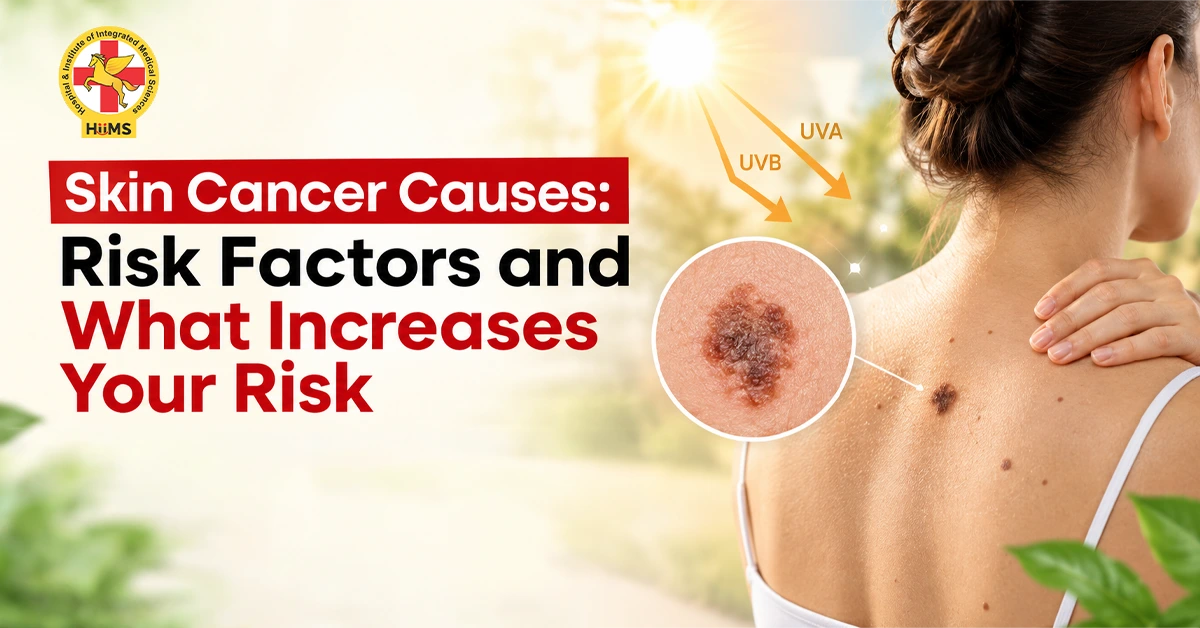
The rays of the sun are the biggest trigger because they damage the DNA inside skin cells, and cancer can begin when that damage affects the genes that control cell growth. Among the common causes of skin cancer, the sun stays at the top of the list, even on cloudy days, since UV rays reach us on cold and cloudy days too. Other risk factors include: American Cancer Society: Skin Cancer Risk Factors, Anne Arundel County Department of Health: Risk Factors for Skin Cancer
- Tanning beds and sunlamps: They give out the same harmful rays as the sun, often in a stronger dose.
- Repeated sunburns: Research from the World Health Organization shows that repeated sunburns, especially during childhood, can increase the risk of melanoma.
- Certain chemicals: Long contact with arsenic and some industrial substances can harm the skin.
- Old wounds and burns: Sores or scars that stay inflamed for years may turn into a problem.
- Weak body defence: People with a weak immune system are more likely to develop many types of skin cancer.
Doctors often observe that changes appear most often on parts that meet the sun every day, such as the face, ears, neck, scalp, and the back of the hands.
Risk Factors That Raise Your Chances
Knowing your skin cancer risk factors helps you decide how careful you need to be. Having one or even many risk factors does not mean you will surely get the disease, and some people with few risk factors do get it. Still, these points deserve your attention:
- Fair skin, freckles, light eyes, and red or blond hair: Melanin, the natural pigment, gives some protection, so lighter skin carries a higher risk.
- Family or personal history: If you or a close family member had skin cancer, your risk may be higher.
- Many or unusual moles: A large count of moles is a strong warning for melanoma.
- Outdoor work: Farmers, drivers, traffic police, and construction workers spend long hours under the strong sun.
- Living in a sunny country: Strong sunlight through the year means more rays over a lifetime.
- Smoking: Tobacco is also linked with some types of skin cancer.
Understanding these risk factors can help you take simple precautions and pay closer attention to changes in your skin.
Why Adults Face a Higher Chance
The causes of skin cancer in adults are mostly the result of many years of sun, which add up quietly. A burn you had as a teenager may show its effect only after you turn forty or fifty. Age also makes the body slower at repairing damaged skin.
Men are found to be at higher risk than women, partly because they often spend more hours outdoors with less covering.
Natural Ways to Protect Your Skin Every Day
Once you know the causes of skin cancer, protecting yourself becomes much easier. Ayurveda teaches that healthy skin depends on good digestion, clean blood, and a calm mind, so care must reach beyond the skin. Good skin cancer prevention does not need costly things. It starts with a few habits at home:
- Stay in the shade between 10 in the morning and 4 in the afternoon, when the sun is strongest.
- Wear full-sleeve cotton clothes, a cap or scarf, and carry an umbrella outdoors.
- Eat fresh fruits, green leafy vegetables, carrots, papaya, and amla, which are rich in natural antioxidants.
- Use turmeric in daily cooking and apply pure aloe vera gel to soothe the sun-heated skin.
- Drink enough water and sleep on time, because rest helps the body repair itself.
- Say no to tobacco and tanning beds.
At Jeena Sikho HiiMS Hospital, care is built around Ayurveda and natural methods. Doctors there look at the whole person, including food habits, sleep, stress, and daily routine, and not only at the spot on the skin.
People who follow a steady routine of simple food, enough water, proper sleep, and shade in the afternoon find it easier to look after their skin over the years. Doctors usually begin by understanding the patient’s medical history, lifestyle and individual health concerns before discussing suitable care options.
Warning Signs That Need a Doctor’s Attention
Because most skin cancer causes develop slowly, the first signs can be easy to overlook. Please get a check-up if you notice:
- A new spot, or a mole that changes in size, shape, or colour
- A sore that does not heal in a few weeks
- A red, scaly, or rough patch that itches or bleeds
- A mole with uneven edges or more than one colour
- A shiny, pearly, or waxy bump
If you notice any of these changes, it is better to have them checked by a doctor rather than ignoring them.
Conclusion
Understanding skin cancer causes gives you the power to act early. The sun, tanning beds, family history, age, and a weak body defence all play a part, but many of these can be handled with care and simple habits. Cover your skin, eat fresh food, sleep well, and check your skin often. If you notice a change, do not wait. Jeena Sikho HiiMS offers a VOPD consultation, so you can speak to an expert from home and get natural, Ayurvedic guidance for your skin and overall health.

FAQs
Q1. What causes skin cancer?
Most cases begin when too much UV light from the sun or tanning beds damages the DNA inside skin cells.
Q2. Can skin cancer happen without sun exposure?
Yes, though it is less common, and it can be linked to chemicals, old scars, a weak immune system, or family history.
Q3. Can people with dark skin get skin cancer?
Yes, natural melanin gives some shield, but it does not provide full protection.
Q4. Are all moles cancerous?
No, most moles are harmless, but any mole that changes in the size, shape, or colour should be checked.
Q5. How does Ayurveda look at skin health?
Ayurveda links healthy skin with good digestion, a balanced routine, proper sleep and a calm mind.