
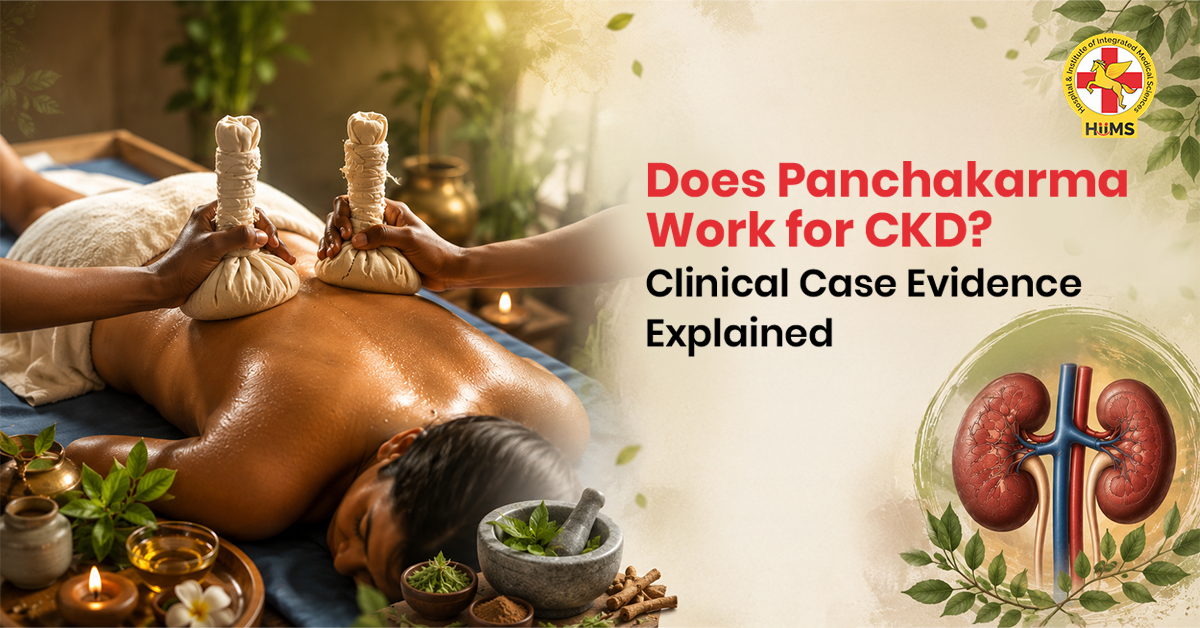

Living with kidney-related issues is not easy. For many people dealing with long-term concerns like CKD, daily life slowly starts changing; food choices become limited, energy feels lower, and there’s always this quiet worry in the background.
Because of these factors, people often begin looking beyond just routine medical care. They explore different ways to feel more balanced, more stable. That’s where Ayurveda often comes into the conversation.
Among its many approaches, Panchakarma for CKD is something people get curious about. However, there is one particular question that keeps resurfacing: Is it really of any significance, or is it merely a tradition with no scientific basis whatsoever?
In order to gain a greater insight into the topic, it would be useful to consider how Panchakarma therapy is perceived as well as what observations regarding it have been made throughout the years. It should not be considered a short-term remedy but a lifestyle choice.
Understanding CKD from a Lifestyle Perspective
Chronic Kidney Disease, or CKD, usually develops over time. It is not something that appears suddenly. Often, it is linked with long-term habits, irregular eating patterns, stress, lack of movement, or other ongoing health conditions. From a modern point of view, CKD is about reduced kidney function. However, when considering Ayurveda, the emphasis is slightly changed. Rather than focusing only on the organ, it emphasises the overall balance of the body.
Whenever the digestive process, lifestyle, and bodily functions become unbalanced, the body can start feeling overwhelmed. This can manifest in various ways, and some of them can lead to kidney disorders. That is the reason why methods such as CKD natural treatment do not consider only one aspect but rather the whole picture.
What is Panchakarma and Why is it Used?
Panchakarma is often referred to as the purification procedure in Ayurveda. However, it is more than that. It is more structured and personalised. The therapy usually involves multiple steps, preparation, mild cleansing procedures, and recovery practices. The idea is not to force change but to support the body’s natural functioning.
Regarding the use of Panchakarma in CKD, the idea of curing this disease is not the intention. Rather, this is viewed as an adjunctive therapy that can help make the person feel lighter, more grounded, and regulated on the inside. There are some people who claim that they feel better after going through these treatments.
Looking at Panchakarma Clinical Evidence
In discussing the Panchakarma clinical evidence, it is important to note that most of the evidence generated on the subject has been from case studies and observations. For example, in one of the clinical case studies conducted at Jeena Sikho Lifecare, there was a remarkable change in a patient with CKD who had been treated using the Ayurvedic method. The patient was relieved from symptoms such as weakness, swelling, and pain. There was also an alteration in the laboratory parameters in that the blood urea was lowered from 129.8 mg/dL to 69 mg/dL and the serum creatinine from 8.46 mg/dL to 6.7 mg/dL.
The observations indicate that Ayurvedic treatments, when done in an organized and supervised manner, might help achieve stability in certain circumstances. However, it is important to understand that this is based on limited evidence, and individual responses can vary. You can download this research paper from here:
Also, in most of these cases, Panchakarma is not used alone. It is combined with diet changes, herbal support, and lifestyle corrections. That is why it is usually considered part of a broader Ayurvedic treatment for kidney failure approach rather than a standalone solution.

Lifestyle Matters More Than One Therapy
One thing that becomes clear while looking at different approaches is this: no single therapy works in isolation. Even if one decides to take either modern healthcare services, Ayurvedic medicine, or both, the daily practices continue to be very important. Such practices as:
- Regular eating.
- Eating light and fresh food.
- Maintaining proper hydration.
- Getting sufficient sleep.
- Keeping stress levels in check.
These may sound basic, but they often make a noticeable difference over time. Even in Panchakarma-based care, lifestyle is always part of the process.
A Closer Look at CKD Care at Jeena Sikho HiiMS
Jeena Sikho HiiMS, an Ayurvedic hospital, focuses on understanding the individual rather than just the condition. Every person experiences CKD differently, so the approach also tends to vary.
The care system may entail an integration of various Ayurvedic concepts as well as basic practices and recommendations. In case Panchakarma is taken into account, it is normally planned according to the condition and readiness of a client.
There are no plans to act fast and recklessly; it is all about taking things slow. Watching how the body reacts, changing daily routines, and remaining within reasonable limits. Such an approach appears to be much more comfortable for many people.
Conclusion
So, does Panchakarma for CKD work? The honest answer is that it may support overall wellness in some cases, but it is not something to look at as a guaranteed solution.
More important is the concept of consistency, lifestyle, and opting for something that will be sustainable for you. Panchakarma can be just one aspect of that process but not the only solution. If you are looking into your options and would like to know what suits your condition, then you can consult with a professional.

FAQs
Q1. What is Panchakarma, explained in layman’s terms?
Panchakarma refers to a conventional practice within Ayurveda that involves cleansing and balancing the body via specific techniques.
Q2. Is Panchakarma applicable in the management of CKD?
Panchakarma can be applied as part of an overall wellness strategy.
Q3. Can everybody undergo Panchakarma?
Panchakarma needs to be tailored based on the health status of the individual.
Q4. Does Ayurveda substitute CKD treatment?
Ayurveda typically complements existing medical treatments.
Q5. How long does Panchakarma last?
The time period depends on the modality of treatment.