
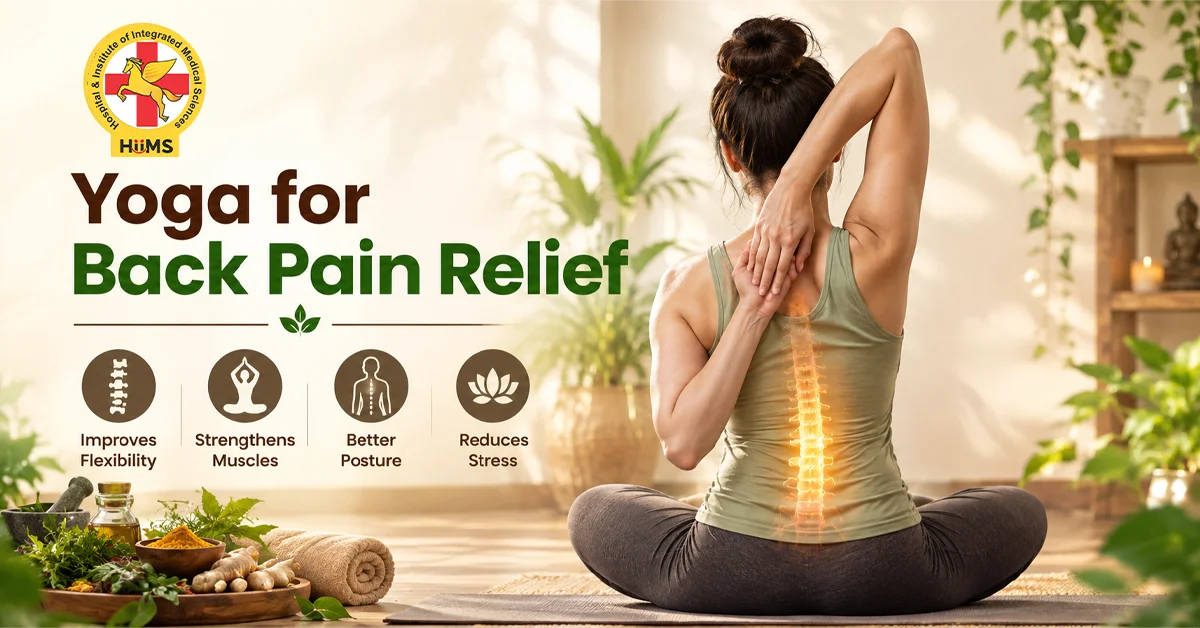

However, back pain can make many regular activities very uncomfortable. It can come from sitting at your desk for prolonged periods, bad posture, lack of activity, muscle tension, and stress, among other possible reasons. While for some people back pain will go away on its own, others will experience chronic back problems.
However, movement can turn out to be one of the key elements in a healthy routine. Yoga for back pain relief involves carefully chosen movements, stretching, breathing exercises and body awareness.
According to the research cited by the National Center for Complementary and Integrative Health, practising yoga can lead to moderate improvements in back pain and mobility in patients with low back pain. However, yoga might have the same effect as any other physical activity.
What is most important about using gentle movements as the remedy is that it is not supposed to be hard.
Can Yoga Help With Back Pain?
Yoga can be a useful supportive practice for some people with low back pain. It combines movement with controlled breathing and can help people become more aware of how they sit, stand and move.
Research on yoga for low back pain has found improvements in pain and function over short and intermediate periods in some studies. However, the benefits are generally modest, and yoga is not suitable for every type of back problem or every person.
For someone beginning beginner yoga for back pain, the focus should be on comfortable movements rather than deep stretching or advanced poses.
If a movement causes sharp pain, numbness, tingling or worsening symptoms, stop and seek appropriate professional guidance.
Simple Yoga Poses for Back Pain
The following poses are gentle options that may be included in a basic routine. They should be performed slowly and within a comfortable range.
1. Cat Cow Pose
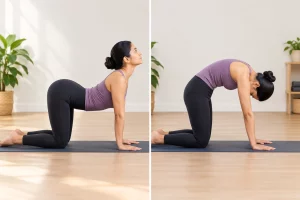
Cat Cow, commonly known as Marjariasana and Bitilasana, is a simple movement for gently moving the spine.
Start on your hands and knees. Keep your hands below your shoulders and knees below your hips.
As you inhale, gently lift your chest and allow your back to move into a comfortable arch. As you exhale, slowly round your spine and allow your head to move slightly downward.
Repeat the movement for around 5 to 10 comfortable breaths.
This can be a useful starting movement before other stretches for lower back pain because it gently takes the spine through two different positions.
Do not force the arch or round the back.
2. Child’s Pose
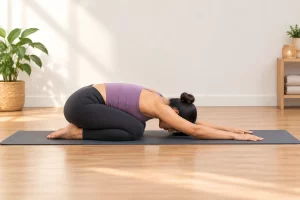
Child’s Pose, which has the name of Balasana, is usually practised for the purpose of relaxation.
Firstly, start by being in a position where you are in all fours. Next, move your hips backward towards your heels and reach forward with your arms.
It may be uncomfortable to reach forward in this case, so either keep your arms close to your body or add some cushioning to ease out the tension.
Practice for about 30 seconds to 1 minute in the beginning.
3. Sphinx Pose
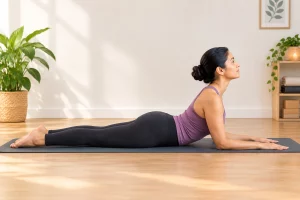
Sphinx Pose can provide a gentle extension movement for the spine.
Lie on your stomach and place your elbows underneath or slightly in front of your shoulders. Keep your forearms on the floor and gently lift your chest.
Hold for a few comfortable breaths.
Do not push strongly into the floor or try to create a deep backbend. If the movement increases your back pain, come out of the pose.
For some people, a gentle version of this movement may be more comfortable than a deeper cobra pose.
4. Supine Spinal Twist
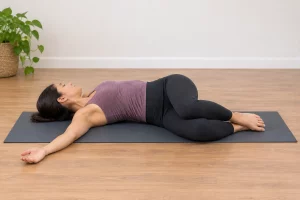
Lie on your back with your knees bent. Bring your knees towards your chest and slowly allow them to move towards one side.
Keep the movement controlled and only go as far as feels comfortable. Try to keep your shoulders relaxed on the floor.
Stay for around 3 to 5 breaths and slowly return to the centre before repeating on the other side.
This is one of the simple yoga poses for back pain that can be included in a gentle floor-based routine.
5. Bridge Pose
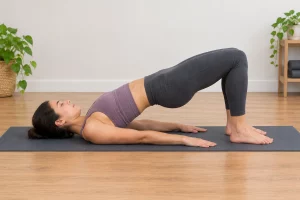
Lie down on your back and bend your legs such that the feet touch the ground.
Place the feet slightly apart from each other at hip distance. Start slowly pressing down the feet on the ground and raise your hips.
Maintain this position for a few comfortable breaths and then slowly lower the hips down.
Bridge Pose works on the gluteal muscles along with other muscles of the hips and trunk region. Strengthening the muscles of these regions may be a part of the exercise programme for the back.
If you experience pain while doing the pose, stop rather than trying to push through it. and

How to Practise Yoga Safely for Lower Back Pain
When starting yoga for lower back pain relief, more is not necessarily better.
Start with a few gentle movements and observe how your body responds. Avoid sudden movements, bouncing or deep stretches. Your breathing should remain comfortable throughout the practice.
A short routine performed regularly may be more practical than doing a long session occasionally. People who are older, pregnant, recovering from an injury or living with a known spine or joint condition may need modified poses.
NCCIH also notes that although yoga generally has a good safety record when performed appropriately, some people may need to avoid or modify certain practices because of their individual health conditions.
What Can Cause Back Pain?
Yoga can facilitate mobility and flexibility; however, it is also necessary to know the reasons for back pain.
There can be various causes for back pain, such as:
- Bad posture
- Long hours of sitting down
- Muscular strain
- Lack of exercise
- Specific disc disorders
- Being overweight
- Stress
- Past injuries
- Some health issues
This is why simple stretching of the affected area may not resolve the issue at hand.
At Jeena Sikho HiiMS, the back pain approach considers factors such as lifestyle, posture, physical activity, diet and other individual factors while developing a broader wellness plan. The centre describes its integrated approach as combining Ayurveda, naturopathy and Unani practices with modern sciences.
Jeena Sikho HiiMS Approach to Back Pain
At Jeena Sikho HiiMS, the approach is focused on understanding the possible contributing factors behind back pain rather than looking only at the painful area.
The HiiMS back pain programme considers factors such as poor lifestyle, posture, sedentary habits, stress, muscle strain and other possible contributors. Its approach combines Ayurveda, naturopathy and Unani therapies with other healthcare practices.
This root cause-focused approach means looking at the person’s daily routine, food habits, movement patterns, sleep, stress and other relevant factors as part of the overall assessment.
Yoga can also be included as a lifestyle practice where it is appropriate. Gentle stretching, mobility work, breathing exercises and regular movement may help a person develop a more active routine.
However, the exact approach should depend on the reason for the back pain. Yoga should not be used as a substitute for professional evaluation when symptoms are severe, persistent or unusual.
When Should You Not Rely Only on Yoga?
Not every type of back pain should be managed at home.
It is recommended to see a doctor for any severe, persistent, and prolonged back pain or for back pain that keeps you from doing your normal work.
See a doctor right away if your back pain comes with signs like excessive weakness, numbness, loss of control of bladder/bowels, fever, unexpected weight loss, or pain following an injury.
All the above signs need evaluation and can’t be just seen as muscle tightness.
A Simple Routine for Beginners
If your back pain is mild and you have no reason to avoid exercise, you can start with a short routine.
Step 1: Start with cat-cow breathing for 5-10 slow breaths.
Step 2: Go to Child’s Pose for 30 seconds to 1 minute if you feel comfortable.
Step 3: Perform the Sphinx Pose for around 5 breaths if you are comfortable.
Step 4: Do a slow spinal twist lying down on the back on both sides.
Step 5: End up with 3-5 repetitions of Bridge Pose.
There is no need to rush through the routine. The goal is controlled movement and comfortable breathing.
Conclusion
Yoga for back pain relief is a simple means of incorporating mild movements, stretches, and body awareness into one’s day. The exercises known as Cat Cow, Child’s Pose, Sphinx Pose, Supine Spinal Twist and Bridge Pose are all good for beginners if done comfortably.
It has been found in research that yoga could offer small benefits in terms of lower back pain and physical function but is not necessarily a cure-all and functions similarly to other forms of exercise.
The emphasis at Jeena Sikho HiiMS is finding out what the causes could be for the back pain and improving well-being in a holistic manner. If you would like to understand your back pain and design a personal wellness programme, then you should consider booking a VOPD consultation.

FAQs
Q1. Does yoga benefit lower back pain?
Yoga may be helpful for the flexibility, mobility and function of those suffering from low back pain.
Q2. What are the best yoga exercises for beginners with back pain?
Some beginner poses include Cat Cow, Child’s Pose, Gentle Sphinx, Supine Spinal Twist and Bridge Pose.
Q3. How many times per week should I practise yoga to ease my back pain?
Begin by starting slow and keep up with your practice. If symptoms get worse, stop or decrease intensity.
Q4. Can yoga treat the root of back pain?
Yoga could help with back pain, but not solve all of the underlying causes of back pain.
Q5. Should I skip yoga exercises when having back pain?
If you experience increased or sharp pains, then you need to stop. Consult a doctor if you have any of the following: severe weakness or numbness, problems with bladders or bowels, fever, weight loss or pain following an accident.

Leave a comment