


Climbing stairs, getting up from the floor, or even standing for a few minutes in the kitchen can start to feel different when your knees hurt. Many people put it down to age or a bad night’s sleep and keep going, until the pain starts deciding how they walk, sit, and sleep. Knee joint pain is one of the most common reasons people slow down in daily life, and it is not limited to older adults.
A knee can hurt after a twist at the gym, after years of long sitting hours, or slowly with no clear reason at all. The good news is that a lot of everyday habits can be adjusted once you understand what may be behind the pain. Keep your own routine in mind while you read, and notice which points sound like you.
What Are the Common Knee Joint Pain Symptoms?
The knee joint pain symptoms people describe are not the same for everyone. Some feel a dull ache after walking. Others feel a sharp pain when the knee bends. You may notice some of these:
- Pain in the front, sides, or back of the knee
- Stiffness, especially in the morning or after sitting for a while
- Mild swelling around the joint
- A feeling that the knee is weak or may give way
- Difficulty in fully bending or straightening the knee
- Warmth or redness around the joint
Painless clicking in the knee is common and usually not a worry. Clicking with pain, locking, or a feeling of giving way is different, and it needs a doctor’s look.
Facing symptoms like these?
 Common Knee Pain Causes
Knee pain does not have one single reason. Understanding the likely knee pain causes in New Ghaziabad, or in any city, starts with looking at your age, your work, your weight, and any earlier injury. Here are the most common ones, explained one by one.
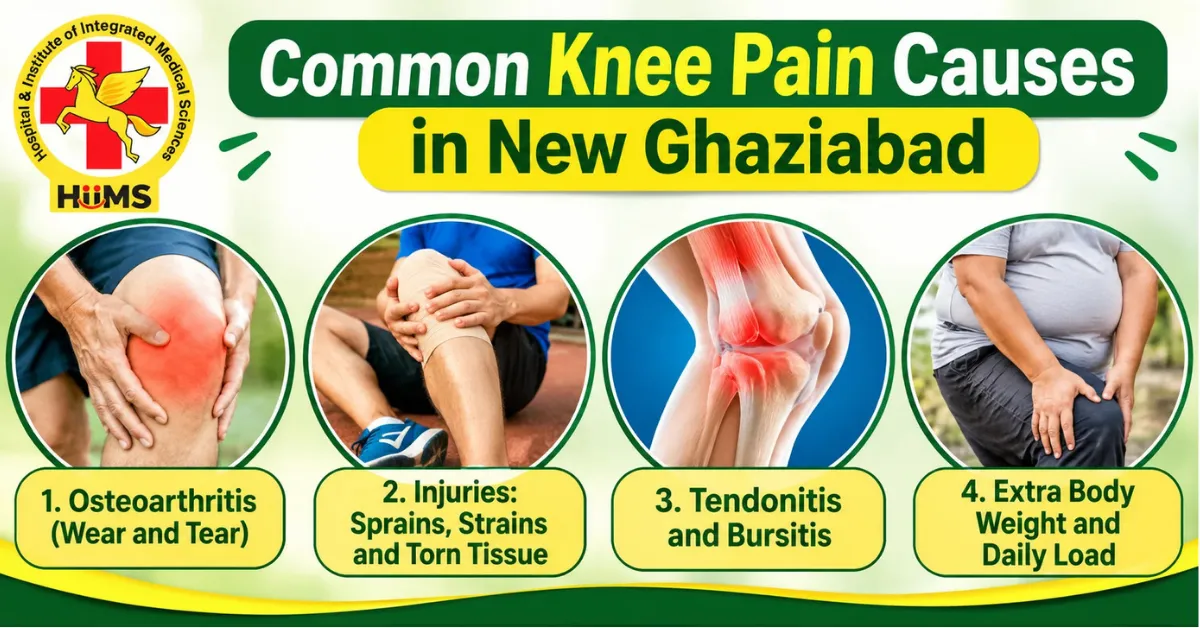
1) Osteoarthritis (Wear and Tear)
Osteoarthritis is the most common reason for knee joint pain after the age of 40 or 50. The smooth cartilage that cushions the joint slowly thins out, and the bones start to rub with more friction. This usually causes pain and stiffness, often in both knees, with mild swelling. It tends to build up over months or years.
A community study from Kanchipuram district in Tamil Nadu, published in the Indian Journal of Public Health in 2018, checked 1,986 adults and found that 27.1% had knee osteoarthritis. It was more common in people above 50, in women, and in those with diabetes, high blood pressure, tobacco use or a family history of the condition.
2) Injuries: Sprains, Strains and Torn Tissue
A twist, a fall, a sudden stop while running or a heavy lift can overstretch the ligaments and muscles around the knee. Minor sprains and strains cause pain after the movement.
A torn ligament or meniscus (the cartilage cushion inside the knee) can make the knee feel unstable, make it hard to straighten, or produce a popping sound at the time of injury. These need a doctor’s examination rather than guesswork.
3) Tendonitis and Bursitis
Tendonitis is irritation of the tendon, often from repeated running, jumping or climbing. It typically causes pain between the kneecap and the shin. Bursitis is irritation of a small fluid-filled sac near the joint. The knee may look warm or red, and kneeling or bending makes it worse.
4) Extra Body Weight and Daily Load
Every step puts load on your knees, and extra body weight adds to that load, so knee joint pain can feel worse when weight goes up. Doctors commonly advise a healthy weight for this reason. Lack of movement also weakens the muscles that support the knee.
5) Everyday City Habits
In a city like New Ghaziabad, many people sit at desks for long hours, travel daily by two-wheeler or car, and use lifts instead of stairs. Weak thigh muscles, long sitting and sudden bursts of activity on weekends can all put the knee under stress. These are general lifestyle patterns, not figures for any one city, but they are worth a look in your own routine.
6) Gout and Infection
Sometimes a knee becomes hot, red and very painful, with sudden attacks. This can be gout or an infection in the joint, and it needs urgent medical attention. Do not wait or try home measures if your knee suddenly becomes very hot and painful, or if you have a fever along with the knee pain.
Ayurvedic View: Understanding Knee Pain Through Sandhigata Vata
In Ayurveda, joint pain with stiffness and discomfort on movement is described as Sandhigata Vata. The idea is that Vata, the principle of movement, becomes disturbed in the joint area, often linked to age, irregular routine, long sitting, cold exposure and a heavy or irregular diet. This is a traditional description. It gives a different way of looking at the same complaint, and it does not replace a modern examination.
Ayurvedic support for knee pain usually combines food, routine, movement and certain therapies given by trained practitioners. One of these is Janu Basti, which we explain below. A small pilot study published in the Journal of Medical and Scientific Research in 2020 looked at Janu Basti for knee osteoarthritis.
Six patients (nine affected knees) received daily Janu Basti with medicated oil and local steam for 21 days, followed by five weeks of home oil massage and warm fomentation. The authors reported improvements in pain, stiffness and walking ability.
Knee Pain Management Tips You Can Start Today
Good knee pain management is made up of small, steady habits. These are the ones that most people can begin with, and each one is explained below.
1) Keep Moving, But Gently
Complete rest for long periods can make the knee stiffer and the muscles weaker. A short, easy walk of 20 to 30 minutes, at a pace that does not increase the pain, is a good place to start. Avoid sudden twisting, deep squats and long stretches of standing. If a movement makes the pain sharper, stop and check with your doctor or a physiotherapist.
2) Build Strength Around the Knee
Strong thigh and hip muscles take some of the load off the joint. A physiotherapist can show you safe leg-strengthening and stretching exercises that suit your knee.
3) Use Ice After an Injury
After a fresh injury or sudden swelling, a cold pack or frozen peas wrapped in a towel, kept on the knee for up to 20 minutes every 2 to 3 hours, is a common home step. Do not put ice directly on the skin. If the swelling is not settling, see a doctor.
4) Be Careful With Pain Medicines
Over-the-counter pain medicines are sometimes used for a short period. Please ask your doctor before using them regularly, because some of them can irritate the stomach.
Natural Knee Pain Management at Home
Many people want natural knee pain management that fits into the day without too much effort. These are the points we suggest keeping in mind:
- Start your day with warm water, light yoga or stretching and a short walk
- Keep meals at regular times, with dinner before sunset
- Prefer fresh, simple, and home-cooked vegetarian food and keep fried and packaged food low
- Do not sit on the floor or in the same position for long if it hurts the knee
- Sleep on time, as rest is when the body repairs itself
Warm fomentation is a traditional part of Ayurvedic care. If your knee is hot, red, or swollen, check with your doctor first, since warmth may not suit it at that time.
Simple Knee Pain Relief Tips for Busy Days
A few knee pain relief tips are easy to fit in at home or at work. Take the stairs slowly, one step at a time, and hold the railing. Get up from a chair using both hands and your legs, not by twisting the knee. When you carry heavy bags, divide the load on both sides.
If you sit for long hours, stand up and move for a minute every half hour. None of these are quick fixes. They add up over weeks, and they work well together with your doctor’s advice.
When Should You See a Doctor?
Home steps are fine for mild, everyday pain. But please see a doctor if your knee pain does not improve within a few weeks. Get medical help without delay if:
- The knee is very painful, or you cannot move it or put weight on it
- The knee is badly swollen or has changed shape
- It locks, gives way, or clicks painfully
- You have a high temperature, and the knee is red or hot
How Jeena Sikho HiiMS New Ghaziabad Support Joint Care
At Jeena Sikho HiiMS New Ghaziabad, our care is supportive. Our approach to joint pain care in New Ghaziabad and across our centres starts with your reports, not with a fixed package.
- Janu Basti: We offer Janu Basti for knee joint pain. In this therapy, warm herbal oil is kept over the knee for a set time, and it is a traditional part of Ayurvedic Support for Knee Pain. Which oil, how long, and how many sessions are decided by our team after reviewing your reports. As with anything applied on the skin, tell us at once if you feel itching, burning, or redness. If your knee is hot, red, or swollen, check with your doctor before any warm therapy.
- Diet: Acharya Manish Ji’s two-plate pH-balanced diet has Plate 1 of raw food and Plate 2 of cooked food, and you eat the raw plate first. Breakfast is 3 to 5 seasonal fruits, about 500 g if you weigh more than 50 kg and about 250 g if you weigh less. Lunch begins with a raw salad, about 250 g above 50 kg and 150 to 200 g below. The evening is water or herbal tea, and dinner is before sunset. Sweets, bakery items, soft drinks, fried food, maida, and white rice are kept low, and dairy is reduced. The whole diet is vegetarian. If you have diabetes, acidity, or other conditions, please confirm the portions with your doctor.
- Panchakarma and herbs: These are considered only after your reports are reviewed, and any change in your medicines is your doctor’s decision.

Conclusion
Knee joint pain has many possible reasons, from wear and tear to injuries and daily habits, and finding the likely reason is the first step. A mix of gentle movement, strength work, steady meals, a healthy weight, and the right medical advice forms the base of knee pain management. Natural habits and natural knee pain management work well when they stay simple, and knee pain relief tips are most useful when they become part of your day.
Ayurveda adds one more view, and Ayurvedic Support for Knee Pain, such as Janu Basti, can go alongside, not instead of, your doctor’s plan. Note down when your pain starts, what makes it worse, and what makes it better, as it will help any doctor who examines you.
If you would like to share your reports and talk about joint pain care in New Ghaziabad from home, you can speak with the doctors at Jeena Sikho HiiMS New Ghaziabad through a VOPD.

FAQs
Q1. Is knee pain a sign of arthritis?
Ans: No. Injuries, tendon problems, and overuse can also cause it. Your doctor can tell you the reason after an examination.
Q2. Should I stop walking if my knee hurts?
Ans: Gentle walking is often fine, but stop if the pain gets sharper, and check with your doctor or physiotherapist about the right amount.
Q3. Why is my knee stiff in the morning?
Ans: Stiffness after rest is common with joint wear and tear. If it lasts long or comes with swelling and warmth, please get it checked.
Q4. Can Janu Basti replace my medicines?
Ans: It is supportive care, and any decision about your medicines should be made with your doctor.
Q5. Is the pH-balanced diet vegetarian?
Ans: Yes. Portions of fruit and salad should be confirmed with your doctor if you have other health conditions.
Leave a comment