

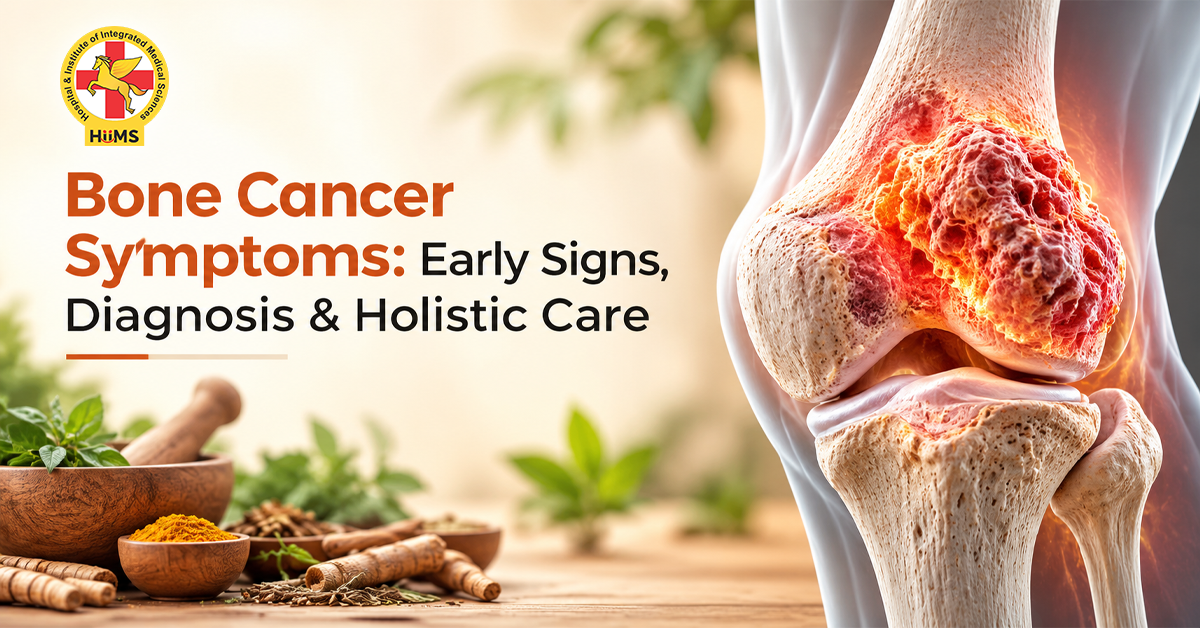
Pain in a bone does not simply mean cancer. A sports injury, arthritis, muscle strain, or even an old injury can cause similar discomfort. The issue starts when pain keeps returning, gets worse without a clear reason, appears at night, or comes with swelling or a lump.
Bone cancer remains uncommon, but knowing the symptoms of bone cancer can help you recognise unusual changes and seek healthcare advice at the right time.
In this blog, we’ll look at the early signs, how bone cancer pain can differ from everyday aches, who may face a higher risk, how doctors confirm a diagnosis, and where an integrative approach may fit alongside cancer care.
What Is Bone Cancer and Why Do Its Symptoms Matter?
Bone cancer develops when abnormal cells begin growing in the bone and form a malignant tumour. It is broadly divided into primary bone cancer, which starts in the bone itself, and secondary bone cancer, which develops when cancer from another part of the body spreads to the bones. Osteosarcoma, Ewing sarcoma, and chondrosarcoma are common types of primary bone cancer.
Primary bone cancers account for about 0.2% of all cancers. SEER data reports around 1.1 new cases per 100,000 people each year in the United States, with an overall 5-year relative survival rate of approximately 68.7%. Bone cancer is uncommon, but persistent or unusual changes in the body should still be checked rather than ignored.
It also helps to understand the difference between a symptom and a sign. Pain is something you feel, while swelling or a lump is something a doctor may notice during an examination.
At Jeena Sikho HiiMS, doctors look at the person’s overall health, symptoms, medical history, and lifestyle. For diagnosed cancer patients, Ayurveda, Naturopathy, Homeopathy, and other AYUSH-based approaches may be included as part of an integrative care plan alongside appropriate oncology treatment.
Note: This blog provides general information and cannot diagnose bone cancer. Persistent or unexplained symptoms should always be evaluated by a qualified healthcare professional.
Key Symptoms of Bone Cancer You Should Not Ignore
The symptoms of bone cancer are not always the same for everyone. Some people first notice pain that does not seem to go away, while others see swelling, stiffness, or a change in how easily they can move a limb. In some cases, the problem only comes to attention after a bone breaks following a minor injury.
These signs do not automatically mean cancer. Many everyday conditions can cause similar problems. What is important is when a symptom stays around, gradually gets worse, or does not have an obvious explanation.
1. Bone Pain That Does Not Settle
Pain is one of the most common early signs of primary bone cancer. It may begin as a mild, dull ache and slowly become harder to ignore. At first, you might notice it after exercise or movement, but over time it can also appear while resting or during the night.
This is one reason bone cancer can be easy to overlook, especially in teenagers and young adults who play sports. Pain around the knee, for instance, may seem like a simple sports injury. Aches and strains are common, but pain that continues for several weeks, keeps returning, or becomes more intense deserves a closer look.
2. Swelling or a Lump Near the Bone
Some bone tumours cause swelling around the affected area. You may notice that one part of an arm or leg looks different, or you may feel a lump below the skin.
The area can sometimes feel tender or warm, and swelling near a joint may make the limb feel stiff or heavy.
There are many reasons for a lump or swelling, and most do not mean cancer. Still, a lump that feels firm, continues to grow, or appears without a clear cause should be checked by a doctor.
3. Stiffness or Trouble Moving
A tumour growing close to a joint can make ordinary movements uncomfortable or difficult.
You might struggle to bend your knee fully, raise your arm, walk normally, or use the affected limb as you usually do. As pain and stiffness increase, even simple daily activities may start to feel different.
If the stiffness has no clear connection with an injury and does not improve with time, it is worth getting it assessed rather than continuing to work around it.
4. A Fracture After a Minor Injury
A bone affected by a tumour can become weaker than normal. In some cases, this can result in a pathological fracture, where the bone breaks after a relatively small amount of force.
A fracture after a simple stumble or an activity that would normally not cause such an injury needs proper medical attention. It does not mean cancer is the cause, but doctors should investigate why the bone became vulnerable.
5. Unusual Tiredness and Other General Symptoms
Some people with bone cancer may experience ongoing tiredness, particularly when the disease has progressed. Fever, night sweats, anaemia, reduced appetite, or other changes in general health can sometimes occur as well.
These symptoms are much more common in many other conditions, so they cannot point to bone cancer on their own. Doctors consider them alongside the person’s pain, examination findings, medical history, and test results.
If you notice several of these changes together, or one symptom continues without a clear reason, it is better to have it evaluated than to keep guessing about the cause.
For a closer look at the symptoms of bone cancer, you can also read our blog on how to identify bone cancer symptoms at an early stage.
Bone Cancer Symptoms vs Common Bone and Joint Problems
One reason bone cancer can take time to diagnose is that its early symptoms may resemble everyday musculoskeletal problems.
A teenager may assume persistent knee pain comes from sports. An older adult may think hip or back pain is simply arthritis. Children may describe certain aches as growing pains.
The difference often lies in the pattern, duration, and progression of the symptoms.
| Feature | Common Injury / Arthritis | Bone Cancer |
| Response to rest | Often improves | May continue or worsen |
| Night pain | Less typical | Can occur |
| Duration | Often settles over days or weeks | May continue for weeks or months |
| Swelling | May follow an injury | Can appear as a firm or growing lump |
| Pain medicines | May provide noticeable relief | Relief may be incomplete |
These differences do not provide a diagnosis by themselves. They simply explain why persistent or unusual symptoms deserve closer attention.
In Teenagers and Young Adults
Osteosarcoma often affects the long bones around the knee. A young person who plays sports may naturally connect knee pain with training or an injury.
However, pain that continues despite rest, keeps returning at night, or gradually becomes more troublesome needs assessment rather than repeated self-treatment.
In Adults
Chondrosarcoma often develops in older adults and can affect areas such as the pelvis, thigh, or shoulder. Its symptoms may develop slowly, which can make them easier to dismiss.
A persistent ache that gradually changes, especially when accompanied by swelling or a palpable mass, deserves a healthcare evaluation.
Warning Signs That Need Healthcare Attention
Speak with a healthcare professional if you notice:
- Bone or joint pain that continues for more than 3–4 weeks without a clear explanation
- A firm or growing lump over a bone
- An unexplained fracture or fracture after minor trauma
- Persistent back or pelvic pain that becomes worse at night
- Ongoing swelling that does not settle
Research has also highlighted how easily some bone cancers can initially resemble other conditions. A Swedish cohort study involving Ewing sarcoma of the ribs found that 21 of 26 patients had initially received another diagnosis, often involving chest infections. The median doctor’s delay was three months, and some cases experienced delays of more than seven months.
The lesson is not to assume that every persistent pain represents cancer. It is to avoid ignoring symptoms that continue, change, or fail to follow the usual recovery pattern.
At Jeena Sikho HiiMS, doctors consider the patient’s history, pain pattern, physical findings, and functional changes before deciding whether further investigation or specialist referral is appropriate.
How Symptoms Differ by Type of Primary Bone Cancer
Bone cancer does not look exactly the same in every person. The type of tumour, its location, and the person’s age can all change the symptoms. Here are some of the more common patterns.
Osteosarcoma
Osteosarcoma is the most common primary bone cancer and often develops near the knee or upper arm. It occurs more frequently in teenagers and young adults. Persistent pain, swelling, limping, and difficulty moving a nearby joint are common signs, and the pain may initially seem like a sports injury.
Ewing Sarcoma
Ewing sarcoma mainly affects children, teenagers, and young adults. It can develop in the long bones, pelvis, or ribs. Pain and swelling are common, while fever may sometimes make it look like an infection. Because this cancer can progress quickly, symptoms that do not settle need proper evaluation.
Chondrosarcoma
Chondrosarcoma is more common in adults over 40 and often affects the pelvis, thigh, or shoulder. The pain may start off occasionally and become more persistent. Stiffness or a gradually growing lump can also appear. Early cases have a reported 5-year survival rate of approximately 79%, although the outlook varies by tumour type, grade, location, and stage.
Chordoma
Chordoma is rare and usually develops near the base of the spine or skull. Symptoms depend on its location and may include back pain, numbness, weakness, difficulty walking, or bowel and bladder changes when nearby nerves are affected.
Secondary Bone Cancer
Secondary bone cancer occurs when cancer from another part of the body spreads to the bones. Breast, prostate, lung, kidney, and thyroid cancers can spread in this way. Pain in several bones, repeated fractures, and symptoms linked with high calcium levels, such as thirst, nausea, or confusion, may occur.
Multiple myeloma is a blood cancer rather than a primary bone cancer, but it can also affect the bones and cause pain, fractures, and fatigue.
Who Has a Higher Risk of Bone Cancer?
There is no single known cause behind most cases of bone cancer. However, certain inherited conditions, previous treatments, and bone-related conditions can make the risk higher.
Genetic Conditions
Some inherited conditions are linked with a greater chance of developing bone tumours. These include Li-Fraumeni syndrome, which involves changes in the TP53 gene, hereditary retinoblastoma linked to the RB1 gene, and multiple exostoses.
Having one of these conditions does not mean a person will develop bone cancer, but it can be important information when doctors assess their overall health and family history.
Previous Radiation Therapy
People who have received high doses of radiation, particularly as part of earlier cancer treatment, may have a higher chance of developing a bone sarcoma later in life. These tumours can appear years after the original treatment, with reported intervals often ranging from about 5 to 20 years.
Paget’s Disease of Bone
Paget’s disease affects the normal process of bone formation and breakdown. In a small number of cases, particularly among older adults, it can be linked with osteosarcoma.
Rapid Bone Growth
Osteosarcoma occurs more often during the teenage years, when bones grow rapidly. Researchers have studied this connection, although normal growth does not mean that a young person will develop bone cancer. Certain chemotherapy medicines have also been studied as possible risk factors.
What About Lifestyle and Environmental Factors?
Researchers continue to study environmental factors linked with bone cancer. Unlike some other cancers, however, most primary bone cancers do not have a clear lifestyle-related cause.
Having one or more risk factors does not mean a person will develop bone cancer. Many people diagnosed with bone cancer have no known family history or obvious risk factor.
For more information, see our detailed blog on what causes bone cancer and its risk factors.
How Do Doctors Diagnose Bone Cancer?
Noticing the symptoms of bone cancer is only the beginning. These symptoms can occur with many other conditions, so doctors need proper tests to understand what is causing them.
The process usually starts with your medical history and physical examination, followed by imaging tests and, when necessary, a biopsy.
Medical History and Examination
Your doctor may ask when the pain started, whether it is getting worse, and whether it changes with activity or rest. Swelling, stiffness, movement problems, previous illnesses, and family history can also help complete the picture.
Imaging Tests
An X-ray is often one of the first tests used to look at a suspicious area of bone. If doctors need a closer view, they may recommend a CT scan or MRI.
CT scans provide detailed images of the bone and can also help doctors check the chest for possible spread. MRI gives a clearer view of the bone marrow and nearby soft tissues. Depending on the situation, a bone scan or PET-CT may also be used.
Biopsy
Scans can show an abnormal area, but they cannot always tell whether it is cancer. A biopsy involves taking a small tissue sample and examining it under a microscope.
This helps doctors identify the type and grade of tumour and, in some cases, specific genetic changes. For example, Ewing sarcoma may show an EWSR1 rearrangement.
Blood Tests and Staging
Blood tests may provide additional information, including changes in haemoglobin, calcium, or alkaline phosphatase levels.
If cancer is confirmed, doctors then determine its stage by looking at the tumour’s size, grade, location, and whether it has spread to the lungs or other parts of the body. This information helps the medical team decide on the most suitable treatment approach.
A cancer diagnosis can feel overwhelming, especially while waiting for reports and planning the next step. At Jeena Sikho HiiMS, counselling, virtual consultations, and family guidance can form part of the wider care journey.
Is Bone Cancer Curable?
This is one of the first questions many people ask after reading about the symptoms of bone cancer.
There is no single answer because the outcome depends on the type of cancer, its grade, location, stage, overall health, and whether the disease has spread.
Some localised primary bone cancers, particularly when doctors detect them before they spread, can be treated with curative intent. Advanced disease can be more difficult to manage.
The treatment plan may include one or more of the following approaches.
Surgery
Surgery is designed to remove the tumour along with an appropriate margin of surrounding tissue.
Modern surgical techniques allow doctors to preserve the affected limb in many cases. However, the exact procedure depends on the tumour’s location, size, involvement of nearby structures, and other clinical factors.
In some advanced situations, amputation may be necessary.
Chemotherapy
Chemotherapy plays an important role in treating certain bone cancers, particularly osteosarcoma and Ewing sarcoma.
Doctors may use medicines before surgery, after surgery, or at other stages depending on the treatment plan. The goal is to address cancer cells that surgery alone may not remove.
Radiation Therapy
Radiation therapy uses high-energy radiation to target cancer cells.
Doctors may use it for certain tumours, including Ewing sarcoma, or when surgery cannot safely remove the tumour. It may also have a role in managing pain in advanced disease.
What Do Survival Numbers Mean?
SEER data reports an overall 5-year relative survival rate of approximately 68.7% for bone and joint cancers. However, a single survival figure cannot predict what will happen to an individual patient.
A localised cancer can have a very different perspective from cancer that has spread to the lungs or several bones. Tumour type also makes a major difference.
Where Can Ayurveda and Integrative Care Fit Into Bone Cancer Care?
Cancer treatment can place considerable demands on the body and mind. Alongside the primary cancer treatment recommended by an oncology team, some patients explore Ayurveda and other traditional systems to help them manage their overall wellbeing.
At Jeena Sikho HiiMS, an integrative approach may include Ayurveda, Naturopathy, Homeopathy, yoga, pranayama, meditation, nutrition guidance, and selected therapies based on the individual’s condition.
Disclaimer: The role of these approaches should remain complementary. They should not replace surgery, chemotherapy, radiation therapy, or other cancer treatment when those treatments are medically indicated.
Ayurveda and Personalised Care
Ayurveda traditionally looks at food, daily routine, digestion, sleep, activity, and the individual’s overall body type rather than focusing only on one symptom.
For a person undergoing cancer treatment, an Ayurvedic practitioner may consider these factors while coordinating care with the medical team.
Dietary guidance can also be adjusted according to appetite, digestion, treatment schedule, and nutritional needs.
Yoga, Pranayama and Meditation
Gentle yoga and breathing practices may form part of a person’s wellbeing routine when their medical team considers them appropriate.
Meditation and relaxation practices can also help patients create a calmer daily routine during a period that may involve repeated tests, hospital visits, and treatment sessions.
The intensity of any physical practice should always match the person’s current strength and medical condition.
Panchakarma and Cancer Care
Panchakarma is a traditional Ayurvedic therapeutic approach. However, cancer patients should not undertake Panchakarma or intensive cleansing procedures on their own.
A qualified practitioner should first review the patient’s diagnosis, treatment stage, medications, strength, nutritional status, and other health factors. Any Ayurvedic therapy should also be coordinated with the treating oncology team.
Looking for personalised Ayurvedic and integrative care? Talk to an expert and explore your options with HiiMS.
Everyday Steps That Help You Pay Attention to Bone Health
There is no guaranteed method for preventing primary bone cancer. Still, you can take sensible steps to maintain general health and bone strength. Like:
- A balanced diet can provide important nutrients such as calcium and vitamin D.
- Regular weight-bearing activity can help maintain bone strength when your physical condition allows it.
- Avoiding tobacco and limiting alcohol can also contribute to better overall health.
- Most importantly, do not ignore a symptom simply because it seems small.
If pain continues for several weeks, a swelling grows, movement becomes difficult, or a fracture occurs after minor trauma, arrange an appropriate medical evaluation.
When Should You Speak With a Doctor?
Not every ache needs an urgent cancer evaluation. At the same time, persistent symptoms deserve more than repeated self-treatment.
Consider speaking with a healthcare professional if you experience:
- Bone or joint pain that continues beyond 3–4 weeks
- Pain that keeps getting worse without an obvious cause
- Pain that repeatedly wakes you at night
- A firm or growing swelling over a bone
- Unexplained difficulty moving a joint or limb
- A fracture following a minor injury
- Persistent back or pelvic pain
- Ongoing fatigue or other unexplained changes in general health
These signs do not mean you have bone cancer. They simply indicate that a professional should assess the situation instead of leaving the cause uncertain.
How Jeena Sikho HiiMS Approaches Cancer Care
At Jeena Sikho HiiMS, cancer care follows an integrative approach that looks beyond the tumour alone.
The team may consider the patient’s diagnosis, treatment history, nutrition, digestion, daily routine, physical strength, emotional wellbeing, and other individual factors when planning supportive care.
Depending on the person’s condition, the approach may include Ayurveda, naturopathy, homoeopathy, nutrition guidance, yoga, meditation, and selected traditional therapies (such as Panchakarma, golden therapy, cancer detox juice, autophagy) alongside appropriate medical oncology care.
- Panchakarma: A traditional Ayurvedic approach that uses a planned combination of therapies based on a person’s individual condition and strength.
- Golden Therapy: A traditional Ayurvedic therapy prepared using herbs and plant ingredients such as neem, peepal, banyan leaves, raw turmeric, scutch grass, etc.
- Cancer Detox Juice: A specially prepared herbal juice included in the HiiMS integrative approach according to the person’s individual care plan.
- Autophagy: A natural cellular process through which the body breaks down and recycles older or damaged cell components.
All these should always be done under an expert’s supervision.
For patients who cannot travel easily, virtual consultations can also make it easier to discuss reports, symptoms, and the next steps with experienced doctors.
The basic idea is simple: cancer care should remain personalised, coordinated, and based on the person’s actual condition.
Conclusion
The symptoms of bone cancer can look surprisingly similar to common injuries, arthritis, or other everyday bone and joint problems. That is why the pattern is so important. Pain that continues for weeks, becomes worse at night, appears without a clear injury, or comes with swelling or an unexplained fracture deserves proper medical attention.
Bone cancer remains uncommon, and having one of these symptoms does not mean that you have cancer. Only a proper clinical evaluation, imaging, and, when required, a biopsy can provide an accurate diagnosis.
If you are concerned about persistent bone pain, swelling, movement changes, or an existing cancer diagnosis, speak with an experienced doctor rather than relying on self-diagnosis.
Looking for guidance about your bone health or cancer care? Connect with experienced doctors at Jeena Sikho HiiMS through a VOPD consultation. Share your symptoms, medical reports, and treatment history so the team can understand your condition and guide you towards the next appropriate step with an integrative approach to care.
FAQs
- What is the most common symptom of bone cancer?
Persistent bone pain is one of the most common symptoms of primary bone cancer. The pain may gradually become more noticeable, continue during rest, or become worse at night. Swelling or a lump can also appear near the affected bone. - How can bone cancer pain differ from normal joint pain?
Bone cancer pain may continue for weeks, gradually become more intense, or occur during rest and at night. Common injuries often improve as the affected area heals. However, pain patterns alone cannot confirm cancer, so persistent symptoms need professional assessment. - Can a lump on a bone mean cancer?
A lump does not necessarily mean cancer because several non-cancerous conditions can cause swelling or a mass. A firm, growing, unexplained lump over a bone should still be examined by a qualified healthcare professional. - How do doctors confirm bone cancer?
Doctors usually combine a physical examination with imaging such as X-ray, CT, or MRI. If an abnormal area requires further investigation, a biopsy allows specialists to examine tissue and establish the tumour type and grade. - Can Ayurveda be used during bone cancer treatment?
Ayurveda may form part of an integrative care plan for selected patients, but it should not replace medically indicated cancer treatment. Ayurvedic therapies, herbs, diet, and other practices should be planned by qualified practitioners and coordinated with the patient’s oncology team.