
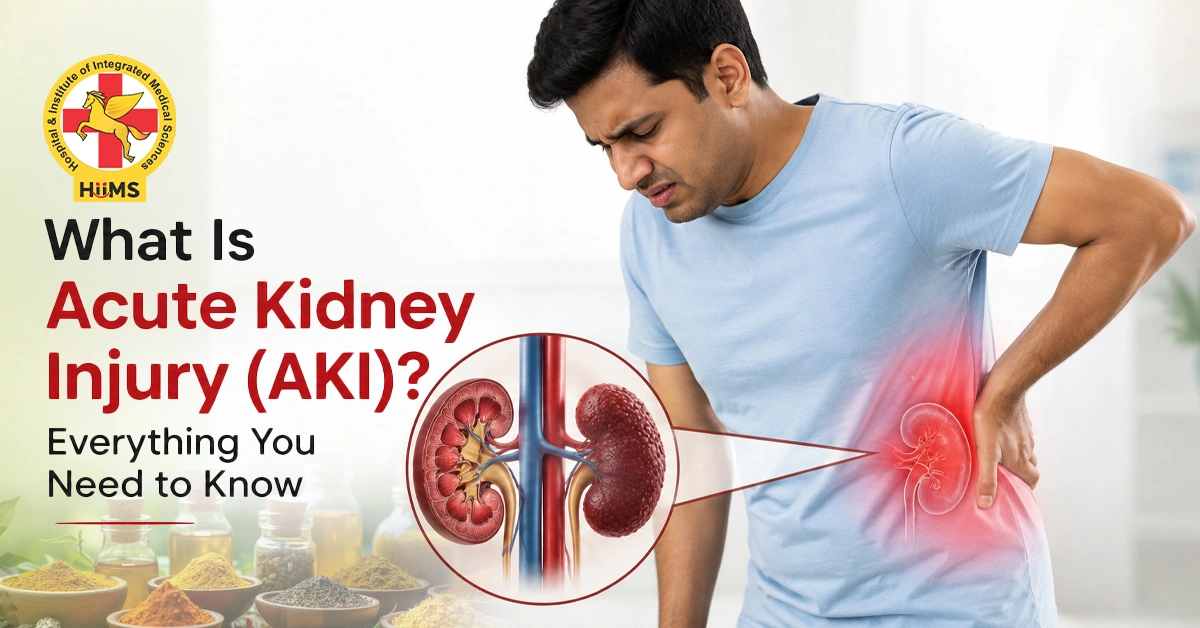

The kidneys work in the background through their role in cleaning the blood and ensuring balance between fluids and important minerals. Occasionally, kidney function may be impaired in a matter of hours or days. This state is called acute kidney injury (AKI).
What distinguishes acute kidney injury from chronic kidney disease is the rapid development of the former, which at times improves once the reason for the problem is recognised. Nonetheless, this does not imply that AKI is an unimportant state. AKI may become severe, especially once the production of urine is reduced and toxic substances and excess fluid accumulate in the body.
Understanding acute kidney injury symptoms, causes, and available medical care can help a person recognise the condition earlier. In this blog, we will look at what AKI means, why it happens, its common signs, how doctors diagnose it, and what acute kidney injury treatment may involve.
What Is Acute Kidney Injury?
Acute kidney injury is a sudden decrease in kidney function. It was previously known as acute renal failure. In the case of AKI, the kidney may fail to remove wastes and extra fluids from the blood like it usually does. Such a process can be associated with the alteration of creatinine levels, decreased production of urine, and disruption of electrolyte balance.
AKI can develop in someone who previously had healthy kidneys, but it can also occur in a person who already has chronic kidney disease. Sometimes, the condition of the kidneys improves after dealing with the cause of the problem. However, there may be situations when full recovery cannot take place, particularly when the damage done to the organ is beyond repair. This is why sudden changes in kidney function deserve medical attention rather than being managed only with home remedies.
What Causes Acute Kidney Injury?
There are many possible acute kidney injury causes. Doctors generally group them into three broad categories: problems before the kidneys, problems within the kidneys, and blockage after the kidneys.
- Reduced Blood Flow to the Kidneys
The kidneys need a steady blood supply to filter waste properly. A major loss of fluids from severe vomiting, diarrhea, or bleeding can reduce blood flow to the kidneys.
Very low blood pressure, severe infections, and certain heart-related problems can also reduce kidney perfusion and contribute to AKI.
- Direct Injury to the Kidneys
Sometimes the kidney tissue itself becomes damaged. Severe infections, prolonged lack of blood flow and certain medicines or toxic substances can injure kidney structures.
Some medicines, including certain pain relievers and other drugs, may contribute to kidney injury in particular situations. This is one reason medicines should be taken according to professional advice, especially when a person already has kidney problems.
- Blockage of Urine Flow
Urine needs to pass freely from the kidneys through the urinary tract. A blockage can interfere with this process and cause pressure to build up in the urinary system.
Kidney stones, enlarged prostate, blood clots, tumors, and other conditions can sometimes obstruct urine flow and contribute to AKI.
Who May Be More at Risk of AKI?
A patient can get AKI at any time, although some factors might put one at a higher risk. Those individuals that are critically ill, have an infection, low blood pressure, heart problems or renal problems are more likely to suffer from AKI.
In addition, someone who has pre-existing kidney problems, diabetes, heart problems or any other health complications is likely to be at a higher risk. Some drugs and certain substances used in the diagnosis and treatment of some health conditions can also have an effect on the risk factor.
Other risk factors for AKI include age, dehydration, and previous kidney problems.
What Are the Symptoms of Acute Kidney Injury?
It is worth noting that AKI does not necessarily present with evident symptoms initially. There have been cases where the change in kidney function has been detected through laboratory tests or decreased urine output.
The following are the common signs and acute kidney injury symptoms:
- Production of significantly less urine than normal
- Swelling of the feet, ankles, or face
- Weakness or tiredness
- Nausea or vomiting
- Difficulty breathing as a result of fluid accumulation in lungs
- Dizziness or confusion
- Change in blood pressure
- Fluid retention
There have been instances where the patient does not exhibit any apparent symptoms, hence the need for laboratory testing in case of suspicion of acute kidney injury.
A sharp drop in urine production should never be ignored especially when accompanied by symptoms like swelling, difficulty breathing, dizziness, or weakness.
How Is Acute Kidney Injury Diagnosed?
There is no single symptom that confirms AKI. Doctors usually combine the person’s medical history, physical examination, urine output, and laboratory investigations.
A blood test that measures serum creatinine is typically employed to examine variations in kidney functionality. A urine test can also give valuable data regarding the activities taking place in the kidneys. Based on the suspected cause, an ultrasound or another imaging test is required to determine whether there is urinary obstruction.
Physicians also consider any prior illnesses, dehydration, variations in blood pressure, medications, and other factors that could have been responsible. Determination of the cause is critical when making decisions about further steps.
How Is Acute Kidney Injury Treated?
There is no single acute kidney injury treatment that works for every patient. Treatment depends mainly on what caused the kidney injury and how severely kidney function has been affected.
If dehydration or significant fluid loss is responsible, medical professionals may carefully restore fluids when appropriate. If a medicine is contributing to the injury, the doctor may review or adjust it. When an infection is involved, treatment is directed towards the infection.
If a urinary blockage is responsible, the obstruction may need to be relieved. In more serious cases, particularly when dangerous electrolyte changes, severe fluid overload or other complications develop, temporary dialysis may be required while the kidneys recover.
The important point is that treatment is aimed at the underlying cause as well as the kidney injury itself.
Can AKI Be Reversed?
Recovery from AKI is possible for some individuals but not everyone. AKI recovery depends upon identifying and managing the cause early enough.
There are some who will recover completely to their pre-AKI levels of renal function, and then there are those who will still have residual loss of renal function. In addition, severe or recurrent episodes of AKI could lead to complications with kidneys in the future.
AKI recovery may take days, weeks, or even longer. Hence, further tests to check renal function may be necessary even after the patient feels fine.
What Can You Do to Support Kidney Health After AKI?
After AKI, it becomes necessary to protect one’s kidneys from harm. Some simple actions that will help in preserving kidney health include the following:
- Maintain proper hydration: While staying hydrated is essential, people who have to limit their fluid intake should adhere to what their doctor suggests instead of drinking more water.
- Use medications wisely: Do not use, discontinue, or alter the dose of your medications without consulting your physician, as some commonly prescribed medications can influence your kidney’s performance in certain situations.
- Schedule follow-up visits: One’s kidney function can be tested via blood and urine tests after AKI.
- Control your current health issues: High blood pressure, diabetes, and cardiovascular issues can impact kidney health.
- Avoid taking additional supplements: While herbal and nutritional supplements do not have to be harmful just because they are natural, one should always consult his or her healthcare provider before using any of them.
Can Ayurveda Support Kidney Wellness After AKI?
Ayurveda looks at overall well-being through factors such as Aahar (food), Vihar (lifestyle), digestion, and individual constitution. After an episode of AKI, these areas can be considered as part of a broader wellness plan, but only after proper medical evaluation.
At Jeena Sikho HiiMS Derabassi , kidney care includes an integrated approach that combines Ayurvedic principles, diet, and natural therapies. One of the approaches associated with HiiMS is the GRAD System, which brings together diet and supervised therapeutic practices.
The GRAD system includes the following:
- Head Down Tilt Therapy (HDT): A supervised positioning-based therapy in which the body is placed on an inclined surface with the head positioned lower than the feet.
- Hot Water Immersion (HWI): A therapy involving immersion in warm water. HiiMS describes it as part of its natural therapy approach for circulation and overall wellness.
- pH-Balanced Diet: It focuses on whole foods, structured eating, and mindful food choices.
- Zero Volt Therapy: HiiMS also offers Zero Volt Therapy as part of its broader natural wellness protocols. It is presented as a grounding-based practice within the HiiMS approach.
For those who have completed their medical evaluation and wish to go for the Ayurvedic way of living for good kidney health, Jeena Sikho HiiMS Derabassi could be able to provide them with personalised guidance. Whether GRAD is the appropriate treatment or not should be decided on the basis of the individual’s health status.
When Should You Seek Medical Help?
AKI can worsen without producing dramatic symptoms at first. Seek medical attention if there is a sudden reduction in urine output, new swelling, breathing difficulty, severe weakness, persistent vomiting, confusion, or other sudden changes in health.
People who are already dealing with kidney disease or other serious health conditions should be particularly careful about sudden changes.
It is better to have an unexpected change in kidney function checked early than to wait for symptoms to become severe.
Acute Kidney Injury vs. Chronic Kidney Disease
AKI and chronic kidney disease are not the same thing.
Acute Kidney Injury (AKI): The sudden development of the disease within hours or days, which is possibly reversible based on the causative factor and its degree.
Chronic Kidney Disease: A slowly developing disorder that has persistent changes or lowered function of the kidneys for several months or more.
It is still possible to link the conditions because a person suffering from CKD can have an episode of AKI, and repetitive cases of AKI can lead to a chronic condition.
Conclusion
Acute kidney injury is a sudden decline in kidney function that can develop because of dehydration, low blood pressure, severe illness, medicines, direct kidney damage, or urinary blockage. The condition can sometimes improve when its cause is identified and managed early, but serious cases may require hospital-based care or temporary dialysis.
It is useful to know the acute kidney injury symptoms, as they may prove beneficial in getting prompt medical attention. In case you are having AKI or experiencing any repeated problems related to kidneys, follow-up care, medications, a healthy diet, and correct advice become essential. You could try Ayurveda as a complementary therapy for overall health issues; however, you must not ignore medical diagnosis and treatment. To get personalized advice about Ayurveda, you can contact Jeena Sikho HiiMS Derabassi using VOPD consultations.
FAQs
1. What is acute kidney injury?
Acute kidney injury is the fast reduction in the function of kidneys over a brief period. This could interfere with waste removal from the body and fluid and electrolyte balance maintenance.
2. What are the causes of acute kidney injury?
Common causes include dehydration or massive blood loss, low blood pressure, severe infections, certain medications, direct injury to the kidneys, and blockage of the flow of urine.
3. What are the symptoms of AKI?
They include low urine output, swelling, fatigue, nausea, vomiting, difficulty breathing, and mental confusion. Some individuals might not have any obvious signs, with the disorder being found during blood tests.
4. Is there treatment for acute kidney injury?
There is treatment for the disorder, which is dependent on the causative factor. Medication to treat dehydration, infections, drug-induced problems or urinary obstruction will be considered. Extreme cases might need temporary dialysis.
5. Is a patient able to recover from AKI?
It is possible to recover full kidney function or have incomplete recovery depending on the individual circumstances.