

Migraine isn’t “just a bad headache,” even though it gets called that all the time. Basically, it’s a neurological condition that your brain reacts way more strongly than it should to things like stress, certain foods, bright light, or hormone changes, and the result is intense, usually one-sided throbbing pain, nausea, vomiting, and a kind of sensitivity to light and sound that makes you want to disappear into a dark room. An attack can last a few hours or drag on for three days. And for most people, it’s not a one-time thing — it comes back, again and again, sometimes for years. The good news? Once you start figuring out what triggers your problem, real migraine relief actually becomes possible.
Key Takeaways:
- Migraine is a neurological condition, not just a severe headache.
- Migraine symptoms often include a throbbing headache, nausea, vomiting, and sensitivity to light and sound.
- Stress, sleep disturbances, hormonal changes, and dehydration are common triggers.
- Identifying your triggers and following healthy lifestyle habits may help manage migraine episodes.
- Ayurveda focuses on holistic wellness — dietary guidance, lifestyle modifications, and individualised care.
Table of Contents
What is Migraine?
Anyone who’s actually had one knows the difference instantly. A normal headache, you can push through. A migraine, you can’t do that, in that you end up cancelling plans, lying down in the dark, sometimes for hours.
Medical Definition of Migraine
In medical terms, migraine is classified as a neurological disorder, which basically means it originates in how your brain and nerves are functioning, not just in muscle tension or stress like a typical headache. There’s a temporary change in brain chemicals and how blood vessels in and around the brain behave, and that shift is what triggers the pain along with everything that is associated along with it such as nausea, light sensitivity, sometimes visual disturbances. It’s this nervous-system overreaction that sets migraine apart from a “regular” headache.
How Does Ayurveda View Migraine?
In Ayurveda, migraine-like headaches are often described as Ardhavabhedaka, which means “splitting pain on one side of the head”.
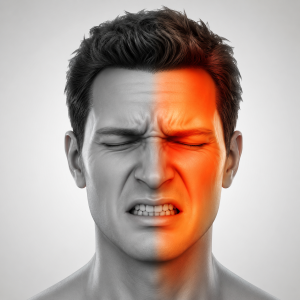
Ayurveda explains that this condition may develop when Vata and Kapha doshas become imbalanced. Factors such as irregular meals, poor sleep, stress, overwork, and weak digestion are traditionally believed to disturb this balance. As digestion weakens, Ama (metabolic waste) may accumulate and affect the body’s natural channels (Srotas), eventually contributing to Ardhavabhedaka.
Instead of focusing only on the headache, Ayurveda looks at overall health, including diet, daily routine, sleep, digestion, and body constitution (Prakriti). Based on this assessment, an Ayurvedic practitioner may recommend personalised dietary guidance, lifestyle changes, herbal preparations, or suitable Panchakarma therapies.
How Migraine Affects Daily Life
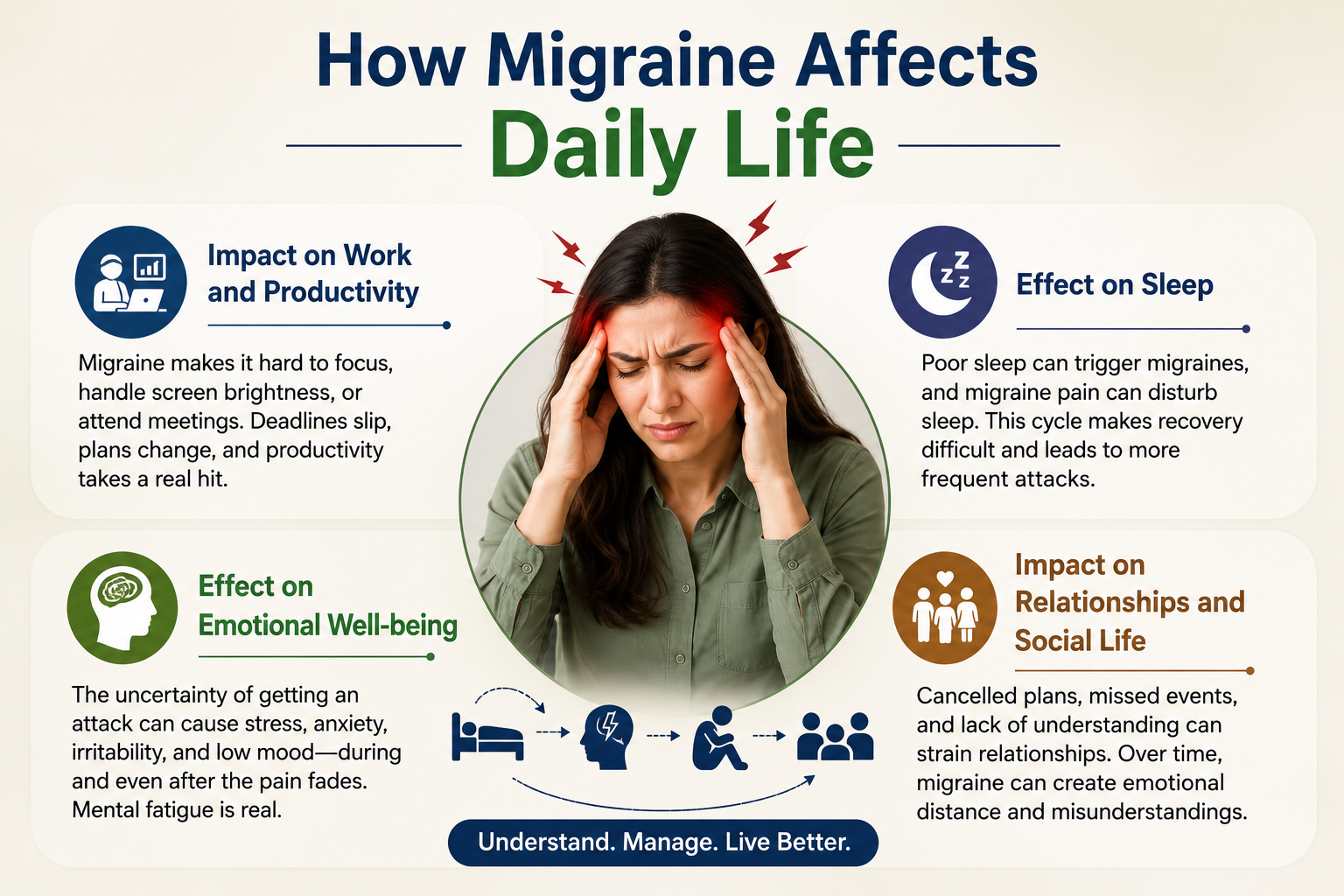
This is the part that doesn’t always get talked about enough — migraine doesn’t just cause discomfort, it disrupts everything around it.
Impact on Work and Productivity
Try concentrating on a spreadsheet or a client call while your head is throbbing and your eyes can’t handle the screen brightness. Most people simply can’t. Deadlines slip, meetings get missed, and for anyone with frequent attacks, this adds up to a real, recurring cost at work.
Effect on Sleep
Poor sleep can trigger a migraine, and then the pain itself keeps you from sleeping properly, which can set up another attack. Breaking this cycle is honestly one of the more underrated parts of managing migraine long-term.
Effect on Emotional Well-being
Living with the uncertainty of “will I get an attack today” is mentally tiring on its own. Many people describe feeling low, irritable, or anxious — both during an occurrence and in the hours after, once the pain has technically passed but the mental fog hasn’t quite lifted.
Impact on Relationships and Social Life
Cancelled dinners. Missed birthdays. Family members who don’t always understand why you suddenly need to lie down in a dark room. Over time, frequent migraine can quietly put a burden on relationships, simply because the people around you don’t always see what you’re dealing with.
Types of Migraine
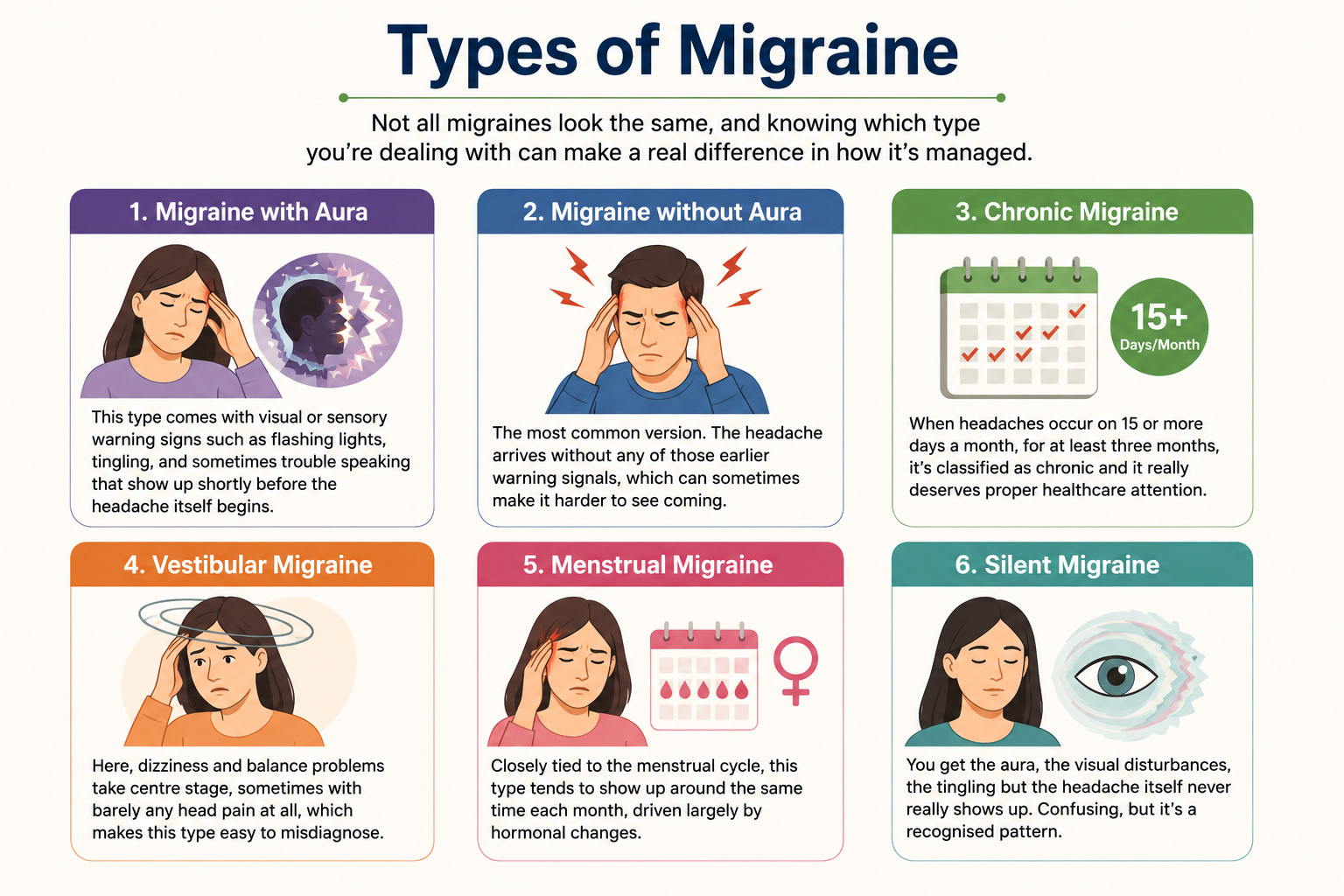
Not all migraines look the same, and knowing which type you’re dealing with can make a real difference in how it’s managed.
Migraine with Aura
This type comes with visual or sensory warning signs such as flashing lights, tingling, and sometimes trouble speaking that show up shortly before the headache itself begins.
Migraine without Aura
The most common version. The headache arrives without any of those earlier warning signals, which can sometimes make it harder to see coming.
Chronic Migraine
When headaches occur on 15 or more days a month, for at least three months, it’s classified as chronic and at this point, it really deserves proper healthcare attention rather than just home remedies.
Vestibular Migraine
Here, dizziness and balance problems take centre stage, sometimes with barely any head pain at all, which makes this type easy to misdiagnose.
Menstrual Migraine
Closely tied to the menstrual cycle, this type tends to show up around the same time each month, driven largely by hormonal changes.
Silent Migraine
You get the aura, the visual disturbances, the tingling but the headache itself never really shows up. Confusing, but it’s a recognised pattern.
What are the Symptoms of Migraine?
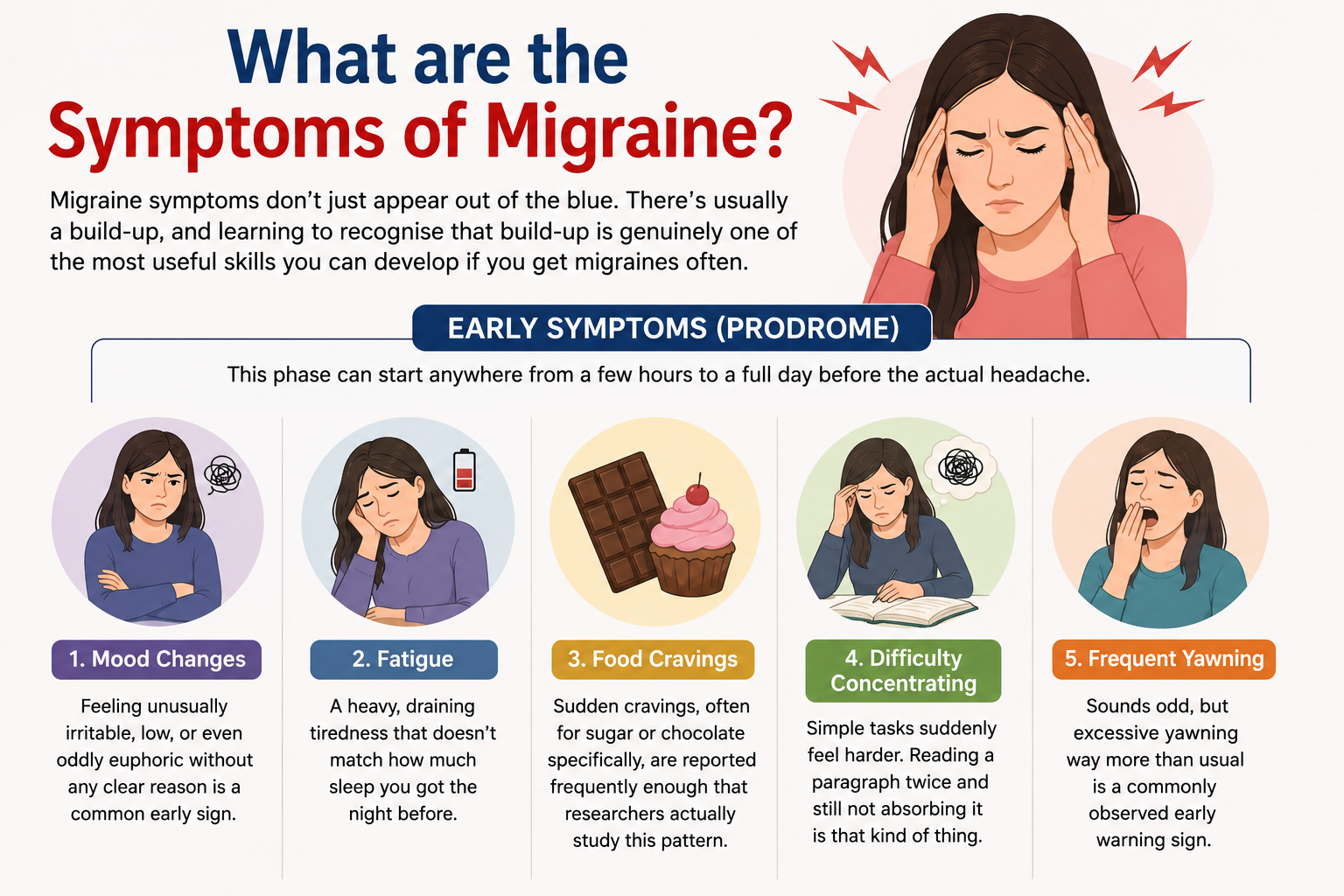
Migraine symptoms don’t just appear out of the blue. There’s usually a build-up, and learning to recognise that build-up is genuinely one of the most useful skills you can develop if you get migraines often.
Early Symptoms (Prodrome)
This phase can start anywhere from a few hours to a full day before the actual headache.
Mood Changes
Feeling unusually irritable, low, or even oddly euphoric without any clear reason is a common early sign.
Fatigue
A heavy, draining tiredness that doesn’t match how much sleep you got the night before.
Food Cravings
Sudden cravings, often for sugar or chocolate specifically, are reported frequently enough that researchers actually study this pattern.
Difficulty Concentrating
Simple tasks suddenly feel harder. Reading a paragraph twice and still not absorbing it is that kind of thing.
Frequent Yawning
Sounds odd, but excessive yawning way more than usual is a commonly observed early warning sign for many people.
Common Migraine Symptoms
Once the Migraine Attack actually sets in, here’s what most people experience:
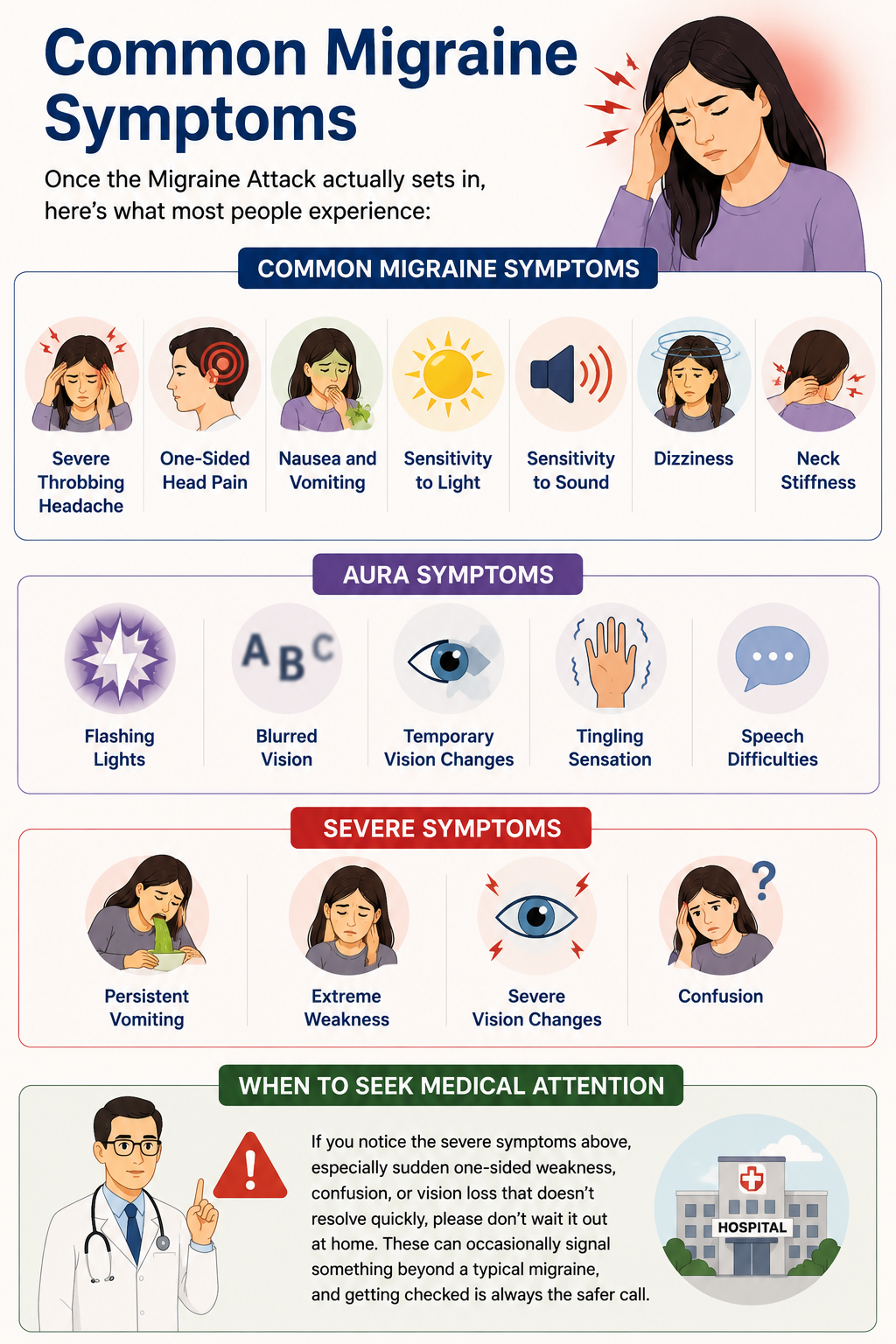
Severe Throbbing Headache
A deep, pulsing pain that often gets worse with movement, bending down, or even coughing.
One-Sided Head Pain
Most migraines (though not all) concentrate on just one side of the head.
Nausea and Vomiting
Common enough that anti-nausea medication is often part of standard migraine treatment.
Sensitivity to Light
Even regular daylight or a phone screen can feel unbearably harsh.
Sensitivity to Sound
Normal conversation, or even quiet background noise, can feel overwhelming.
Dizziness
A spinning or unsteady feeling that sometimes lingers even after the headache eases.
Neck Stiffness
Tightness or pain in the neck, which some people mistake for a separate issue entirely.
Aura Symptoms
Roughly a third of people with migraine experience aura, usually right before or alongside the headache.
Flashing Lights
Brief, jagged flashes or zigzag patterns in your vision.
Blurred Vision
A general haziness that comes and goes.
Temporary Vision Changes
You may experience temporary blind spots or patchy areas in your vision, which can be unsettling the first time it occurs.
Tingling Sensation
A pins-and-needles feeling, often in the face, lips, or one hand.
Speech Difficulties
Briefly struggling to find the right words or form a sentence clearly.
Severe Symptoms
Persistent Vomiting
Vomiting that doesn’t let up, beyond what’s typical even for a bad migraine.
Extreme Weakness
Sudden, pronounced weakness, especially if it’s on just one side of the body.
Severe Vision Changes
Vision loss or disturbance that feels more serious or lasts longer than your usual aura.
Confusion
Disorientation or trouble understanding what’s happening around you.
When to Seek Medical Attention
If you notice the severe symptoms above, especially sudden one-sided weakness, confusion, or vision loss that doesn’t resolve quickly, please don’t wait it out at home. These can occasionally signal something beyond a typical migraine, and getting checked is always the safer call.
What Causes Migraine?
There’s not always just one cause. It’s usually a particular combination, which is exactly why your migraine pattern might look nothing like a friend’s, even if you’re both dealing with the same condition.
Genetic Factors
If migraine runs in your family, you’re statistically more likely to deal with it yourself. This genetic link is actually one of the more well-established pieces of migraine research.
Hormonal Changes
This is a big one, particularly for women — fluctuating estrogen levels around the menstrual cycle, pregnancy, or menopause are closely tied to migraine frequency.
Stress and Anxiety
Can stress cause migraine? For a large number of people, yes, directly and reliably. Stress is one of the most consistently reported causes across migraine research.
Sleep Disturbances
Both, too little sleep and interestingly too much sleep have been linked to migraine onset.
Dietary Factors
Certain foods and drinks act as a switch for sensitive individuals, more on specific triggers in the next section.
Environmental Factors
Strong smells, bright or flickering lights, and sudden weather or air-pressure changes all fall into this category.
Lifestyle Factors
Irregular Meal Timing
Skipping meals or eating at wildly different times each day can quietly destabilise blood sugar and trigger attacks.
Excessive Screen Time
Long, uninterrupted hours staring at a screen strain the eyes and contribute to migraine in many people.
Physical Inactivity
A sedentary routine, with little to no regular movement, is associated with more frequent migraine episodes.
Poor Hydration
Simply not drinking enough water throughout the day is one of the most common, and most fixable, contributing factors.
What Triggers a Migraine Attack?
Causes explain why migraine exists in your body in the first place. Migraine triggers are what actually sets off a specific attack on a specific day, but not quite the same thing.
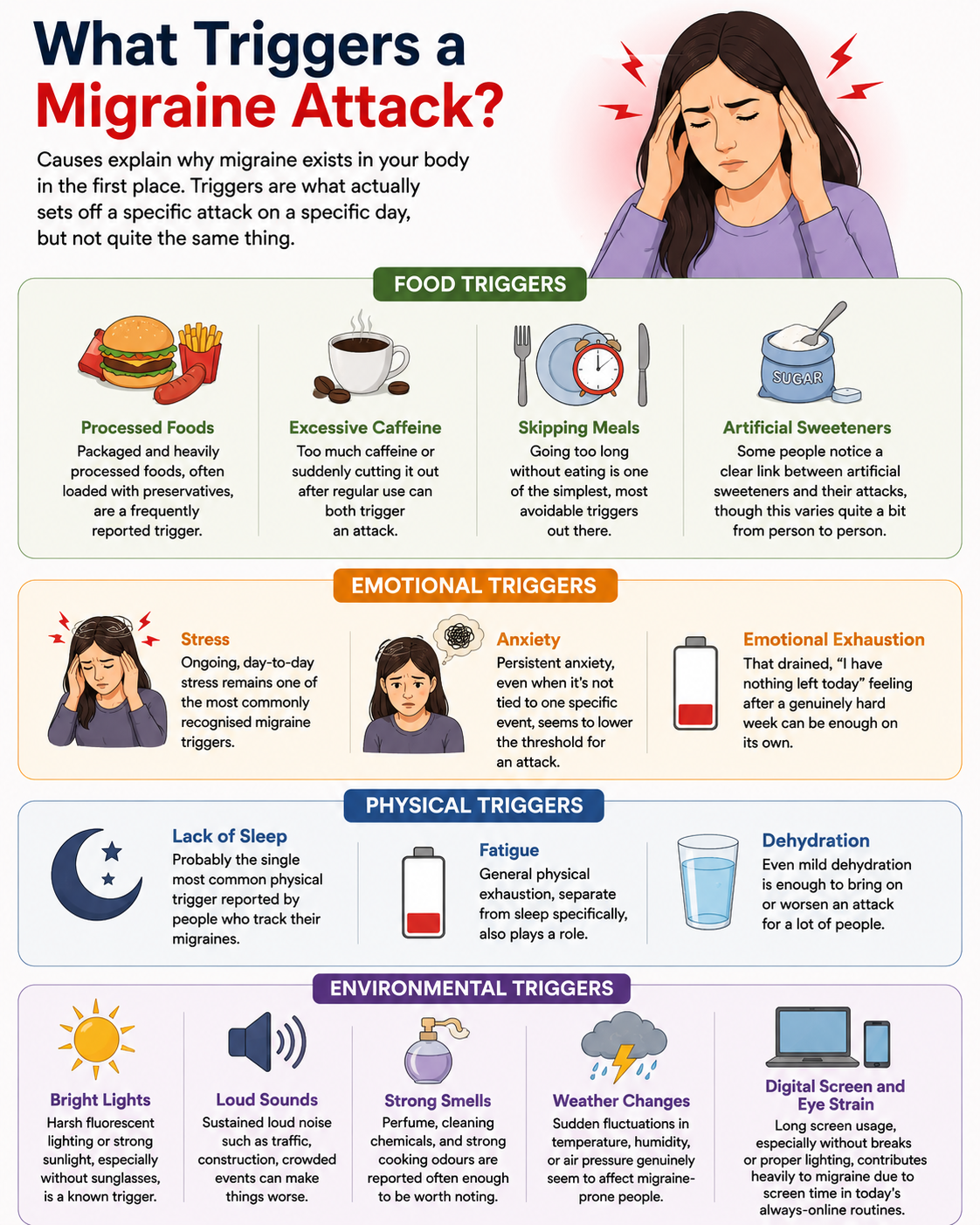
Food Triggers
Processed Foods
Packaged and heavily processed foods, often loaded with preservatives, are a frequently reported trigger.
Excessive Caffeine
Too much caffeine or suddenly cutting it out after regular use can both trigger an attack.
Skipping Meals
Going too long without eating is one of the simplest, most avoidable triggers out there.
Artificial Sweeteners
Some people notice a clear link between artificial sweeteners and their attacks, though this varies quite a bit from person to person.
Emotional Triggers
Stress
Ongoing, day-to-day stress remains one of the most commonly recognised migraine triggers.
Anxiety
Persistent anxiety, even when it’s not tied to one specific event, seems to lower the threshold for an attack.
Emotional Exhaustion
That drained, “I have nothing left today” feeling after a genuinely hard week can be enough on its own.
Physical Triggers
Lack of Sleep
Probably the single most common physical trigger reported by people who track their migraines.
Fatigue
General physical exhaustion, separate from sleep specifically, also plays a role.
Dehydration
Even mild dehydration is enough to bring on or worsen an attack for a lot of people.
Environmental Triggers
Bright Lights
Harsh fluorescent lighting or strong sunlight, especially without sunglasses, is a known trigger.
Loud Sounds
Sustained loud noise such as traffic, construction, crowded events can make things wrong.
Strong Smells
Perfume, cleaning chemicals, and strong cooking odours are reported often enough to be worth noting.
Weather Changes
Sudden fluctuations in temperature, humidity, or air pressure genuinely seem to affect migraine-prone people.
Digital Screen and Eye Strain
Long screen usage, especially without breaks or proper lighting, contribute heavily to migraine due to screen time in today’s always-online routines.
Stages of a Migraine Attack
Most migraine attacks move through four stages, though not everyone goes through all four every single time.
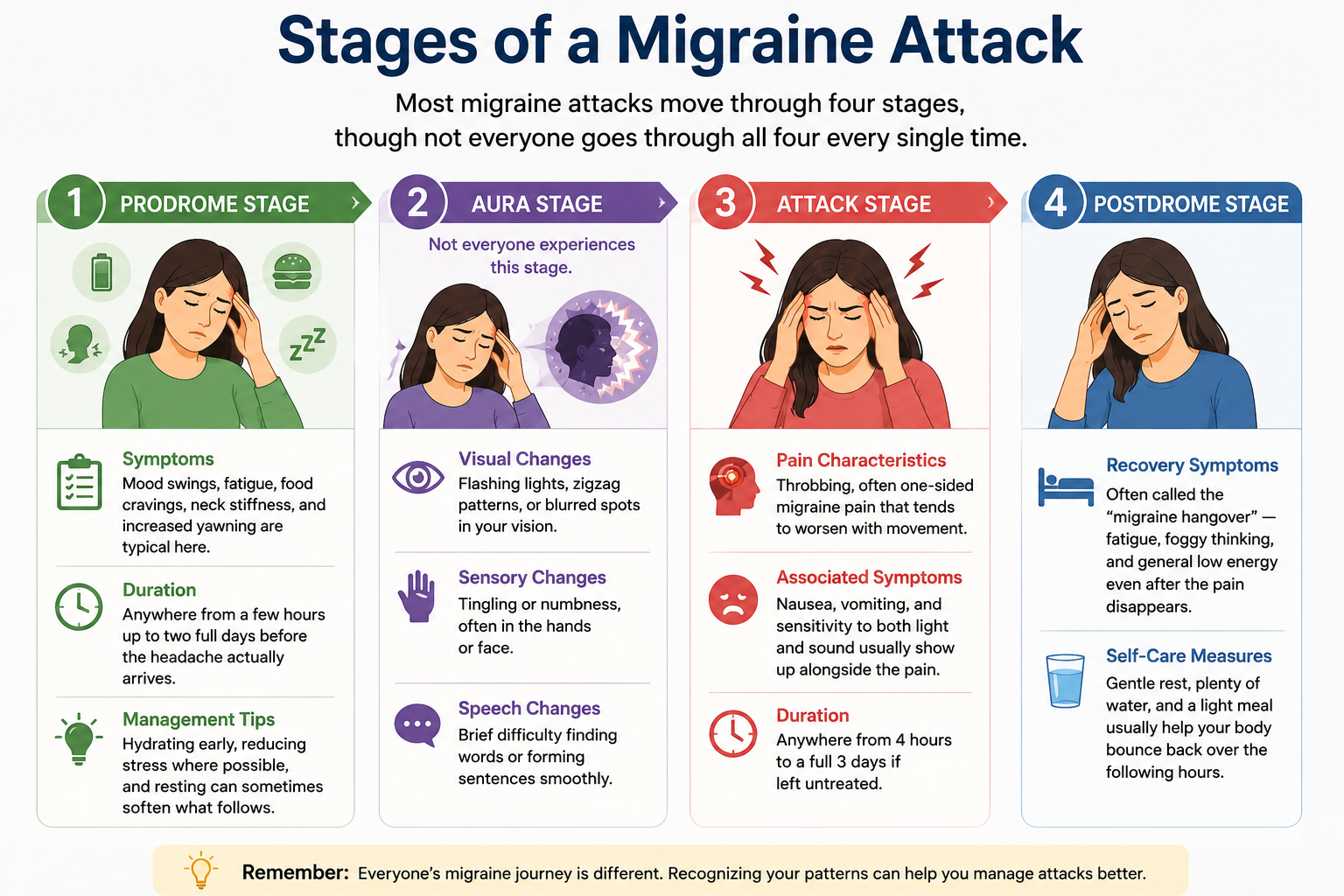
Prodrome Stage
Symptoms
Mood swings, fatigue, food cravings, neck stiffness, and increased yawning are typical here.
Duration
Anywhere from a few hours up to two full days before the headache actually arrives.
Management Tips
Hydrating early, reducing stress where possible, and resting can sometimes soften what follows.
Aura Stage
Not everyone experiences this stage.
Visual Changes
Flashing lights, zigzag patterns, or blurred spots in your vision.
Sensory Changes
Tingling or numbness, often in the hands or face.
Speech Changes
Brief difficulty finding words or forming sentences smoothly.
Attack Stage
Pain Characteristics
Throbbing, often one-sided migraine pain that tends to worsen with movement.
Associated Symptoms
Nausea, vomiting, and sensitivity to both light and sound usually show up alongside the pain.
Duration
Anywhere from 4 hours to a full 3 days if left untreated.
Postdrome Stage
Recovery Symptoms
Often called the “migraine hangover” — fatigue, foggy thinking, and general low energy even after the pain disappears.
Self-Care Measures
Gentle rest, plenty of water, and a light meal usually help your body bounce back over the following hours.
Migraine vs Headache
Understanding Migraine vs Headache is important because both involve head pain, but that’s really where the overlap ends. They differ in their causes, symptoms, and treatment approaches.
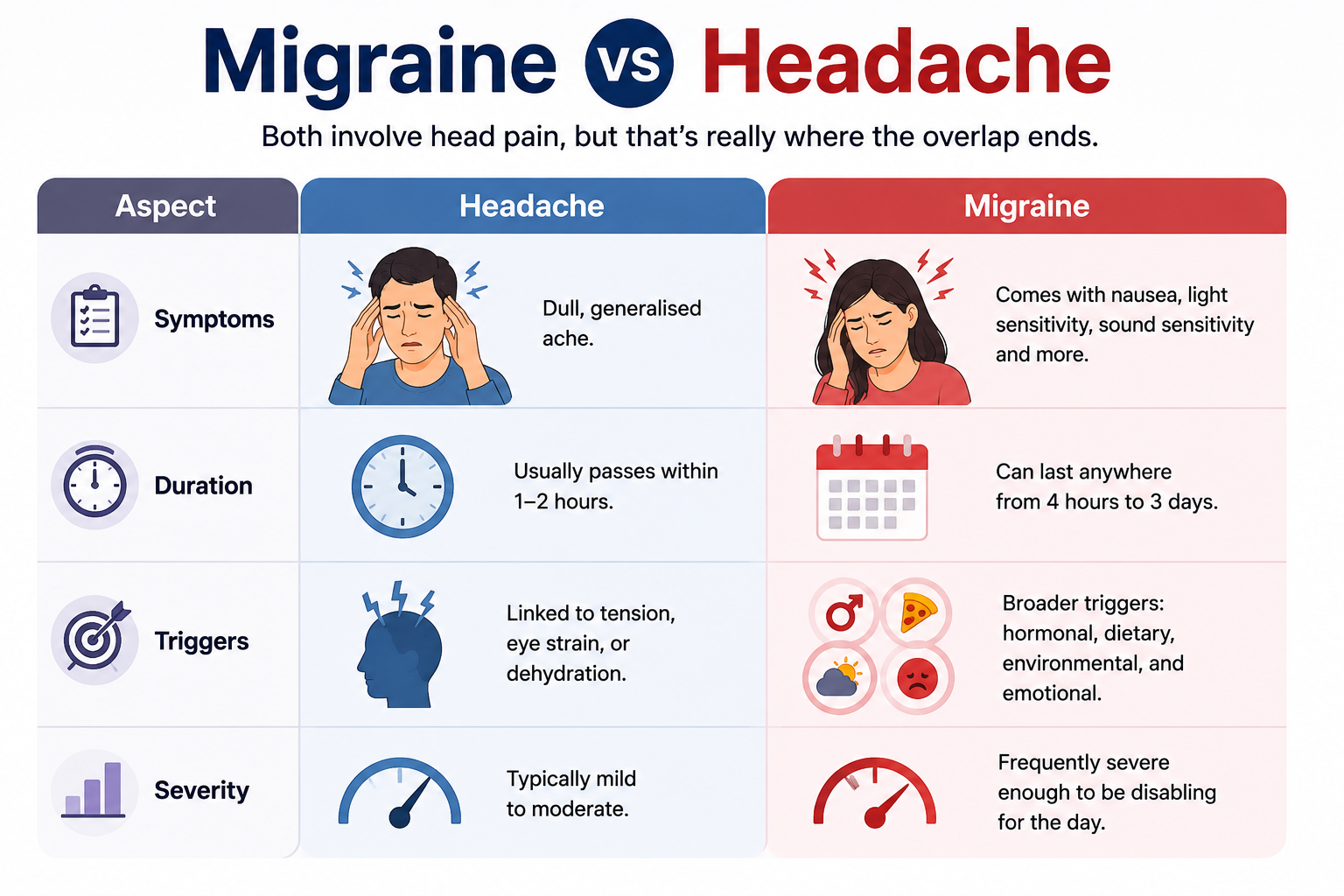
Difference in Symptoms
A regular headache tends to be a dull, generalised ache. Migraine comes with a whole set of symptoms such as nausea, light sensitivity, sound sensitivity that a normal headache hardly ever brings along.
Difference in Duration
Headaches usually pass within an hour or two. Migraine can stretch from 4 hours to 3 days.
Difference in Triggers
Headaches are often linked to tension, eye strain, or dehydration. Migraine triggers are broader, such as hormonal, dietary, environmental, and emotional, often all at once.
Difference in Severity
Headaches are typically mild to moderate. Migraine pain is frequently severe enough to be disabling for the day.
Comparison Table
| Factor | Migraine | Regular Headache |
| Pain Intensity | Moderate to severe | Mild to moderate |
| Duration | 4 hours to 3 days | 30 minutes to a few hours |
| Nausea | Common | Rare |
| Light Sensitivity | Common | Uncommon |
| Sound Sensitivity | Common | Uncommon |
| Effect on Daily Activities | Often disabling | Usually manageable |
| Need for Medical Evaluation | Often recommended if frequent | Rarely needed unless persistent |
Knowing this difference is essential, because the right migraine headache treatment looks quite different from what works for a simple tension headache.
Complications of Untreated Migraine
Reduced Productivity
Frequent, unmanaged attacks fade away at work and academic performance over time.
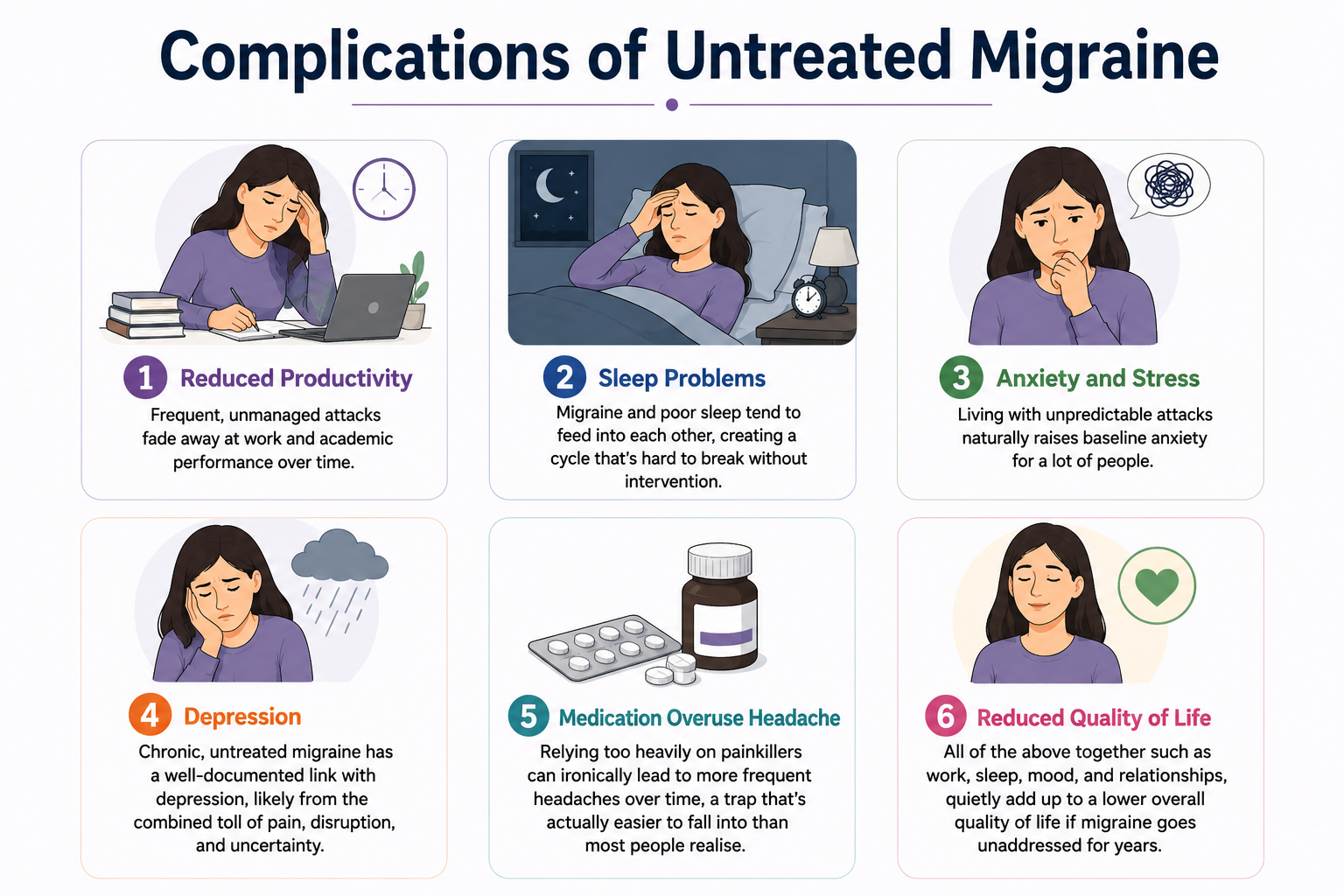
Sleep Problems
Migraine and poor sleep tend to feed into each other, creating a cycle that’s hard to break without intervention.
Anxiety and Stress
Living with unpredictable attacks naturally raises baseline anxiety for a lot of people.
Depression
Chronic, untreated migraine has a well-documented link with depression, likely from the combined toll of pain, disruption, and uncertainty.
Medication Overuse Headache
Relying too heavily on painkillers can ironically lead to more frequent headaches over time, a trap that’s actually easier to fall into than most people realise.
Reduced Quality of Life
All of the above together such as work, sleep, mood, and relationships, quietly add up to a lower overall quality of life if migraine goes unaddressed for years.
How is Migraine Diagnosed?
There’s no single blood test for migraine, so a migraine doctor relies on a combination of medical history, symptom evaluation, and physical examination to make an accurate diagnosis.
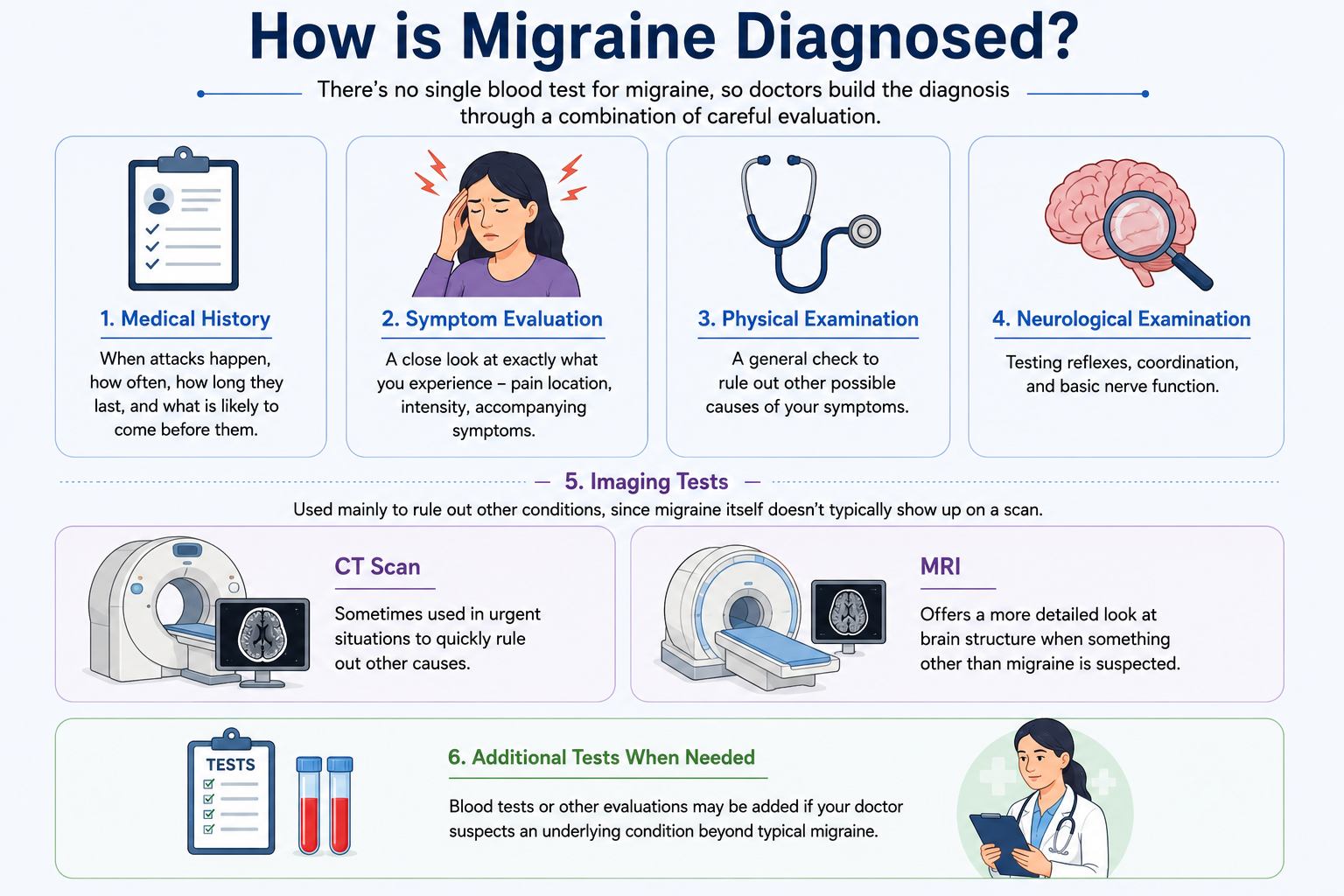
Medical History
When attacks happen, how often, how long they last, and what is likely to come before them.
Symptom Evaluation
A close look at exactly what you experience – pain location, intensity, accompanying symptoms.
Physical Examination
A general check to rule out other possible causes of your symptoms.
Neurological Examination
Testing reflexes, coordination, and basic nerve function.
Imaging Tests
Used mainly to rule out other conditions, since migraine itself doesn’t typically show up on a scan.
CT Scan
Sometimes used in urgent situations to quickly rule out other causes.
MRI
Offers a more detailed look at brain structure when something other than migraine is suspected.
Additional Tests When Needed
Blood tests or other evaluations may be added if your doctor suspects an underlying condition beyond typical migraine.
Home Remedies for Migraine Relief
Medical guidance is important, but a lot of genuine comfort also comes from simple home remedies for migraines, especially when used early in an attack.
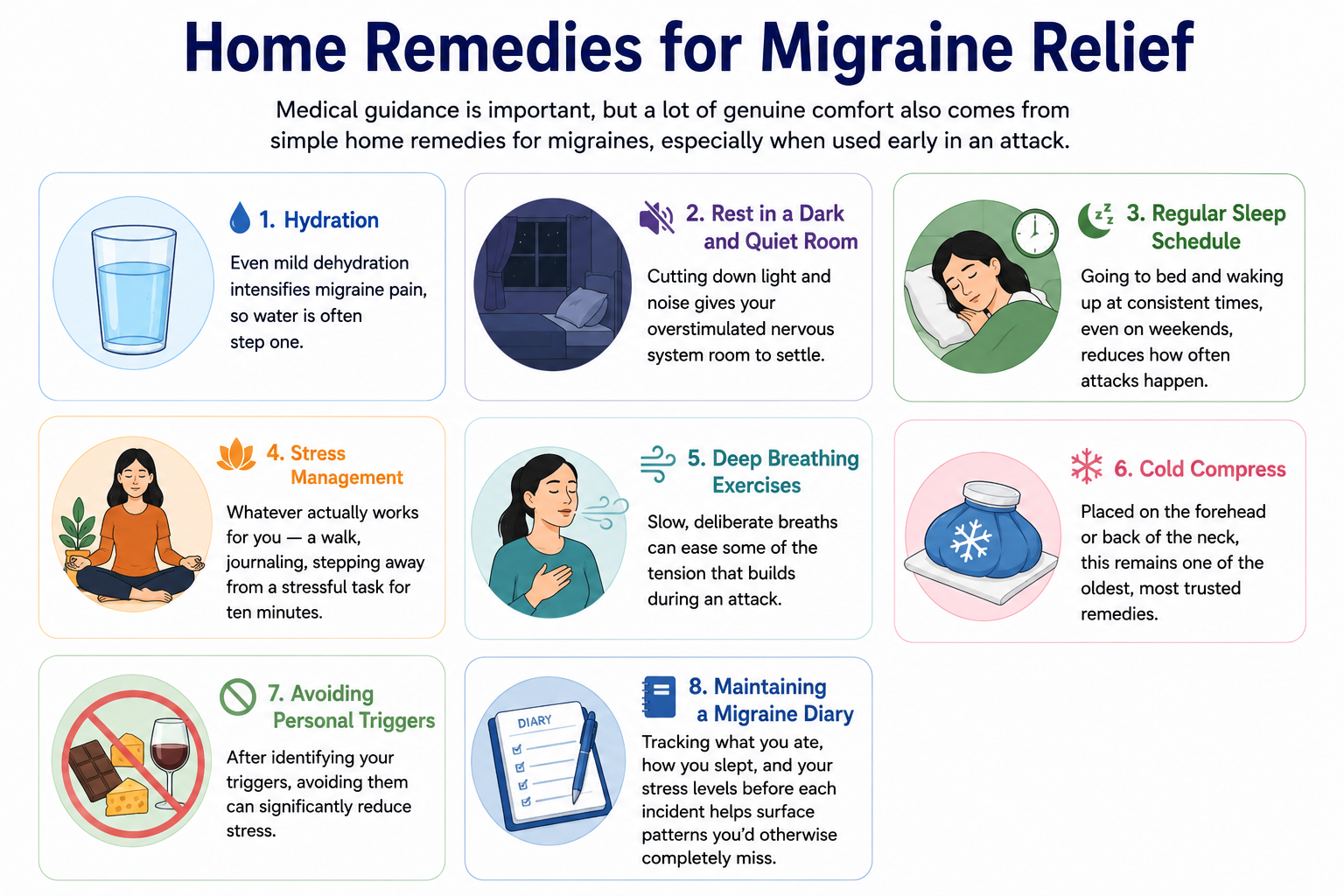
Hydration
Even mild dehydration intensifies migraine pain, so water is often step one.
Rest in a Dark and Quiet Room
Cutting down light and noise gives your overstimulated nervous system room to settle.
Regular Sleep Schedule
Going to bed and waking up at consistent times, even on weekends, genuinely reduces how often attacks happen for a lot of people.
Stress Management
Whatever actually works for you — a walk, journaling, stepping away from a stressful task for ten minutes.
Deep Breathing Exercises
Slow, deliberate breaths can ease some of the tension that builds during an attack.
Cold Compress
Placed on the forehead or back of the neck, this remains one of the oldest, most trusted remedies for migraine treatment at home.
Avoiding Personal Triggers
After identifying your triggers, avoiding them can significantly reduce stress.
Maintaining a Migraine Diary
Tracking what you ate, how you slept, and your stress levels before each incident helps surface patterns you’d otherwise completely miss.
How Does Jeena Sikho HiiMS Approach Migraine Management?
At Jeena Sikho HiiMS, the starting point is understanding the person, not just labelling the symptom.
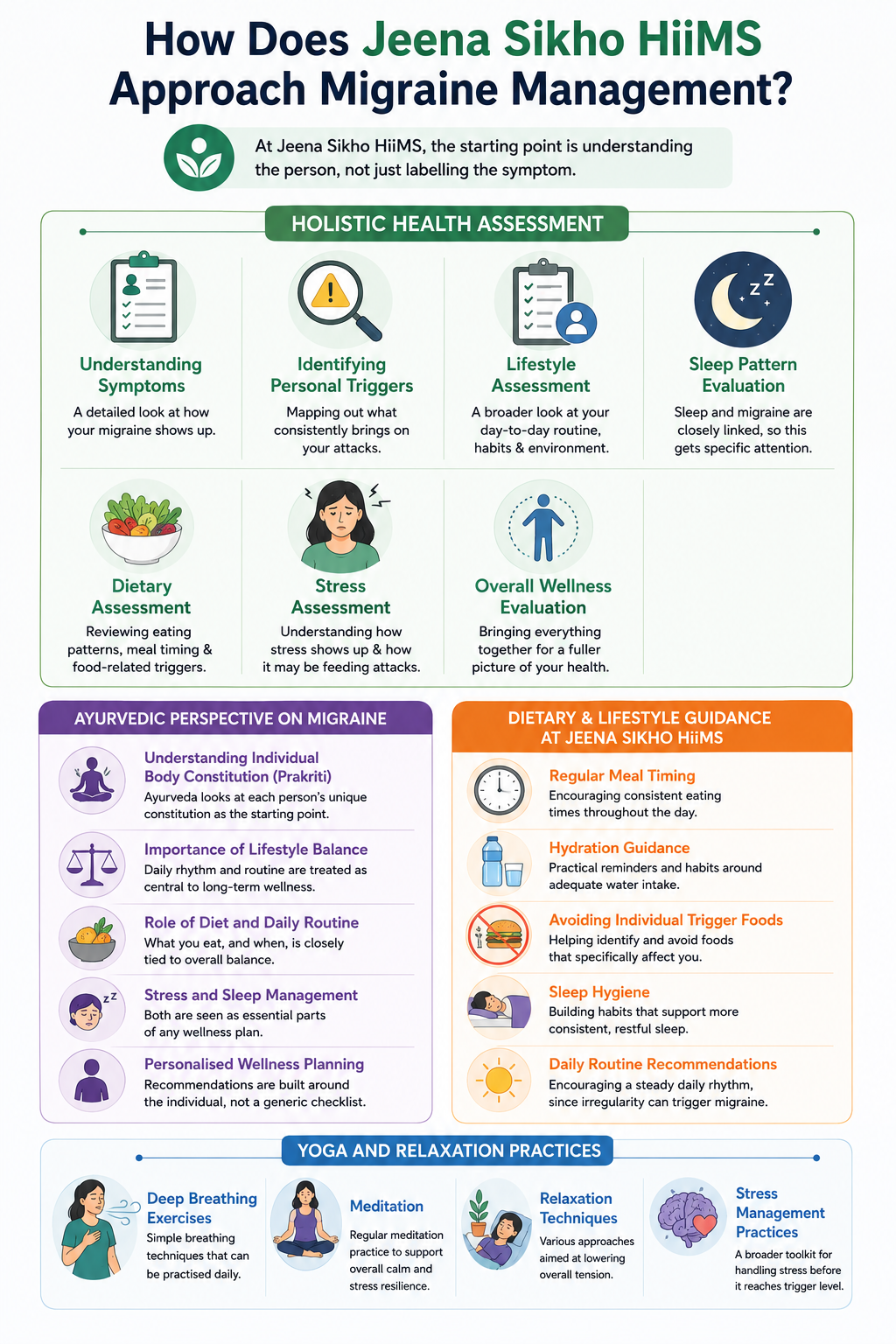
Holistic Health Assessment
Understanding Symptoms
A detailed look at exactly how your migraine shows up, its frequency, intensity, accompanying signs.
Identifying Personal Triggers
Working with you to map out what consistently seems to bring on your attacks.
Lifestyle Assessment
A broader look at your day-to-day routine, habits, and environment.
Sleep Pattern Evaluation
Because sleep and migraine are so closely linked, this gets specific attention.
Dietary Assessment
Reviewing eating patterns, meal timing, and any food-related triggers.
Stress Assessment
Understanding how stress shows up in your life and how it might be feeding your attacks.
Overall Wellness Evaluation
Bringing all of the above together into a fuller picture of your health, rather than treating migraine in an isolated manner.
Ayurvedic Perspective on Migraine
Understanding Individual Body Constitution (Prakriti)
Ayurveda looks at each person’s unique constitution, or Prakriti, as a starting point for any wellness recommendation.
Importance of Lifestyle Balance
Daily rhythm and routine are treated as central to long-term wellness, not as an afterthought.
Role of Diet and Daily Routine
What you eat, and when, is considered closely tied to overall balance and migraine patterns.
Stress and Sleep Management
Both are seen as essential parts of any wellness plan.
Personalised Wellness Planning
Recommendations are built around the individual rather than a generic checklist.
Dietary and Lifestyle Guidance at Jeena Sikho HiiMS
Regular Meal Timing
Encouraging consistent eating times throughout the day.
Hydration Guidance
Practical, day-to-day reminders and habits around adequate water intake.
Avoiding Individual Trigger Foods
Helping identify and steer clear of foods that specifically affect you.
Sleep Hygiene
Building habits that support more consistent, restful sleep.
Daily Routine Recommendations
Encouraging a steady daily rhythm, since irregularity itself can be a quiet trigger.
Yoga and Relaxation Practices
Deep Breathing Exercises
Simple breathing techniques that can be practised daily, not just during an attack.
Meditation
Regular meditation practice to support overall calm and stress resilience.
Relaxation Techniques
Various approaches aimed at lowering overall tension in the body.
Stress Management Practices
A broader toolkit for handling stress before it builds up to trigger level.
Panchakarma Therapies That May Be Considered (When Clinically Appropriate)
Nasya
What is Nasya?
A traditional Ayurvedic procedure involving the administration of medicated substances through the nasal passage.
Procedure Overview
Carried out under guidance, typically as part of a broader treatment plan rather than as a standalone fix.
Potential Wellness Benefits
Some people find it supportive for sinus and head-related discomfort, though individual response varies.
General Precautions
Done with appropriate care and only when suitable for the individual, under professional supervision.
Shirodhara
What is Shirodhara?
A continuous, gentle stream of warm oil poured over the forehead.
Procedure Overview
A calming, hands-on therapy usually performed over a fixed duration in a quiet setting.
Relaxation and Stress Management Aspects
Often valued specifically for its deeply relaxing, stress-easing quality rather than as a direct pain treatment.
Abhyanga
Therapeutic Oil Massage
A full-body or targeted oil massage using warm, medicated oils.
Potential Wellness Benefits
Many find it supportive for general relaxation and easing physical tension.
Swedana
What is Swedana?
A therapeutic sweating technique, often used alongside other therapies.
Supportive Role in Wellness Care
Typically included as a complementary part of a broader Panchakarma plan, not used in an isolated manner.

Personalised Panchakarma Planning
Individual Assessment
Every recommendation starts with understanding the specific person, not a generic protocol.
Therapy Selection
Therapies are chosen based on individual suitability, not applied generally.
Monitoring and Follow-up
Ongoing check-ins to see what’s actually helping and adjust accordingly.
Can Ayurveda Help in Migraine Management?
Importance of Personalised Care
There’s no single Ayurvedic “fix”. The value lies in adapting the approach to the individual.
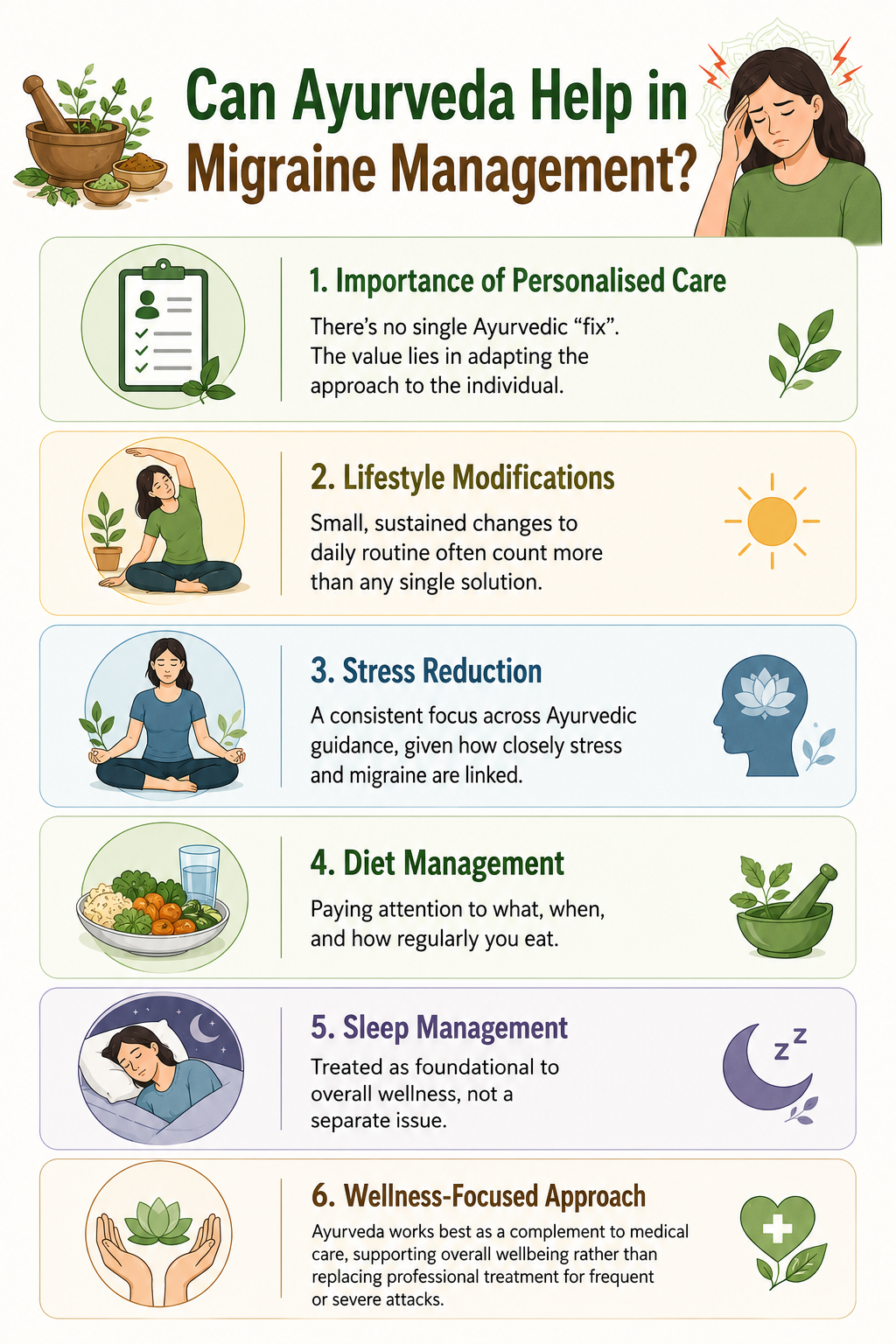
Lifestyle Modifications
Small, sustained changes to daily routine often count more than any single solution.
Stress Reduction
A consistent focus across Ayurvedic guidance, given how closely stress and migraine are linked.
Diet Management
Paying attention to what, when, and how regularly you eat.
Sleep Management
Treated as foundational to overall wellness, not a separate issue.
Wellness-Focused Approach
Ayurveda works best as a complement to medical care, supporting overall wellbeing rather than replacing professional treatment for frequent or severe attacks.
Common Herbs Used in Ayurveda for Migraine Management
Ayurveda takes a personalised approach to migraine management, so there is no single herb that is recommended for everyone. The choice of herbs depends on a person’s body constitution (prakriti), daily habits, digestion, and overall health.
Brahmi
Brahmi is one of the well-known herbs in Ayurveda. It is traditionally used to support mental calmness and concentration. It may be considered for people whose headaches are often linked with stress, mental fatigue, or an irregular lifestyle.
Jatamansi
Jatamansi has been used in Ayurvedic practice for many years. It is commonly included in personalised wellness plans for people who experience headaches along with disturbed sleep or emotional stress.
Shankhapushpi
Shankhapushpi is traditionally valued for supporting mental relaxation and overall cognitive well-being. Ayurvedic practitioners may recommend it as part of an individualised approach when recurring headaches are associated with mental strain.
Ashwagandha
When everyday stress and physical tiredness become a regular part of life, Ashwagandha may be included in an Ayurvedic wellness plan. It is traditionally used to help maintain overall balance and support the body’s response to daily stress.
Note: No Ayurvedic herb should be taken without professional guidance. An experienced Ayurvedic practitioner recommends herbs only after understanding the individual’s health condition, body constitution, and symptoms.
Tips to Prevent Migraine Attacks
Stay Hydrated
Drink water consistently throughout the day, not just when you remember to.
Get Adequate Sleep
Both the amount and the timing of your sleep are important here.
Manage Stress
Find what genuinely helps you unwind, and make space for it regularly.
Maintain Regular Meal Times
Avoid long gaps between meals wherever possible.
Exercise Regularly
Even a daily walk can make a noticeable difference over time.
Limit Excessive Screen Time
Take real breaks, especially during long work sessions.
Maintain a Migraine Diary
Track patterns over weeks and months, not just individual bad days.
Avoid Known Triggers
Once you’ve identified yours, actively steering clear does more than most remedies combined.
Talk to an Ayurvedic Expert Without Visiting the Clinic.
Book your Video Consultation and receive personalised guidance from Jeena Sikho HiiMS Doctors.

Frequently Asked Questions
Q.1. What is migraine?
Ans: Migraine is a neurological condition causing intense, often one-sided headaches along with nausea, vomiting, and sensitivity to light and sound.
Q.2. What causes migraine headaches?
Ans: A combination of genetics, hormonal changes, stress, poor sleep, certain foods, and environmental factors typically causes migraine headaches.
Q.3. How to cure migraine naturally?
Ans: There’s no absolute natural cure, but hydration, rest, stress management, regular sleep, and identifying your personal triggers can meaningfully reduce attack frequency and severity.
Q.4. How to stop a migraine attack?
Ans: Resting in a dark, quiet room, staying hydrated, applying a cold compress, and practising slow breathing can help ease an attack once it starts.
Q.5. How long does a migraine last?
Ans: A typical attack lasts anywhere from 4 hours to 3 days if untreated.
Q.6. How do I know if I have migraine?
Ans: If you get recurring, often one-sided throbbing headaches along with nausea and sensitivity to light or sound, it’s worth talking to a doctor to confirm.
Q.7. What are the first signs of migraine?
Ans: Mood changes, unusual fatigue, food cravings, and trouble concentrating are common early signs, often appearing hours before the headache itself.
Q.8. What foods trigger migraine?
Ans: Processed foods, excess caffeine, artificial sweeteners, and skipped meals are commonly reported triggers.
Q.9. How to get migraine relief at home?
Ans: Hydration, resting in a dark room, a cold compress, and avoiding known triggers are simple, effective starting points.
Q.10. Can stress cause migraine?
Ans: Yes, stress is one of the most consistently reported migraine triggers.
Q.11. Can dehydration cause migraine?
Ans: Yes, even mild dehydration can trigger or worsen an attack for many people.
Q.12. Can lack of sleep cause migraine?
Ans: Yes, both insufficient and irregular sleep are well-known triggers.
Q.13. Can migraine affect vision?
Ans: Yes, some people experience aura symptoms like flashing lights, blurred vision, or temporary vision changes before or during an attack.
Q.14. How is migraine diagnosed?
Ans: Through detailed medical history, symptom evaluation, and a physical and neurological examination, sometimes supported by imaging tests.
Q.15. Can Ayurveda help in migraine management?
Ans: Ayurveda can support migraine management through personalised diet, lifestyle changes, and stress reduction, alongside medical care rather than replacing it.
Q.16. Can Panchakarma help in migraine?
Ans: Certain therapies like Shirodhara and Nasya may offer supportive relaxation and wellness benefits when recommended by a qualified practitioner for suitable individuals.
Q.17. How to prevent migraine attacks naturally?
Ans: Staying hydrated, sleeping well, managing stress, eating at regular times, and avoiding known triggers are the core natural prevention strategies.
Q.18. What is the difference between migraine and a regular headache?
Ans: Migraine typically involves more severe, one-sided pain along with nausea and light or sound sensitivity, while regular headaches are usually milder and more generalised.
Q.19. Can migraine happen right after waking up?
Ans: Yes, some people experience migraine after waking up, often linked to sleep quality, overnight dehydration, or irregular sleep schedules.
Q.20. Is migraine more common in women or men?
Ans: Migraine symptoms in women are often more frequent, largely due to hormonal fluctuations, though men experience migraine too, often with somewhat different patterns.
References
- Cleveland Clinic: https://my.clevelandclinic.org/health/diseases/5005-migraine-headaches
- Mayo Clinic: https://www.mayoclinic.org/diseases-conditions/migraine-headache/symptoms-causes/syc-20360201
- National Institute of Neurological Disorders and Stroke (NINDS): https://www.ninds.nih.gov/health-information/disorders/migraine
- World Health Organization (WHO): https://www.who.int/news-room/fact-sheets/detail/headache-disorders
Author Bio: Doctor Team – Jeena Sikho HiiMS
Medical Reviewer: Reviewed by Qualified Healthcare Professionals at Jeena Sikho HiiMS
Medical Disclaimer: This blog is intended for educational and informational purposes only and should not be considered medical advice. The content is not meant to replace professional diagnosis, treatment, or clinical consultation. As every individual’s health condition is unique, please consult a qualified healthcare professional or an experienced Jeena Sikho HiiMS Ayurveda doctor for personalised guidance and appropriate treatment.
Looking for more information about migraine management?
Learn more about migraine management approaches, lifestyle guidance, and holistic wellness programs at Jeena Sikho HiiMS or book a consultation with qualified healthcare professionals.

Disclaimer: The information provided on this blog is for general educational and informational purposes only. It is not intended to replace professional medical advice, diagnosis, or treatment. Always consult a qualified healthcare professional before making any changes to your diet, lifestyle, or treatment plan. Individual results may vary.