
Finding the right hospital for a kidney problem is rarely simple. One day you are looking at a routine blood report, the next, you are hearing words like “creatinine,” “eGFR,” and “albumin,” and every relative has a different suggestion about where to go. Some people want a large hospital with dialysis and transplant units. Others want a place that looks at food, daily routine, and long-term habits as well, because kidney health depends so much on what happens at home between check-ups.
If you are searching for the top 5 kidney care hospitals in India, this blog is meant to make that search easier. We explain what each hospital offers for kidney care, what kind of patient it may suit, and what to ask before you book.
Table of Contents
Why Kidney Care Needs Attention in India
Kidney disease is often silent. The ICMR-INDIAB study tested 25,408 adults across 31 states and union territories and found impaired kidney function in about 3.2% of adults, as published in the Indian Journal of Medical Research. Many of them would not have known without a blood and urine test.
When kidneys fail, treatment means dialysis or a transplant, and access to both varies a lot between cities. A review in the Indian Journal of Nephrology notes that Delhi-NCT alone has done over 23,000 kidney transplants up to 2023, with 97% involving living donors.
Not sure which kind of kidney care you need? Talk your reports through with a Jeena Sikho HiiMS doctor.
Best 5 Kidney Care Hospitals in India
Our list of the top 5 kidney care hospitals in India looks at four things: whether the hospital has a dedicated kidney care service, what it lists (tests, therapies, diet, and lifestyle support), how widely it is available, and how accessible it is in terms of cost. Here is the hospital list:
1. Jeena Sikho HiiMS: Ayurveda-Based Kidney Care Across India
Jeena Sikho HiiMS (Hospital and Institute of Integrated Medical Sciences) is the hospital network of Jeena Sikho Lifecare, a company founded in 2017 and headquartered in Zirakpur, Punjab. Its hospitals combine Ayurveda, Panchakarma, naturopathy, and diet-based care. Among the top 5 kidney care hospitals in India, it is the one with the largest spread of centers and the one that puts daily food, routine, and therapies at the center of kidney care.
According to the company’s 2026 disclosures, as summarized by financial data sites, the network has:
- 119 centers, made up of 61 hospitals, 58 clinics and day-care centres
- 23 states and more than 100 cities and towns
- About 2,300 operational beds, after the company added 561 beds in 2026, with a total capacity of 2,861 beds
Jeena Sikho HiiMS also states that it has over 900 Ayurvedic doctors across its network. The company has said it plans to keep adding 500 to 600 beds every year, so these figures keep changing. Hospital size varies from city to city, and the bigger ones are where admission-based therapies are usually done:
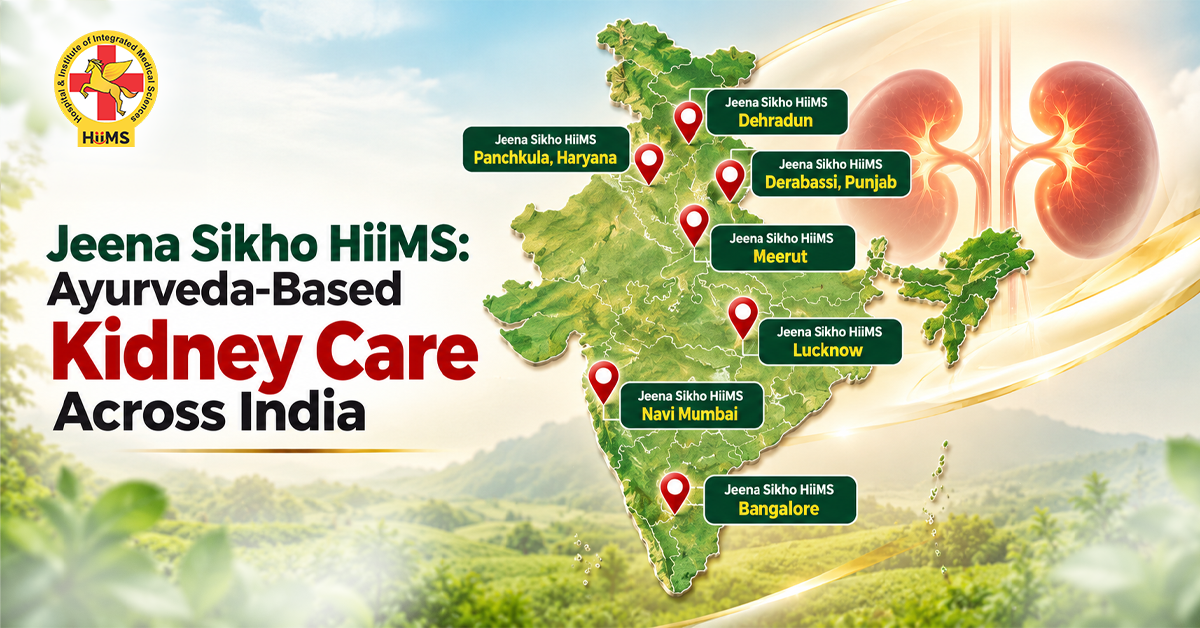
- Jeena Sikho HiiMS Meerut: The largest. An NSE filing from February 2025 shows its bed capacity rising from 315 to 435 beds, and the company has described it as a 1,000-bed HiiMS hospital project.
- Jeena Sikho HiiMS Derabassi, Punjab: The company’s FY25 annual report lists 113 beds and reports the facility as operational from October 2020.
- Jeena Sikho HiiMS Panchkula, Haryana: This hospital has a 100-bed facility.
- Jeena Sikho HiiMS Bangalore: This hospital has a 28-bed facility.
- Jeena Sikho HiiMS Lucknow: A 160-bed hospital is planned by FY27, along with an existing facility on Sitapur Road.
- Jeena Sikho HiiMS Navi Mumbai: A new 150-bed hospital has been proposed.
- Jeena Sikho HiiMS Dehradun: A hospital with about 40 beds, now NABH accredited.
This spread means that, for many people, the nearest Jeena Sikho HiiMS center is within a day’s travel, and the first consultation can happen by video.
Several Jeena Sikho HiiMS hospitals, including those in Agra, Panchkula, Noida, Dehradun, Bhopal, and Pune, have received NABH accreditation. A Jeena Sikho HiiMS facility in Mumbai is listed as a CGHS-empanelled hospital, and the network is also empanelled with some private insurers.
Jeena Sikho HiiMS states that Ayushman and Arogya Sanjeevani insurance are accepted at its hospitals, so please confirm your eligibility with the centre before admission. You can start with an OPD visit at a centre or a VOPD, the Virtual Out-Patient Department, which is a video consultation from home.
Jeena Sikho HiiMS shares patient stories on its YouTube channel, including a kidney patient’s review of the kidney care programme. These are personal experiences, and results differ from person to person, so use them as information and not as a promise.
2. Medanta The Medicity, Gurugram
Medanta was ranked No. 1 in India in Newsweek’s World’s Best Hospitals 2026, and 110th globally, according to Medical Dialogues. Its kidney care service covers chronic kidney disease, acute kidney injury and critical care. Dialysis includes hemodialysis, CAPD, hemodiafiltration and CRRT, available round the clock.
It does kidney transplants, including complex ABO- and HLA-incompatible ones, and has a transplant ICU and an interventional team for AV fistulas and kidney biopsies. Medanta also runs hospitals in Lucknow, Patna, Ranchi and Indore. It is a private hospital, so ask for an estimate in advance.
3. AIIMS New Delhi
The Department of Nephrology at AIIMS started in 1969, and Delhi’s first kidney transplant was done there in April 1972. AIIMS ranked 115th in Newsweek’s 2026 global list, and as a government institute, its costs are low.
In December 2025, the head of Urology told ETV Bharat that transplant capacity had risen by over 50%, that transplants are free of cost, and that the wait is about three months. Expect queues for OPD and tests, and plan for a donor, since finding a match is the hardest step.
4. PGIMER Chandigarh
PGIMER is a major government centre for kidney transplants in North India. According to the Tribune, its record stands at 4,786 kidney transplants (4,215 live-donor and 571 deceased-donor).
The wait for a transplant has dropped from about a year to two and a half months, and it leads among Union Territory hospitals under Ayushman Bharat with over 100 free kidney transplants. If you are in Punjab, Haryana or Himachal, it is one of the nearest big options, but expect crowds and carry your reports.
5. CMC Vellore
CMC Vellore’s Department of Nephrology was the first independent nephrology department in a medical college in India, and the hospital did the country’s first successful kidney transplant in 1971. According to the CMC page, it also did the first deceased-donor transplant in 1991 and the first ABO-incompatible transplant in India in 2009.
Its dialysis unit has 50 beds on the Ranipet campus and 25 in the town campus; it does about 1,200 kidney biopsies a year, and it runs a Child Kidney Care Clinic. CMC is a not-for-profit mission hospital, and many patients travel long distances, so plan for the wait and your stay.
What to Look for in the Best Kidney Care Hospitals in India
The best kidney care hospital in India for you depends on what you need right now. A person with a kidney stone needs different care from someone whose creatinine has been rising for months. Use these points to compare your options.
1) Qualified Kidney Doctors in India
Among kidney doctors in India, a nephrologist (DM or DrNB) treats kidney disease and dialysis, while a urologist treats stones and the urinary tract and often does transplant surgery.
- Kidney stones, a blockage, or a prostate problem: you will usually need a urologist
- Chronic kidney disease, protein in urine, swelling, or rising creatinine: you need a nephrologist
- Check that the doctor explains your reports in simple words and tells you what the next step is
2) The Right Tests
A good hospital does not guess. Look for these tests, and ask for copies of every report:
- Serum creatinine and eGFR, which show how well your kidneys are filtering
- Blood urea and electrolytes such as potassium and sodium
- Urine albumin or protein, to check for leakage
- An ultrasound to check the size of the kidneys, stones and cysts
A quick note on creatinine: the normal range is roughly 0.6 to 1.3 mg/dL, depending on age, sex and muscle mass, and an eGFR below 60 for three months or more points to chronic kidney disease. If your creatinine is rising, or is already well above the normal range, please consult a doctor or Ayurvedic practitioner soon.
3) Diet and Lifestyle Support
Kidney disease depends heavily on diet, fluids and blood pressure. A hospital that plans your meals and daily routine around your reports adds a lot. Ask whether you will get:
- A diet chart that sets limits for protein, salt, potassium and phosphorus at your stage
- Guidance on how much water to drink, since this changes as kidney function drops
- Advice on blood sugar and BP control, sleep, exercise and avoiding painkillers taken without advice
4) Clear Costs and Insurance
Ask for a written estimate before you begin. Also check which insurance schemes and cashless options the hospital accepts, and what is included in package costs such as dialysis sessions, medicines and tests. Surprises in billing add stress to a long treatment.
5) Regular Follow-Up
Kidney care continues for years, so check how follow-ups are organised. Find out how often tests are repeated, who you can contact between visits, and whether review consultations can be done online, which helps if you live far away.
6) Room for Ayurvedic Support
Many families want Ayurveda alongside regular treatment, and this works best when both sides know about each other. Look for a hospital where doctors ask for your reports and medicines first, and where Ayurvedic therapies, herbs and diet are planned for your stage of kidney disease. Ayurveda is usually taken as supportive care, and the research on it is still limited, so it should never replace dialysis or prescribed medicines.
If Ayurveda is part of what you are looking for, Jeena Sikho HiiMS is a hospital to consider. For kidney patients, its approach includes OPD and VOPD consultation, pH-balanced, plant-based diet, GRAD system and Panchakarma.
Bring your latest creatinine, eGFR and urea reports to the first visit, along with your medicine list, so the doctor can plan around them. You can reach the team on 82704-82704.
Finding the Best Kidney Specialists in India
The best kidney specialists in India are not found through rankings alone. Pick a doctor who explains your reports, sets a clear plan and is honest about what a treatment can and can’t do. Bring all your past reports, and don’t hesitate to take a second opinion.
Kidney Disease Care Beyond the Hospital
Kidney disease care is mostly about daily habits. Keep your blood pressure and sugar in range, take your medicines as prescribed and limit salt (pickles, papad and namkeen add up fast). Avoid frequent use of painkillers like ibuprofen. Drink the amount of water your doctor advises, since some patients need to limit fluids. And get your creatinine, eGFR and urine albumin checked as often as your doctor suggests.
Everyday Kidney Health Care
For general kidney health care, a few habits go a long way. Stay active, keep a healthy weight, avoid smoking and eat fresh food with less packaged and salty snacks. If you have diabetes, high blood pressure or a family history of kidney disease, ask about a yearly kidney check even if you feel fine.
Conclusion
The right kidney hospital depends on what you need. If your priority is diet, daily routine and Ayurveda-based therapies, Jeena Sikho HiiMS offers that across its network of 119 centres and about 2,300 beds, with video consultations for people who can’t travel.
If you are looking for large dialysis and transplant units, Medanta, AIIMS, PGIMER and CMC Vellore are well known for them. Whichever you choose from the top 5 kidney care hospitals in India, bring your reports, ask clear questions and tell your doctor about everything you take.
Can’t travel for a consultation? Take your kidney reports to a VOPD with Jeena Sikho HiiMS from home.

FAQs
1. Which are the top 5 kidney care hospitals in India?
There is no single official ranking. This guide lists Jeena Sikho HiiMS first, followed by Medanta, AIIMS New Delhi, PGIMER Chandigarh and CMC Vellore.
2. What does kidney care at Jeena Sikho HiiMS include?
It can include report review, a pH-balanced diet, the GRAD system, Panchakarma, Natural Detox for Kidneys (kadhas and juices) and follow-ups, in person or by VOPD.
3. How big is the Jeena Sikho HiiMS network?
According to company disclosures, it has 119 centres, including 61 hospitals, across 23 states, with about 2,300 operational beds.
4. How do I know if my kidneys are weak?
Only blood and urine tests can tell, since early kidney disease often has no symptoms. Swelling, foamy urine and changes in urination are warning signs.
5. Can I consult about my kidney reports without travelling?
Yes. Jeena Sikho HiiMS offers VOPD, a video consultation with a doctor, so you can discuss your reports from home.
Ayurvedic Kidney Care Products
100% natural, certified Ayurvedic formulations crafted for targeted kidney wellness.



Disclaimer: The information provided on this blog is for general educational and informational purposes only. It is not intended to replace professional medical advice, diagnosis, or treatment. Always consult a qualified healthcare professional before making any changes to your diet, lifestyle, or treatment plan. Individual results may vary.