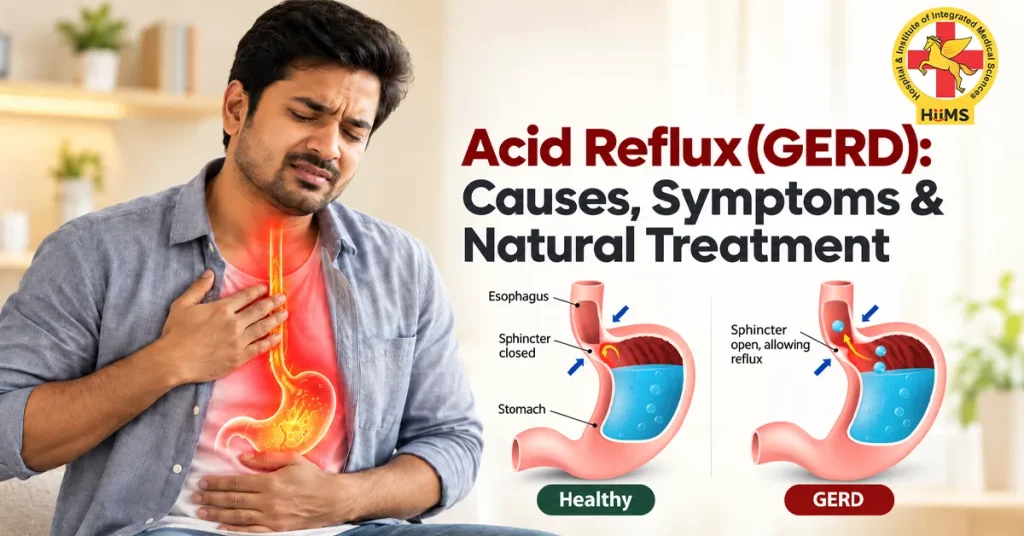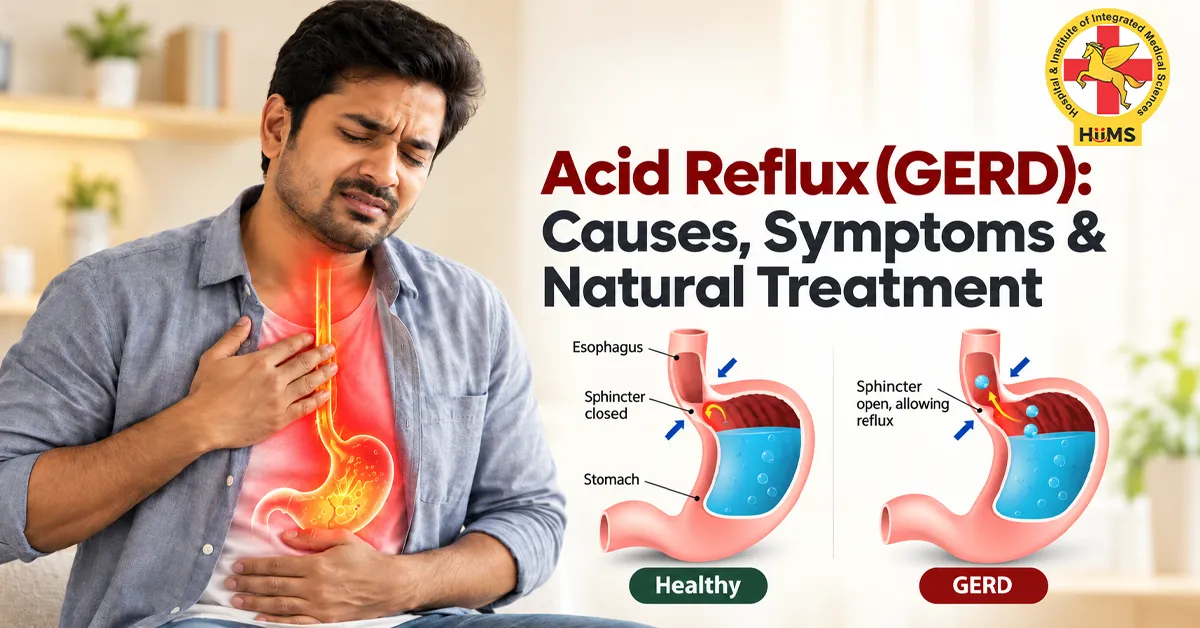

Acid reflux is among the most common digestive disorders worldwide, and in India alone it affects about 15% of people. Even so, most patients treat it as a minor inconvenience and take antacids for years without ever addressing the root cause. This guide explains how gastroesophageal reflux disease (GERD) develops, what triggers it, how modern and Ayurvedic medicine approach treatment, and how structured lifestyle changes can take you from symptom suppression towards genuine disease reversal.
Quick answers: Is my heartburn actually acid reflux or GERD?
When stomach acid flows backward into the esophagus, it causes the familiar burning sensation in the chest known as acid reflux. An occasional episode after a heavy or spicy meal is usually harmless. If chronic acid reflux appears two or more times per week for four to six weeks or longer, however, it may indicate gastroesophageal reflux disease (GERD), which requires the proper evaluation.
GERD symptoms extend well beyond mild heartburn. A burning feeling behind the breastbone is the most common symptom, yet many people also have regurgitation of a sour or bitter taste into the mouth, a persistent sore throat, a hoarse voice, and a chronic cough that ignores typical cold remedies.
GERD that is left untreated can damage the esophageal lining and cause complications. According to research from the U.S. National Institute of Diabetes and Digestive and Kidney Diseases, roughly 5-15% of people with long-term GERD develop Barrett’s esophagus, a precancerous condition that increases the risk of esophageal cancer. Esophageal strictures and ulcers in the esophagus are other possible results of chronic GERD.
Jeena Sikho HiiMS (Hospital & Institute of Integrated Medical Sciences) is an integrated AYUSH and lifestyle-medicine hospital network that aims for long-term disease reversal, not lifelong symptom control. If your symptoms last, interrupt your sleep, or include difficulty swallowing, get evaluated through an offline OPD, virtual OPD, or home-based assessment to get the right acid reflux treatment.
Heartburn that keeps coming back deserves a proper check. Speak to the doctors at Jeena Sikho HiiMS.

What is acid reflux and gastroesophageal reflux disease (GERD)?
Gastroesophageal reflux happens when stomach contents, mainly stomach acid and sometimes bile, move upward into the esophagus. This happens because of weakness in the lower esophageal sphincter, a circular muscle valve between the esophagus and the stomach. When this sphincter relaxes at the wrong time or loses tone, acid travels where it should not.
Occasional reflux after large meals or certain foods is normal. GERD is diagnosed when reflux causes uncomfortable symptoms often enough to affect quality of life, or when it leads to complications like esophagitis. Pressure changes from obesity, pregnancy, and hiatal hernia can weaken the sphincter, and so can some medications, such as nonsteroidal anti-inflammatory drugs and ibuprofen.
Unlike the stomach, the esophagus has no thick protective mucus barrier. Prolonged inflammation from chronic acid reflux (GERD) can damage esophageal tissue, causing pain and a burning sensation that many people mistake for heart trouble. Consider a 42-year-old office worker who eats a heavy dinner at 10 pm and then lies on the couch scrolling her phone. Within minutes, she feels burning in her chest and a bitter taste rising into her throat. The mechanism is simple: a late, large meal, lying down, and a relaxed esophageal sphincter.
Infants and children can also have reflux, but pediatric cases need a separate assessment by a doctor. This article focuses on adults.
Key GERD symptoms: more than just heartburn
GERD shows up in two ways: typical and atypical symptoms.
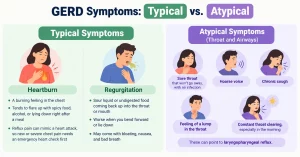
Typical Symptoms
Heartburn
- A burning feeling in the chest
- Tends to flare up with spicy food, alcohol, or lying down right after a meal
- Reflux pain can mimic a heart attack, so new or severe chest pain needs an emergency heart check first
Regurgitation
- Sour liquid or undigested food coming back up into the throat or mouth
- Worse when you bend forward or lie down
- May come with bloating, nausea, and bad breath
Atypical Symptoms (Throat and Airways)
- Sore throat that won’t go away, with no infection
- Hoarse voice
- Chronic cough
- Feeling of a lump in the throat
- Constant throat clearing, especially in the morning
- These can point to laryngopharyngeal reflux
Conditions That Mimic GERD
- Gastritis
- Peptic ulcer
- Gallbladder disease
- IBS
- Because of this overlap, self-diagnosis is unreliable
Red Flags: Get Checked Urgently
- Difficulty swallowing
- Food feeling stuck
- Unexplained weight loss
- Vomiting blood
- Black stools
- Severe choking at night
Smart Tip: Keep a Symptom Diary
- Track for 1 to 2 weeks
- Note meal timings, foods, posture, and stress levels
- Helps your doctor link triggers to symptoms
Why does acid reflux happen? Modern causes & Ayurveda’s view
Repeated reflux episodes, caused by LES dysfunction, elevated abdominal pressure, and delayed stomach emptying, give rise to GERD. The biomedical causes are hiatal hernia, obesity, smoking, high-fat diets, late-night eating, carbonated beverages, caffeine, alcohol and certain drugs. Hormonal changes and increased intra-abdominal pressure during pregnancy can make acid reflux symptoms worse.
In a dose-response meta-analysis of ~484,000 participants, overweight individuals had roughly double the risk of symptomatic reflux, and each 10 kg/m² increase in BMI added about 68% to that risk. The risk of acid reflux also goes up after age 40 and sedentary desk jobs compound the problem.
Ayurveda links GERD to Amla Pitta, a Pitta dosha imbalance characterised by excess heat, acidity, and upward movement of aggravated doshas. Irregular meal timing, stress, and eating during intense screen time disturb Vata and feed this fire further. Physicians at Jeena Sikho HiiMS evaluate biomedical as well as Ayurvedic contributors, studying diet, sleep, emotional stress, work patterns and bowel habits, not just acid production.
Who is at higher risk of chronic acid reflux and GERD complications?
Occasional reflux can affect anyone, but certain risk factors sharply raise the chance of long-term gastroesophageal reflux and tissue damage. These include obesity and central belly fat, age over 40-45, a family history of GERD or esophageal cancer, hiatal hernia, pregnancy, connective tissue diseases, and long-term use of medications like nonsteroidal anti-inflammatory drugs.
Lifestyle-related contributors include sitting for long periods after meals, tight waistbands, frequent heavy dinners after 9-10 pm, regular alcohol use, smoking, and chronic stress. Men have a slightly higher risk of developing Barrett’s esophagus and esophageal adenocarcinoma, especially with long-standing GERD and obesity.
Symptom patterns that signal higher risk are reflux for more than five years, symptoms more than three days a week, nighttime choking, a chronic sore throat or hoarse voice with no clear infection, and frequent use of over-the-counter antacids. When several risk factors apply to you, a specialist check-up and baseline endoscopy between ages 40-60 is strongly recommended.
How acid reflux is diagnosed: from clinical exam to advanced tests
Doctors diagnose the acid reflux through a detailed history, a physical examination, and targeted tests. At Jeena Sikho HiiMS, the consultation covers symptoms, food patterns, stress, sleep and bowel movements. The physical examination includes weight, BMI, vitals, and an abdominal assessment, while the Ayurvedic evaluation adds tongue and pulse analysis.
Tests are advised if alarm features show up, if mild symptoms do not improve with lifestyle changes, or if complications are suspected. The main investigations are upper GI endoscopy (a flexible tube with a camera) to look for esophagitis, ulcers, or Barrett’s esophagus; 24-hour pH monitoring to quantify reflux episodes; esophageal manometry to measure sphincter pressure; and blood tests for anemia. Biopsies guided by endoscopy, where a tissue sample is taken, have helped catch Barrett’s early in patients with more than five to ten years of uncontrolled GERD. Not everyone needs every test, and many cases start with clinical management and careful follow-up.
Struggling with ongoing acid reflux? Book a consultation with Jeena Sikho HiiMS for a complete evaluation.

Conventional GERD treatment: medicines and surgery explained
Acid suppression is the primary target of modern medicine. Quick relief for mild symptoms comes from antacids, which neutralize stomach acid. Over-the-counter H2 blockers moderately reduce acid production, and proton pump inhibitors are strong acid-blockers that help heal esophageal tissue over six to eight weeks. Where over-the-counter medicines prove insufficient, prescription-strength H2 blockers may be recommended for GERD. Prokinetics improve motility and LES tone, but they carry side effects.
A higher risk of nutrient deficiencies has been linked to long-term, high-dose PPI use. Researchers in a Kaiser Permanente study found an odds ratio of ~1.65 for the vitamin B12 deficiency after two or more years on PPIs. Other concerns include magnesium depletion, bone fractures, kidney issues and enteric infections.
Severe GERD cases may call for surgery. Nissen fundoplication, a common surgical GERD treatment option, wraps the stomach fundus around the LES to restore the mechanical barrier. Endoscopic radiofrequency ablation can treat Barrett’s esophagus, though the long-term outcomes of newer endoscopic techniques are still being studied. Emergency or necessary surgical care is not replaced by Jeena Sikho HiiMS, which instead works alongside surgeons to optimize pre- and post-operative lifestyle when surgery is unavoidable.
Natural, integrative management at Jeena Sikho HiiMS: lifestyle changes, Ayurveda & disease reversal
Acid reflux is fundamentally a lifestyle and metabolic problem. When it disturbs normal digestion, it can bring on secondary stress and set up a vicious cycle. Applied consistently, lifestyle adjustments can bring symptoms down significantly.
Core changes include:
- An early, lighter dinner, finished at least three to four hours before sleep
- Smaller, frequent meals in place of large ones
- No eating while lying down or during intense screen time
- A wedge that lifts the head of the bed by six to eight inches (extra pillows alone are not enough), which eases nighttime reflux
- Loose-fitting clothes that take pressure off the abdomen
- Weight loss, if BMI is elevated
The dietary approach combines modern nutrition and Ayurveda. Eat more cooked vegetables, whole grains, non-citrus fruits, moderate ghee, and buttermilk. Citrus fruits, tomatoes, and chocolate can trigger reflux, so avoid them, along with excessively oily, fried, fermented, or ultra-processed foods. Limit tea, coffee, cola, and alcohol late in the day. A qualified nutritionist can help you with a detailed diet plan for GERD.
Yashtimadhu, amla, coriander, cumin and fennel are the Ayurvedic herbs traditionally used for Amla Pitta. In a randomized controlled trial, Phyllanthus emblica (Amla) tablets at 500 mg twice daily for four weeks significantly reduced heartburn and regurgitation compared with placebo. Certain classical Ayurvedic formulations are prescribed on an individual basis, and self-medication is not advised.
For chronic cases, Panchakarma-based approaches such as Virechana (medicated purgation) help pacify excess Pitta under hospital supervision. Because emotional stress is strongly linked to gastric acid secretion, mind-body therapies, yoga, diaphragmatic breathing and guided relaxation are used as well. A 2023 review of 11 studies confirmed that breathing training can reduce GERD symptoms and sometimes PPI use. Giving up smoking may markedly improve acid reflux too.
At HiiMS, integrated care brings together Ayurvedic and modern clinicians for assessment, along with structured diet charts, daily routines, virtual follow-ups, and acidity management programs. Tapering of allopathic medicines takes place only under supervision when sustained improvement is documented.

Preventing GERD complications: Barrett’s esophagus, cancer risk & long-term follow-up
Long-standing, poorly controlled GERD can progress in stages. Chronic acid reflux may cause esophagitis, followed by ulceration and strictures, and eventually Barrett’s esophagus, a precancerous change in the esophageal lining. Barrett’s raises the risk of esophageal cancer, although the yearly rate of progression is low. The condition becomes dangerous mainly when it is neglected for many years.
Conventional care for Barrett’s includes routine surveillance endoscopy, high-dose PPIs, and radiofrequency ablation to remove abnormal tissue. HiiMS does not perform these procedures directly but can refer patients to specialised centres when clinically needed and supports them with lifestyle optimization before and after treatment.
Ongoing follow-up is essential. This includes periodic clinical reviews, symptom tracking, blood tests, and repeat endoscopy for high-risk patients. Lasting lifestyle changes such as weight management, quitting tobacco and alcohol, and good sleep habits are proven to lower reflux burden. Acting early on symptoms and risk factors, alongside structured integrative care, helps most patients avoid serious complications.
When to seek help & how Jeena Sikho HiiMS supports you (hospital, home & online)
If you often have heartburn, a sour taste rising in your throat, a sore throat that won’t go away, or a hoarse voice, your body is telling you something. These symptoms are common, but they are not normal, and reaching for antacids again and again is not the answer. Speak with a doctor.
Get help right away if you have chest pain with breathlessness or pain spreading to your jaw or arm, if you vomit blood or notice black stools, or if swallowing becomes difficult and you are losing weight without trying. If your symptoms are milder but don’t ease with lifestyle changes, or you find yourself needing antacids often, a routine appointment is the right step.
At Jeena Sikho HiiMS, you can choose what suits you: visit our hospitals for OPD or IPD care, consult a doctor by video from anywhere in India, or receive care at home through HiiMS at Home, including diet coaching, yoga, and monitoring. Our team of specialists builds a plan around you, with the goal of healing GERD rather than keeping you on pills for life.
Before your first visit, gather your old reports, write down all the medicines you take, and note what you eat, how you feel, and how you sleep for 7-10 days. Even GERD that has lasted for years can improve with steady lifestyle changes, integrative therapies and regular follow-up. We are with you at every step.
Conclusion
Many people live with acid reflux, but that doesn’t mean frequent or persistent symptoms are something to ignore. If you have ongoing heartburn, a sour taste in your throat, a sore throat, or a hoarse voice, it could be GERD. Left unaddressed for years, it can cause problems like inflammation, narrowing of the food pipe, and Barrett’s esophagus. Antacids and PPIs can help, but they mostly quiet the symptoms rather than fix what is causing them.
The good thing is that simple changes make a real difference: an early, light dinner, a healthy weight, less stress, and a diet that avoids your personal triggers. Ayurvedic and integrative care, guided by qualified doctors, can support you further.
If your symptoms keep coming back, affect your sleep, or show warning signs, please get checked rather than self-treating. Jeena Sikho HiiMS is here for you through hospital visits, online consultations across India, and care at home.
Frequently Asked Questions
1. How do I know if my heartburn is occasional acid reflux or GERD?
Occasional heartburn after a heavy or spicy meal is usually harmless. If it happens two or more times a week for four to six weeks or longer, it may be GERD and needs evaluation.
2. Can acid reflux be treated naturally?
Yes, in many people. An early, lighter dinner, smaller meals, a raised head of the bed, trigger-food avoidance, weight loss, and quitting smoking help. Yoga and Ayurvedic therapies can support these changes under a doctor’s guidance.
3. Is it safe to take PPIs for a long time?
Long-term, high-dose PPIs are linked to deficiencies such as vitamin B12 and magnesium and to bone, kidney, and infection concerns. Never stop them on your own. Tapering should happen only under medical supervision.
4. Can untreated GERD lead to Barrett’s esophagus or cancer?
Yes, long-standing GERD can lead to Barrett’s esophagus, a precancerous change in the esophageal lining. The yearly risk of cancer is low, and regular follow-up helps catch changes early.
5. When should I see a doctor for acid reflux?
Get urgent help for chest pain with breathlessness, vomiting blood, black stools, or trouble swallowing with weight loss. Book a routine visit if symptoms persist despite lifestyle changes or you need antacids often.

Disclaimer: The information provided on this blog is for general educational and informational purposes only. It is not intended to replace professional medical advice, diagnosis, or treatment. Always consult a qualified healthcare professional before making any changes to your diet, lifestyle, or treatment plan. Individual results may vary.