
Globally, one in six couples is affected by infertility. If you have been trying to conceive through 12 months or more of unprotected intercourse without success, it is time for a clinical evaluation. Women above 35 should not wait that long and should seek a fertility evaluation after six months. Infertility is classified as primary (no previous conception) or secondary (a past conception, but difficulty conceiving again), and the underlying cause decides which treatment path will work.
Infertility is not only a woman’s concern. Male factors account for nearly half of all cases: about 40% of cases trace to female factors, 40% to male factors, and 20% to combined or unexplained causes, according to Instituto Bernabeu. Treatment options include lifestyle modifications and Ayurvedic therapies (including Panchakarma), fertility medications, intrauterine insemination, in vitro fertilisation, corrective surgery, and mind-body support. This article compares all seven pathways using specific evidence, then highlights the clinical research behind Ayurvedic infertility treatment and where Jeena Sikho HiiMS fits within this ecosystem.
How We Evaluated the Best Infertility Treatment Approaches
Rather than a “top clinics” list, this is a ranked comparison of treatment approaches available in cities across India, from metros to Tier-2 centres. Each approach was evaluated against these criteria:
- Clinical effectiveness: pregnancy and live birth rates reported in peer-reviewed trials
- Safety profile: maternal, child, and epigenetic risk data
- Suitability: how broadly it applies to PCOS, male factor, endometriosis, unexplained infertility, and age-related decline
- Evidence base for integrative therapies: an emerging but growing body of work, with recent RCTs from 2024-2026
- Cost and accessibility: realistic 2024-2026 ranges within India
- Patient experience: injection burden, hospital visits, and emotional challenges
- Holistic benefits: metabolic health, menstrual regularity, sexual wellness, and mental health
The purpose is to guide couples struggling with infertility toward the right starting point rather than promote one option. Talk to a fertility expert and find the path that fits your diagnosis.
Top 7 Infertility Treatment Options for Couples in India
Infertility is not a single condition with a single cause. Seven distinct pathways have evidence behind them, and they are ranked here from least invasive to most technology-intensive. In practice, doctors often combine several of them.
1. Lifestyle, Diet & Nutritional Therapy for Fertility Optimisation
Often, a few lifestyle changes made before any medical treatment can restore ovulation and make natural conception more likely. Managing your weight, eating anti-inflammatory foods, exercising regularly, sleeping enough and giving up harmful substances are where fertility care begins.
Why It Stands Out
Diets that are healthy can improve fertility outcomes for both partners. Women with PCOS who reduce body weight by 5-10% see ovulation restored in up to 50-60% of cases, as reported in a 2024 Human Reproduction study. Smoking has a negative impact on both sperm quality and quantity; stopping smoking and limiting alcohol can enhance the fertility. Excessive alcohol is a contributor to fertility issues in men and women.
Obesity is associated with the lower fertility in both genders. Stress management techniques, including structured exercise, support reproductive health. For couples trying to conceive, tracking menstrual cycles naturally can guide the timing of intercourse.
Best For
- Couples under 38 with PCOS, metabolic syndrome, or insulin resistance
- Mild to moderate male factor issues, such as low sperm count or motility, and no serious structural abnormalities
- Infertility with no identified cause and no mechanical obstruction
Key Strengths
- Non-invasive and foundational, and it improves the pregnancy outcomes across all treatment types
- Integrates with allopathic, AYUSH, and ART treatments without any conflict
- Boosts semen parameters and lowers oxidative stress markers
- An essential element of Jeena Sikho HiiMS disease reversal and fertility programs
Possible Limitations
Results take months and depend on consistent adherence. Lifestyle changes alone are not enough for bilateral tubal block, absent vas deferens, or diminished ovarian reserve after 40. Get personalised diet and lifestyle guidance from our experts.
2. Ayurvedic & Integrative Infertility Treatment (Including Panchakarma)
Ayurveda traces infertility (Vandhyatva) back to problems with Agni (metabolic fire), Dhatu (tissue elements) and the reproductive essences Shukra (male) and Artava (female). The treatment aims to bring hormones back into balance, open up blocked channels (Srotas), and build strength in the reproductive organs. It does this with herbal formulations, Rasayana therapy, Panchakarma detox, yoga, and pranayama.
At Jeena Sikho HiiMS, treatment usually begins by assessing the patient’s Prakriti and Vikriti. It then moves on to standardised herbs (Ashwagandha, Shatavari, Gokshura, Kapikacchu), Panchakarma procedures (Virechana, Basti, Uttar Basti), diet coaching, and follow-ups held virtually.
Why It Stands Out
A 2024 randomised trial from Chennai studied 108 women with PCOS, comparing Ayurveda (Ashokarishtam + Phalasarpis + lifestyle) against standard allopathic care (metformin + clomiphene citrate). Over six months, the trial found a 30% pregnancy rate in the Ayurveda group vs 20% in the allopathy group. Menstrual regularity improved in 70% vs 55%, while LH fell by 35% in the Ayurveda arm vs 20% in standard care.
A pilot RCT in male infertility gave 46 oligospermic men Ashwagandha root extract (675 mg/day for 90 days). It showed sperm count increasing by 167% (from 9.59 to 25.61 million/mL), with motility up 57% and semen volume up 53%, versus minimal change in the placebo group.
Best For
- Couples looking for a non-hormonal, natural first-line or adjunct female infertility treatment
- Care for conditions such as PCOS, endometriosis pain, irregular menstrual cycles, low libido, and stress-related anovulation
- Preparing the body before IVF or IUI to improve egg and sperm quality
Key Strengths
- A holistic approach that addresses digestion, hormones, stress, sleep, and sexual wellness together
- Panchakarma therapies described as beneficial for pelvic circulation and hormonal balance
- Herbs backed by modern research for antioxidant, adaptogenic, and reproductive benefits
- An integrated care model at Jeena Sikho HiiMS: Ayurveda + Naturopathy + dietary coaching + virtual follow-ups + home-based care when needed
Possible Limitations
Large-scale RCTs are still fewer than those for allopathic ART. Not every product on the market is standardised, so choose research-oriented centres. On its own, it cannot overcome absolute mechanical barriers (fully blocked fallopian tubes, absent vas deferens); in such cases it works best alongside ART.
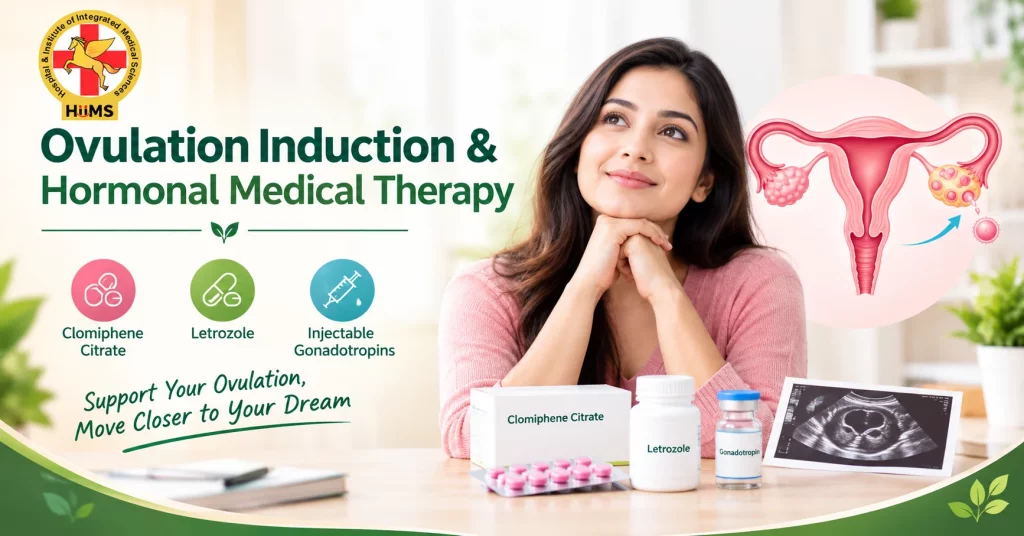
3. Ovulation Induction & Hormonal Medical Therapy
Women with ovulation disorders and irregular menstrual cycles can be helped to ovulate with medications such as clomiphene citrate, letrozole, and injectable gonadotropins. These drugs are widely used as first-line fertility treatment in reproductive medicine.
Why It Stands Out
Large trials (NEJM, 2014 onwards) have shown letrozole to be superior to clomiphene for live birth in PCOS. Even Tier-2 and other cities can offer it, as long as basic ultrasound monitoring is available.
Best For
- Women with PCOS-related anovulation
- Women who have ovulation issues but normal fallopian tubes and partner semen
- Women with unexplained infertility who want controlled ovulation
- Polycystic ovary syndrome causes irregular ovulation, and these medications address it directly
- Hormone testing guides dosing because hormonal imbalances can disrupt ovulation as well as sperm production
Key Strengths
- A strong evidence base with known success rates
- Cheaper and less invasive than IVF treatment
- Works alongside Ayurvedic lifestyle and stress management
Possible Limitations
There is a risk of multiple pregnancy (especially with gonadotropins) and of ovarian hyperstimulation. Used alone, it does not address the underlying metabolic or inflammatory drivers.
4. Intrauterine Insemination (IUI)
In IUI, a sperm sample is washed and concentrated, then placed straight into the uterus at the time of ovulation (natural or induced). It is a non-invasive step between basic treatment and IVF.
Why It Stands Out
Depending on age and diagnosis, success typically ranges from 10-20% per cycle. Over several cycles the cumulative success rate increases, but it falls after repeated failures (usually 3-4 cycles before escalating).
Best For
- Couples dealing with cervical and mild male factor infertility
- Sexual dysfunction that gets in the way of timely intercourse
- Couples with shorter-duration unexplained infertility and good ovarian reserve
Key Strengths
- Simpler than IVF, and mostly done as an outpatient procedure
- Fits well with earlier Ayurvedic detox and sperm-quality optimisation
- Low cost relative to IVF
Possible Limitations
After age 38, success rates decline. It does not help in severe male factor (very low sperm count or motility) or bilateral tubal block. Blocked fallopian tubes can stop natural conception, and they block IUI success too.
5. In Vitro Fertilisation (IVF) and ICSI
In IVF, eggs are fertilised outside the body. The process runs through controlled ovarian stimulation, egg retrieval, laboratory fertilisation, embryo culture, and then embryo transfer. With ICSI, a single selected sperm is injected straight into an egg, which is indicated for severe male factor. More than 5 million babies have been born through assisted reproductive technologies (ART) since 1978, when the first IVF produced Louise Brown. ART made up about 1% of US births by 2006, and in 2009, 441 clinics reported 102,478 fresh IVF cycles in the US alone.
Why It Stands Out
IVF success depends on age. Women under 35 average 40-50% live birth per cycle in good programmes, falling to 15-25% at 38-40 and under 10% beyond 42. During IVF, embryos can undergo genetic testing (PGT) for recurrent pregnancy loss or known genetic factors. For couples with specific fertility issues, donor eggs or sperm are an option.
Best For
- Couples with blocked or damaged fallopian tubes
- Moderate to severe male factor where IUI cannot succeed
- Long-standing unexplained infertility
- Previous IUI cycles that have failed
- Women over 37-38 for whom time is critical
Key Strengths
- Highest per-cycle success of any assisted reproductive technology (ART)
- Makes preimplantation genetic testing possible in selected cases
- Pairs with pre-IVF Ayurvedic optimisation to improve oocyte quality and endometrial receptivity
Possible Limitations
Costs are high, the emotional burden is heavy, and multiple injections are needed. ART can raise the risk of multiple pregnancies. Some cohort data point to slightly higher rates of low birth weight and imprinting disorders, although absolute risks remain low.
6. Corrective Fertility Surgery (Laparoscopy, Hysteroscopy, Varicocele Repair)
In women, surgery may be used to correct blocked or scarred fallopian tubes. The common procedures are laparoscopic adhesiolysis, hysteroscopic removal of uterine fibroids or polyps, septum resection for uterine abnormalities, and varicocelectomy for male infertility. For obstructive azoospermia, surgical sperm retrieval (TESA, micro-TESE) allows intracytoplasmic sperm injection, which opens the door to parenthood.
Why It Stands Out
A varicocele is a common cause of male infertility that can be reversed. Repair may improve sperm production within 3-6 months (sperm production takes approximately 64 days in the testicles). When a submucous fibroid distorts the uterine cavity, removing it alone can restore fertility. Because endometriosis can lead to infertility through inflammation, laparoscopic excision of mild-to-moderate disease improves conception rates.
Best For
- People with structural problems visible on imaging (fibroids distorting the cavity, endometrial polyps, septate uterus)
- Confirmed endometriosis
- Large clinical varicocele with abnormal semen analysis
Key Strengths
- Fixes the underlying cause rather than working around it
- Can improve IVF and IUI outcomes when performed for the right indication
- Integrative rehabilitation after surgery (yoga therapy, Ayurveda, diet) aids healing
Possible Limitations
Anaesthesia and hospitalisation are needed, and surgical risks apply. In advanced disease, function may not be fully restored, and many cases still need IVF. When the anatomy is irreparably damaged, surgical intervention is not suitable.
7. Mind-Body, Stress Management & Counselling-Led Programs
Anxiety, depression and chronic stress can interfere with the hypothalamic-pituitary-gonadal axis, upset hormones, and impair sexual function. In clinical trials, women undergoing IVF who practised yoga and mindfulness showed lower cortisol and coped better. Depression rates in infertility are comparable to those in cancer, and dealing with emotional challenges improves adherence and relationship health.
Best For
- Couples with repeated ART failures
- Recurrent pregnancy loss
- Sexual dysfunction
- Stress-sensitive conditions such as hypothalamic amenorrhea
Key Strengths
- Low risk and non-invasive, with gains in mental health and treatment adherence
- Central to AYUSH-based fertility care at Jeena Sikho HiiMS: yoga, pranayama, guided relaxation
Possible Limitations
Where anatomical or severe hormonal problems exist, it cannot take the place of medical or surgical interventions. The evidence for directly improving live birth is promising but still evolving, which makes it best used as an adjunct.
Quick Comparison of the Best Infertility Treatment Paths
A single option rarely works for most couples, who usually need a combination. This is where each path fits:
- Lifestyle & Nutritional Therapy: a first step for everyone and the base on which all other treatments build
- Ayurvedic & Integrative Care: suited to couples seeking natural, holistic optimisation and disease reversal, either alongside ART or ahead of it
- Ovulation Induction: suited to women with PCOS or other anovulation whose tubes and semen are normal
- IUI: suited to mild male factor, cervical factor, and unexplained infertility in its early stage
- IVF/ICSI: suited to severe male factor, tubal block, advanced age, or repeated failure of simpler treatments
- Corrective Surgery: suited to cases where clear structural problems (fibroids, endometriosis, varicocele) have been found
- Mind-Body Programs: steady support that lowers stress and strengthens resilience at every stage
Find the right fertility care for your needs with a personalised assessment from a Jeena Sikho HiiMS doctor. Visit your nearest HiiMS clinic or hospital and book an appointment to discuss your diagnosis and suitable treatment options.
How to Choose the Right Infertility Treatment Strategy
Diagnosis, age, duration of infertility, and personal philosophy all shape which fertility treatment is right.
Choose Based on Underlying Cause (Diagnosis-First Approach)
Evaluation must be thorough, with no exceptions. For women, it covers ovulation status, AMH and AFC (low AMH indicates reduced ovarian reserve), tubal patency via HSG, an assessment of the uterine cavity, thyroid and prolactin levels, and PCOS or endometriosis evaluation. Because polycystic ovary syndrome affects ovulation in women, it requires targeted treatment. For men, it covers at least two semen analyses (semen analysis is a primary test for diagnosing the male infertility), a hormonal profile, and a scrotal ultrasound when indicated. Hormonal imbalances can affect the sperm production and genetic factors like Klinefelter syndrome can impact male fertility, so genetic testing may be warranted.
Treatment plans for infertility depend on underlying cause, duration, and age:
- Bilateral tubal block → IVF/ICSI + lifestyle/Ayurveda; IUI by itself will not work
- Pure anovulation with normal tubes and sperm → lifestyle + ovulation induction (with or without Ayurveda) first, then ART if needed
- Male factor with varicocele → lifestyle + Ayurveda + varicocele repair, before or together with ART
Choose Based on Age, Time Frame & Ovarian Reserve
Egg quality and quantity both fall as age increases, particularly after 35 and sharply between 38 and 40.
- Under 35, short duration: lifestyle + Ayurvedic optimisation comes first, followed by medical therapy or IUI when needed
- 35-38: shorten timelines by pairing integrative care with earlier IUI or IVF
- Over 38 or low AMH: IVF/ICSI is worth considering first, with integrative support to optimise every cycle
Choose Based on Philosophy, Budget & Willingness for Intervention
In India, a 3-month Ayurvedic fertility program typically costs ₹15,000-₹50,000. IUI costs ₹10,000-₹25,000 per cycle, and IVF/ICSI costs ₹1.5 lakh to ₹3+ lakh per cycle, depending on the city and protocol. A few couples would rather try natural and AYUSH options first, while others put the shortest time to pregnancy ahead of everything. Pollution, occupational exposures and other environmental factors affect the fertility too, as a 2022 systematic review in Human Reproduction Update found, so they should be assessed. HiiMS offers virtual consultations and home-based integrative care, which cut travel stress and costs and give valuable information and access even in smaller cities.
Which Fertility Treatment Combination Is Best for You?
Here is a simple guide to pairing the right treatments based on your diagnosis, age, and goals.
- Pick lifestyle + Ayurvedic integrative care when you are under 35, have PCOS or mild male factor, and would like a disease-reversal-oriented approach before taking medications
- Pick ovulation induction plus IUI with integrative support when tubes and semen are normal, cycles are irregular, and time is a concern
- IVF/ICSI with pre-conception Ayurvedic, nutritional, and mind-body optimisation suits you if you have blocked tubes, severe male factor, low ovarian reserve, or are over 38
- Corrective surgery followed by integrative rehabilitation suits you if a clear mechanical issue (fibroids, endometriosis, varicocele) is documented
Each couple’s path can be personalised through an integrated consultation involving a gynaecologist, AYUSH physician, and nutritionist, as offered at Jeena Sikho HiiMS.
Evidence and Research on Ayurvedic Treatment for Infertility
Here is a summary of published clinical trials, observational studies, and case series on Ayurveda and fertility, with specific numbers.
Ayurvedic Management of Female Infertility and PCOS
In 2024, a randomised, double-blind, placebo-controlled trial tested Shatavari root extract in 66 women with PCOS over 12 weeks in Mumbai. The treatment group showed a lower follicular count (p < 0.0001), increased endometrial thickness (p = 0.028), and lower psychological stress scores (PSS fell by 6.64 ± 3.99 points). There were no serious adverse events, and mild events occurred in 11.4% of the Shatavari group compared with 8.5% of the placebo.
Another RCT, in Chennai in 2024 with 108 women, compared Ayurveda against allopathy for PCOS. It reported 30% pregnancy in the Ayurveda arm vs 20% in standard care, along with fewer adverse events (10% vs 30%). A further trial pitted Palashadi Basti + Pathadi Choorna against metformin in 96 women with PCOS and over 3 months the Ayurvedic group had greater weight reduction, improved menstrual regularity, and higher conception rates.
A multicenter prospective study (2025-2026, n = 534 women) spanning PCOD, unexplained infertility, and low AMH cohorts recorded an overall conception rate of 31% within 90 days, with the PCOD-delayed-cycles cohort reaching 45%.
Ayurvedic Management of Male Infertility
The Ashwagandha pilot RCT gave 675 mg/day for 90 days to 46 oligospermic men. Sperm count went from 9.59 to 25.61 million/mL (+167%), motility from 18.6% to 29.2% (+57%), and semen volume from 1.74 to 2.76 mL (+53%), while the placebo group barely changed. Meanwhile, a study at IPGT & RA, Jamnagar gave oligospermic men Virechana followed by Go-Ghrita and found improved semen parameters relative to baseline.
Panchakarma and Uttar Basti Therapies
A case report followed a 30-year-old woman with tubal block and 8 years of infertility. After 16 weeks of Panchakarma, which included Snehapana, Virechana, Phalaghrita, and Kanchanara Guggulu, she achieved pregnancy, confirmed at 8 weeks 5 days by ultrasonography. In a retrospective observational study (Bengaluru, 2024-2025), 98 women with Vandhyatva received Uttar Basti. Most tolerated it well with the mild adverse events and reported symptomatic relief and ultrasonographic improvements.
Safety, Standardisation, and Research Gaps
According to AYUSH safety reports, Ashwagandha at standard doses over 90 days was well tolerated in clinical trials, and Shatavari’s safety profile was comparable to placebo. Still, gaps remain: most Ayurvedic trials report clinical pregnancy instead of live birth, sample sizes are moderate (46-534), and protocols vary between centres in herb species, dose, extraction, and Panchakarma procedure. Standardisation of herbal formulations and long-term neonatal follow-up data are both lacking.
Integrative AYUSH-ART Collaboration
The multicenter Ayurveda-based protocol (534 women, 31% conception over 90 days) combined ovulation tracking, male fertility support, and standardised formulations. Ashwagandha oligospermia data points to a model of male fertility support that could be used alongside ICSI or by couples who want to try natural routes first. A large RCT comparing Ayurveda + IVF with IVF alone for embryo quality or live birth has yet to be done.
Ayurveda holds promising evidence for optimising reproductive health and tackling fertility issues with multiple causes. That evidence is strongest in research-oriented, integrated centres like Jeena Sikho HiiMS, where proper investigation and monitoring happen alongside conventional fertility specialists.
Final Thoughts on Infertility Treatment in an Integrative Era
Most patients with infertility can be treated when modern diagnostics, reproductive technologies, and evidence-based AYUSH therapies are combined with realistic expectations. There is no universally best option. A personalised plan, often integrative and built on a thorough diagnosis, is the safest and most effective.
Jeena Sikho HiiMS acts as a partner for holistic fertility assessment, evidence-based Ayurvedic interventions and co-management with IVF centres when high-tech ART is needed. Book your VOPD consultation today and start with a clear diagnosis.
Frequently Asked Questions
1. When should a couple see a doctor about infertility?
If you have been trying to conceive through 12 months or more of unprotected intercourse without success, it is time for a clinical evaluation. Women above 35 should seek a fertility evaluation after six months instead.
2. Is infertility only a woman’s problem?
No. About 40% of cases trace to female factors, 40% to male factors, and 20% to combined or unexplained causes. That is why a thorough evaluation includes both partners.
3. What are the main infertility treatment options in India?
Seven pathways have evidence behind them: lifestyle and nutritional therapy, Ayurvedic and integrative care, ovulation induction, IUI, IVF/ICSI, corrective surgery, and mind-body programs. They are ranked from least invasive to most technology-intensive, and doctors often combine several.
4. Does stress affect fertility?
Yes. Chronic stress, anxiety, and depression can interfere with the hypothalamic-pituitary-gonadal axis, upset hormones, and impair sexual function. Yoga and mindfulness have been shown in clinical trials to lower cortisol and improve coping in women undergoing IVF.
5. Can lifestyle changes improve fertility?
Yes. For women with PCOS, a 5-10% reduction in body weight restores ovulation in up to 50-60% of cases. Quitting smoking and limiting alcohol also support fertility in both partners.
Disclaimer: The information provided on this blog is for general educational and informational purposes only. It is not intended to replace professional medical advice, diagnosis, or treatment. Always consult a qualified healthcare professional before making any changes to your diet, lifestyle, or treatment plan. Individual results may vary.