

If you have landed on this blog, chances are either you or someone close to you is dealing with some kind of kidney concern, or maybe you’re just trying to understand this topic before it becomes one. Either way, let’s start from the basics. Kidney disease isn’t one single thing; it’s a broad term that covers everything from mild filtration issues to more serious, long-term conditions like CKD. What makes it tricky is that most people don’t realise something’s wrong until it’s already progressed quite a bit, simply because the early stages rarely come with loud symptoms.
This is exactly where Ayurveda brings something different to the table. Instead of looking at the kidney as an isolated organ, Ayurveda looks at digestion, fluid balance, and the body’s overall internal rhythm, and tries to support kidney wellness by working on all of these together, gradually, over time.
Once you understand this bigger picture, it becomes easier to see where something like the HiiMS Kidney Support Combo actually fits in, not as a quick fix, but as part of a daily routine built around supporting your kidneys the way Ayurveda has traditionally approached this.
Table of Contents
How Kidney Disease Develops Without Clear Symptoms
Here’s the part that surprises most people: your kidneys can lose a significant chunk of their function while you’re still going about your normal day, feeling completely fine. There’s no dramatic warning bell that rings the moment something starts going wrong. Your body compensates quietly, right up until it can’t anymore, and that’s usually when symptoms finally show up.
This is exactly why kidney disease gets called a “silent” condition, and why regular check-ups, even when you feel healthy, end up being far more useful than most people give them credit for.
Understanding Kidney Disease
In the simplest terms, kidney disease means your kidneys have stopped filtering blood the way they’re supposed to. Every day, your kidneys perform many important tasks. They get rid of waste, balance minerals, control blood pressure and keep fluid levels under control.
When this filtering slows down or gets damaged, waste products that should be leaving your body start piling up instead. And this doesn’t always look the same for everyone; kidney disease actually shows up in a few different forms, each behaving a little differently.
1) Chronic Kidney Disease (CKD)
This is a slow, gradual decline in kidney function that can take months or even years to become noticeable. Chronic kidney disease rarely announces itself early, which is why by the time fatigue or swelling shows up, the kidneys have often already lost a meaningful portion of their capacity.
2) Kidney Stones
Hard mineral deposits form inside the kidney. They don’t always cause long-term damage, but they can be extremely painful, especially when they start moving through the urinary tract.
3) Nephrotic Syndrome
This happens when the kidneys start leaking protein into the urine that shouldn’t be there, often showing up as swelling in the legs, feet, or around the eyes.
4) Kidney Shrinkage
In fact, the kidneys shrink and lose the ability to function properly. This is usually a long-term development caused by prolonged stress or damage.
5) Acute Kidney Injury (AKI)
This stands apart because it happens suddenly, often triggered by severe dehydration, a serious infection, or another major health event. Unlike CKD, AKI can sometimes be reversed if it’s caught and treated quickly.
6) Diabetic Kidney Disease
Diabetes is one of the most common reasons people develop kidney problems. When blood sugar remains high for a long time, it can gradually damage the tiny blood vessels that help the kidneys filter waste and extra fluid from the body. High blood pressure can further increase this strain, and over time, this condition is known as diabetic kidney disease.
Signs of Kidney Problems You Should Not Ignore
The tricky part about early kidney disease symptoms is how ordinary they can feel. Most people brush them off as tiredness from a busy week or just getting older, and that’s understandable, because these signs really don’t demand attention the way you’d expect a serious health issue to.
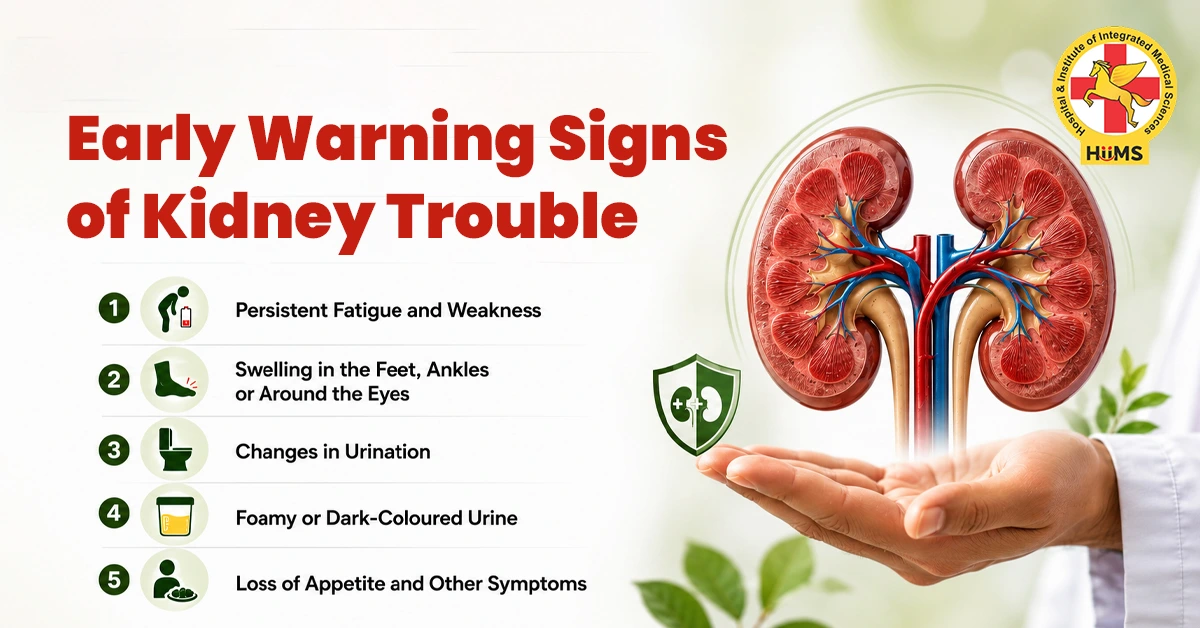
Here are the symptoms of kidney disease:
1) Persistent Fatigue and Weakness
When kidneys aren’t filtering properly, waste products build up in your bloodstream instead of leaving your body, and this shows up as tiredness that doesn’t go away, no matter how much you rest.
2) Swelling in the Feet, Ankles or Around the Eyes
Puffiness, especially noticeable first thing in the morning usually points to your body struggling to manage fluid the way it should.
3) Changes in Urination
Needing to go more frequently, especially at night, or noticing a sudden drop in output, are both worth paying attention to rather than ignoring.
4) Foamy or Dark-Coloured Urine
Foamy urine can mean protein is leaking out where it shouldn’t be. And blood in urine, even if it happens just once and seems minor, is genuinely something you should never dismiss or wait out.
5) Loss of Appetite and Other Symptoms
A dropped appetite, a lingering metallic taste, or feeling nauseous without any obvious reason can also be part of this picture.
Interestingly, Ayurveda has its own way of thinking about this early phase, a concept called “Purvaroopa“, referring to the subtle signs a body gives before a condition fully develops. It’s a useful lens for early awareness, but it’s meant to complement your understanding, not replace an actual medical diagnosis.
The Common Causes Behind Kidney Problems
Understanding what actually puts pressure on your kidneys is just as important as recognizing symptoms of kidney disease afterwards. Most of these causes aren’t dramatic or rare; they’re everyday things that quietly add up over the years.

1) Diabetes and High Blood Sugar
Consistently high sugar levels gradually damage the tiny blood vessels inside the kidneys that are responsible for filtration.
2) Uncontrolled High Blood Pressure
This forces your kidneys to work under constant strain, and over time, that strain wears them down.
3) Certain Medicines and Toxins
Painkillers used frequently or over long stretches, can quietly harm kidney tissue without you even realising it’s happening.
4) Kidney Infections and Other Medical Conditions
If left unmanaged, infections that keep coming back can eventually start affecting how well your kidneys function.
5) Obesity and Metabolic Risk
Extra weight adds its own strain and also increases your risk of developing diabetes and high BP in the first place.
6) Smoking and Lifestyle Factors
Smoking affects the blood flow throughout your entire body, including your kidneys.
7) Dehydration and Acute Kidney Injury
If you don’t drink enough water, especially if you’re sick or it’s hot outside, you can suddenly stress your kidneys and it will surprise most people.
8) Kidney Stones and Urinary Obstruction
Blockages from stones can cause pressure to build up and damage kidney tissue over time if left unaddressed.
9) Other Underlying Causes
Genetics, autoimmune conditions, and certain infections also play a role for some people, even without the more common lifestyle triggers being present.
The Ayurvedic Connection Between Doshas and Kidney Health
Now let’s shift gears and look at how Ayurveda has traditionally understood kidney health, because this is really interesting territory. The kidneys are referred to as Vrikka in Ayurvedic texts. The “Mutravaha Srotas” are the channels that are closely related to the functions of the kidneys. This system is responsible for the formation and elimination of urine from the body.
This understanding is that Vrikka originate from Rakta (blood tissue) and Meda (fat tissue) and are seen as deeply connected with the body’s overall fluid balance and vitality, and not as a separate filter organ.
1) Vrikka in Ayurveda
The Ayurvedic name for the kidneys is Vrikka, the organs of blood and fat tissue, and they are the center of the body’s fluid balance and vitality.
2) The Role of Mutravaha Srotas
This is the pathway system used by Ayurveda to describe the formation of urine and its passage out of the body, linking the kidneys, bladder and urinary tract as one connected system.
3) The Role of Apana Vayu
The downward-moving form of Vata dosha, called Apana Vayu, is said to control the process of elimination, including the downward movement of urine and stool through and out of the body.
4) Vata Imbalance and Kidney Wellness
Vata imbalance is associated in Ayurveda with a decrease in urinary flow, dryness and a general degeneration of the urinary channels.
5) Pitta Imbalance and Urinary Symptoms
Excess Pitta is linked to heat-related symptoms, such as a burning sensation during urination.
6) Kapha Imbalance and Fluid Retention
An increase in Kapha is traditionally associated with swelling, fluid retention, and blocked channels.
7) Agni and Ama: The Broader Ayurvedic Perspective
Ayurveda also looks at Agni (digestive fire) and Ama (toxins from poor digestion), holding that weak digestion over time can gradually add to the toxin load your kidneys have to deal with.
It’s worth being upfront here: this is a traditional explanation rooted in classical Ayurvedic thought, meant as a complementary perspective, not a proven substitute for a modern medical diagnosis of any kidney condition.

Ayurvedic Ways to Support Healthy Kidney Function
Ayurveda generally structures its approach to wellness support in three broad stages, and understanding this sequence helps make sense of why Ayurvedic routines often feel gradual rather than instant.
Stage 1: Shodhana – Cleansing and Preparation
This stage focuses on gently preparing the body and supporting its natural detox processes.
Stage 2: Shamana – Balancing and Supportive Management
Here, the focus shifts toward balancing the doshas and supporting the body’s internal systems through diet, herbs, and daily routine.
Stage 3: Rasayana – Long-Term Rejuvenation and Wellness Support
This final stage is about long-term strengthening, helping the body maintain balance once things have settled into a steadier rhythm.
One thing that genuinely needs to be said clearly: Ayurvedic approaches should always be personalised. People diagnosed with CKD, those dealing with significant protein loss in urine, serious electrolyte imbalances, or anyone on dialysis or living with a kidney transplant, should never start herbal or detox routines on their own without guidance from both their nephrologist and a qualified Ayurvedic practitioner.
Natural Herbs Traditionally Used for Kidney Support
Here are the main Ayurvedic herbs used for kidney and urinary wellness:
1) Punarnava
Traditionally used to support healthy fluid balance in the body, especially where puffiness or water retention is a concern.
2) Gokshura
Traditionally associated with supporting smooth, comfortable urine flow.
3) Varuna
Long has been linked with supporting the health of the urinary tract more broadly.
4) Pashanbheda
Its name literally hints at “stone-breaker” in classical texts, and it’s been traditionally used in the context of kidney and urinary wellness.
5) Giloy
Valued in Ayurveda for its role in supporting the body’s overall detox processes.
6) Shilajit
Used for centuries as a rejuvenating tonic believed to support strength and vitality more generally.
These herbs carry a genuinely rich history of traditional use, but it’s worth keeping the language honest: they’ve been “traditionally used for” these purposes based on classical texts and generations of practice, not scientifically proven as direct cures for any diagnosed kidney condition.
A Balanced Approach to Everyday Kidney Care
If everything you’ve read so far has made you want to bring some of this traditional approach into your own routine in a structured way, this is where Acharya Ji’s Signature Kidney Care Combo comes in, built for kidney function, urinary flow, cleansing, and strength support, and centred around herbs like Pashan Bhed and Gokhru.

The combo brings together seven products working alongside each other: Gut Care Juice, Mix Berry Herbal Blend Juice, Pet Yakrit Pleeha Shuddhi Kit, Dr. Kidney Care Tablets, Pure Shilajit Capsules, Vrikk Shuddhi Kwath, and Shuddhi Body Care Juice. The kidney-centric products in this pack are based on traditional herbs like Pashan Bhed, Gokhru, Kasni, Makoy and Punarnava that are used to support kidney function, urinary flow and fluid balance.
Alongside this, the digestive formulations help maintain comfortable digestion and regular waste elimination, since Ayurveda always ties kidney wellness back to how well your gut is functioning, too. The Mix Berry Juice and Body Care Juice bring in fruit-based nutrients and antioxidant support, while Pure Shilajit is included to help maintain everyday strength and stamina.
What this combo is meant to support:
- Natural kidney function – The kidney herbs support the natural filtration and waste removal of the body.
- Urinary flow – Gokhru, Punarnava, Kasni and Pashan Bhed help a comfortable and regular urinary routine.
- Fluid balance – The classic formulas help normal fluid regulation and internal balance.
- Digestion and elimination – Gut Care Juice and the Pet Yakrit Pleeha Shuddhi Kit helps to maintain digestion and proper bowel movement.
- Antioxidant protection – Amla, Sea Buckthorn, Haldi and other fruit extracts help fight against daily oxidative stress.
- Energy and stamina – Pure Shilajit and Ashwagandha can help support physical strength and everyday activity levels
What’s inside each product:
- Gut Care Juice is made with Baheda, Amla, Papaya, Kokam, Apple, Maricha, Nimbu, and Jeera.
- The Mix Berry Herbal Blend Juice combines Apple, Mango, Amla, Sea Buckthorn, and Pineapple.
- The Pet Yakrit Pleeha Shuddhi Kit is a combination of Amla, Baheda, Harad, Nishoth, Bilva, Amaltas, Ajwain, Saunth, Saunf, Gulab, Sanaye, Lavang and Kala Namak.
- Dr. Kidney Care Tablets are formulated with Punarnava, Gokhru, Pashan Bhed, Varun Chhal, Mulethi, Apamarga, and Shigru (Moringa).
- Pure Shilajit Capsules contain Shilajit Extract on its own.
- Vrikk Shuddhi Kwath brings together Kasni, Makoy, Gokhru, Punarnava, Neem, and Peepal.
- And the Shuddhi Body Care Juice is made with Amla, Haldi, Moringa, Ashwagandha, Mulethi, Giloy, Shatavari, and Gokhru.
How the routine actually works day to day:
- Gut Care Juice is meant to be taken as 15–30 ml once daily on an empty stomach in the morning, keeping a 30-minute gap before breakfast.
- The Mix Berry Herbal Blend Juice follows a similar pattern: 15–30 ml once daily on an empty stomach, with a 30-minute gap before your next food or drink.
- Dr. Kidney Care Tablets are usually taken as 1–2 tablets twice daily with lukewarm water, or as directed by a physician.
- Pure Shilajit Capsules are taken as one capsule in the morning and one in the evening.
- Vrikk Shuddhi Kwath is prepared by adding one teaspoon to a glass of hot water and drinking it once daily on an empty stomach.
- Shuddhi Body Care Juice is again 15–30 ml once daily on an empty stomach in the morning, with a 30-minute gap before the next meal or drink.
- The Pet Yakrit Pleeha Shuddhi Kit works a little differently, since it comes in two forms. The powder is taken as half a teaspoon (roughly 3–3.5 g) of granules mixed with half a glass of lukewarm water before bedtime. The shot, on the other hand, is meant to be taken as 30 ml at bedtime once every 7th day, and on the day you take the shot, the granules are skipped.
It’s worth being direct about what this combo is and isn’t. It’s not positioned as a treatment for diagnosed kidney disease, and it shouldn’t replace anything your doctor has prescribed. What it’s designed to do is sit alongside a generally healthy lifestyle, offering gentle, ongoing support to your kidney, urinary, and digestive wellness through a professionally guided daily routine.
Simple Diet and Lifestyle Tips for Kidney Care
No herb, supplement, or wellness routine works in isolation. Your everyday habits carry just as much weight, sometimes even more. Your kidneys are quietly working every moment of every day, and the small choices you repeat, whether it’s what you eat or how much water you drink, either ease that workload or add to it over time.

1) Manage Salt Intake
Too much sodium forces your kidneys to work harder to balance fluid levels in your body.
2) Stay Hydrated as Advised by Your Doctor
The right amount of water genuinely varies from person to person, so it’s worth checking with your doctor rather than following a generic number.
3) Avoid Unnecessary Painkiller Use
Frequent use of certain painkillers can quietly stress kidney tissue over months and years.
4) Don’t Hold Urine for Long Periods
A habit a lot of people don’t think twice about, but it can increase pressure in the urinary tract over time.
5) Keep Blood Pressure and Blood Sugar Under Control
This remains one of the single most protective things you can do, given how strongly both are tied to kidney damage.
6) Prioritise Sleep and Stress Management
Poor sleep and chronic stress genuinely affect your whole body, kidneys included.
7) Stay Physically Active Within Your Capacity
Regular movement supports healthy blood flow and overall metabolic balance.
8) Get Regular Kidney Health Tests
Even if you feel fine, there’s no reason not to have simple blood and urine tests to catch problems early, long before symptoms would have appeared on their own.
Frequently Asked Questions
1) Can Ayurveda cure kidney disease?
Ayurveda focuses on supporting the body’s natural balance and overall wellness rather than positioning itself as a cure. Anyone with a confirmed diagnosis should continue working closely with their nephrologist, alongside anything else they choose to explore.
2) Can Ayurvedic products be taken with current medicines?
This depends on the individual case, the medicines and the specific product. It’s always best to speak to both your doctor and an Ayurvedic practitioner before mixing anything.
3) How soon can I expect to notice results from Ayurvedic wellness support?
There’s no time frame, it’s based on the individual’s overall health, how consistent they are with the routine, and what they’re trying to treat.
4) Kidney disease vs. kidney stones: what’s the difference?
Kidney stones are solid mineral deposits that form in the kidney and are often very painful. Kidney disease is a more general, progressive loss of the overall functioning and filtering capacity of the kidneys.
5) Can people with CKD take herbal products safely?
Only under proper medical supervision. People with chronic kidney disease need to be given very individualised advice, as not every herb is suitable for every stage of the disease.
6) Should dialysis patients take Ayurvedic products without consulting a doctor?
No. Dialysis patients should always check with their treating doctor and a qualified Ayurvedic practitioner before starting any herbal or wellness product.
Research Papers
- Clinical Evaluation of Chronic Kidney Disease Management: Integrating Lifestyle Modification and Ayurveda
- Ayurvedic Management of Stage 5 Chronic Kidney Disease
- Integrating Ayurveda into Chronic Kidney Disease Management
Ayurvedic Kidney Care Products
100% natural, certified Ayurvedic formulations crafted for targeted kidney wellness.



Disclaimer: The information provided on this blog is for general educational and informational purposes only. It is not intended to replace professional medical advice, diagnosis, or treatment. Always consult a qualified healthcare professional before making any changes to your diet, lifestyle, or treatment plan. Individual results may vary.